• Photography
  • Interviews
  • Business
  • Reviews

Tiffinbox

Inspiring Photographers

  • Home
  • About
  • Blog
  • Contact

6 Free Or Low Cost Tools to Help You Make Your Photography Website Better

April 25, 2012 by Chris Cummins

Today's guest post is by Chris Cummins, a Kansas City photographer and owner of Glow Imagery. His passion is creating images that reveal the personalities, expressions and character of his subjects in beautiful images that become family heirlooms for his clients.

We can all accept that a better website means a better business. But what is a better website?

As a professional photographer specializing in weddings and portraits my definition of a better website is how well it answers a simple two-part question: Are the right people finding my website? Also, is the website doing its best to persuade as many of the right people as possible to contact me?

The website’s job is not to be the prettiest, get the design awards or get me the most compliments. Nor is its job to make the sale, that’s my job. I just want it to appeal to and persuade a specific kind of person enough to make them want to raise their hand and ask for more information. It’s a conversation starter, that’s all.

What works best to do that? The ideas are virtually unlimited and the questions are even more. For example. Is it best to put a short bio on your splash page? Does an automatically starting video of you talking about your art appeal to your visitors more than a beautiful slideshow gallery of images? Do written testimonials encourage your visitors to email or call you more? Do you want to require them to give you their phone number in your contact forms or is it better not to ask for that information? The challenges and unknowns are endless.

The trouble is what we want people to do on our website and what they actually are doing when visiting our website are so often two different things. So many of our assumptions are often wrong and we don’t even know it when it comes to our websites.

Whether you accept it or not, a business website has the task of herding cats. People get distracted, they don't think like us, they don't respond the same as us, their values are different, their means of experiencing your website can be very different (smartphones, some old version of Internet Explorer or the latest Chrome browser), simply put they are not us.

Accurate thinking is so critical to your success. Gut feelings, hunches and the simple desire to chase the herd are not good substitutes for making a better photography website. But how do you know the answer to these ongoing questions? Fortunately we can eliminate a lot of guesswork by using a variety of free and low-cost tools.

Many of the tools listed here track visitors and visitor behavior to your website, one even allows you to hear the opinions of visitors to your website. How cool is that?

Warning: This article assumes some working knowledge of how to get to the guts of your website code. Most of the tools described here require some basic familiarity with your website code in order to drop in chunks of special code that will install the ability to track your visitors.

1) Google analytics

Chris Cummins | Google Analytics

Most people know about Google Analytics, but most photographers don't have a clue how to use the information. What the heck is bounce rate anyway? If you aren't using Google Analytics or some other equivalent form of tracking code then you haven't put any serious thought into your photography's web presence. Period. It’s time to change that.

To get started all you need to do is sign up for a GA account through google. Usually your gmail account information is sufficient. From there, google has tutorials that will walk you through how to set things up. Most portfolio website designs have some manner of copying and pasting the code into your web pages. Setting up a new checking account is harder.

With this information you can find out which parts of your website are performing well and which are performing poorly (i.e. lots of exits, poor time on page.) You can also track what online and offline marketing efforts are building your visit numbers through the traffic sources

Don't be thrown by the depth of information and complexity GA provides. It can be overwhelming the amount data it shows you so keep it simple at first. Get it set up and start tinkering with the data reports after a few weeks. Start off my just tracking basic visitors stats. Look at the “Traffic Sources” information to determine where most of your visitors are coming from. From there, just start tinkering a little bit at a time. Since its introduction in the mid 2000's Google Analytics has grown into an application just as complex as Photoshop but you don’t need all that to use it to help your web marketing.

It is a richly layered ocean of data about your website and what visitors are doing on it. Do you what to know how much time Android users are spending on your web page devoted to sleeping beagles? Google analytics will tell you. But don't let that complexity scare you.

Ratings: scale of 1 to 10

Cost: 10 (it’s free, what more do you want?)
Ease of set up: 7 (Google has a neat little verification function which will check to see if you have it set up properly)
Ease of use: 6 (The information is very detailed and little overwhelming, focus on basics and tinker with all those extra data points when you have the time and inclination.)

What do you do with this tool’s information? It tells you who, what, when, where and how of your website visitors. Track the overall visits and dig into the data to see what kind of affect your marketing efforts, both offline and online, are having on the web traffic to your site. Check and see what pages are experiencing high number of exits or a short time on page. Set up goals to track what pages contributed to the most completed goals (hint: those pages are doing their job) and see which ones are losing your visitors (time to fix those.)
2) Crazy Egg Web Analytics

Chris Cummins | Crazy Egg Web Analytics

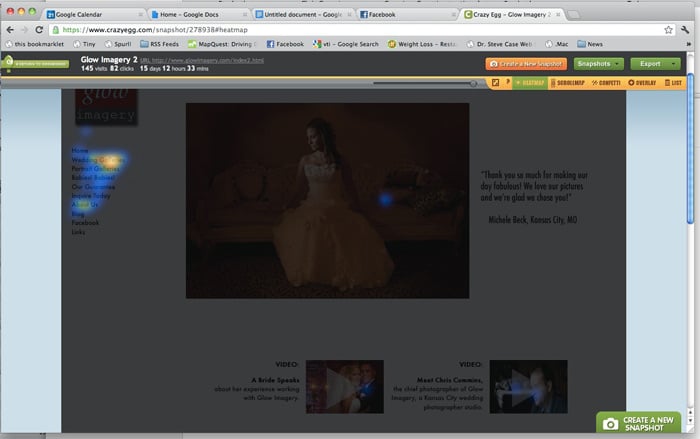
We just started using this one. But we like it… a lot. Crazy Egg seems to know where Google Analytics struggles. Crazy Egg is made for photographers and other visual thinkers. Rather than pile on tons of data into your lap it shows a visual representation of what visitors are doing. It takes your visitor data and tells you where people are clicking on your site and which areas on a site page could use improvement through a series of visual tools. These visual tools show a copy of your web pages with a map overlay of where people clicked. It shows scrollmaps that have heated zones over the page to see where people's eyes have spent the most time on.

For visual people like us photographers, it is a very pleasant experience to look at a photograph of our website’s pages with blurbs of color representing hot zones where people are clicking. It just makes sense!

The set up is remarkably simple. Copy and paste the code into the page's code you want to track. If you can do Google Analytics you'll see that Crazy Egg is as easy. (If you are using a WordPress set-up, even better. There's a plug-in which allows you to enter the code once and every page on your wordpress platform has the code. Easy.)

I am not aware if most portfolio websites are equipped to take such a code, I know my Clickbooq site does not.

The only downside to this software is that it isn't free. But it is very affordable and includes a free 30-day trial. Their basic plan is nine bucks per month (billed annually at $108.) This gives you up to 10 pages to track and 10,000 visitors per month.

Why do you need this? The burden of expertise is a big risk and you are the expert. As someone who eats, breathes and sleeps photography portfolios, very often what you think looks great and makes perfect sense to you website presentations of photography makes no sense to the average person. Crazy Egg is among my faves because it is like sitting in a focus group of hundreds of users and observing what they do with your website. It can be humbling.

Ratings: scale of 1 to 10

Cost: 6 (it is free for 30 days, nine bucks a month afterwards for a basic plan but it is an excellent investment.)
Ease of Setup: 8 (may have some issues with the website portfolio template places that are popular out there.)
East of Use: 10 (it's fun and very simple to learn how to use)

What do you do with this information? Look at several important pages on your website and ask yourself, “what is it I want my visitors to do on this page?” and Crazy Egg will show you in a really visual way what your visitors actually are doing. This will help you to quickly identify any distractions or poorly designed features that may be interfering with that goal.

3) All-in-One SEO Pack (wordpress users only)
Chris Cummins | All In One SEO WordPress Plugin

This is a champion of a little plug-in you can download for free. Activate this guy and give your on-page search engine optimization efforts a major boost in the arm. If you are not familiar with the virtues of search engine optimization, that subject is a huge discussion unto itself. But for now you can start here.

I'll just say this, SEO has been the single closest thing to a marketing magic bullet for my photography business. It beats the holy moly out of just about everything else I have tried. As a photographer, SEO can't be your only marketing effort but it is an essential piece in this day and age.

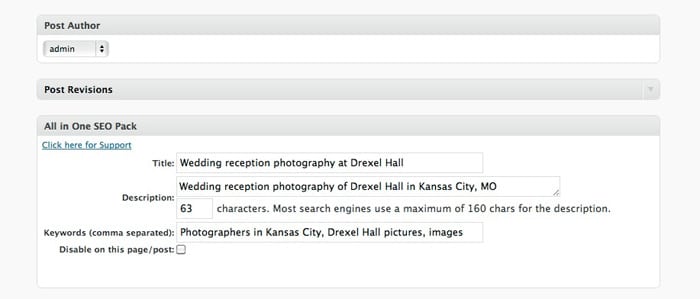
A well known trait to winning SEO is using the right titles and descriptions for pages and blog posts. You can do this through the regular title feature on WordPress but also through the plug-in’s interface. This helps you optimize for keywords and phrases you know your target market may be searching for.

The only downside is it for the WordPress platform and can only be used with wordpress content.

Ratings: scale of 1 to 10

Cost: 10 (it's free)
Ease of Set up: 8 (your basic WordPress plugin installation procedure will do.)
Ease of Use: 10 (every time you publish a page or blog post it is there for you to enhance the search-engine presence of your content.)

What do you do with this tool? Your blog is a tremendous opportunity to create attractive and interesting content that will earn you links and points with the search engines. This plug-in adds a little extra power to all those posts by helping you mix up some of the big items search engines use to evaluate where to rank your website when someone types in a search.

4) WordPress SEO by Yoast (wordpress users only)
Chris Cummins | WordPress Seo By Yoast

It's not often you have a plug-in that educates its users as well as it provides an actual immediate benefit. I've begun to prefer this plug-in over the All-in-One SEO pack simply because it makes the dark science of SEO easier for just about everyone. Using both is a good plan.

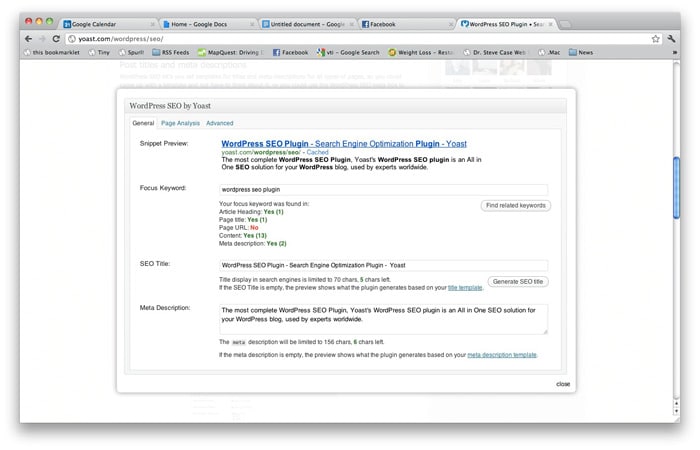
Once you download and activate this plug-in, each post and page you write will have a handy snippet preview in the plug-in’s window that shows what your post will look like as a Google listing. It also helps you identify a focused keyword for your content and keeps a checklist of where your keyword is in the most SEO-smart places (i.e. Page URL, Content, title, etc.)

You can also click on a tab that does a page analysis which features lots of excellent helpful tips, warnings and kudos about your post. Absorb this information while working on your blog or website and you are way ahead of your competition in a short period of time.

Ratings: scale of 1 to 10

Cost: 10 (it's free)
Ease of Set up: 8
Ease of Use: 10

What do you do with this tool? This tool helps analyze your posts and page content to see what you can do to improve its potential to be ranked highly by search engines. More importantly, it educates you about the important set of habits you need to be forming when using the web to help your business grow. Kick ass SEO is about good habits repeated over and over.
5) Feedback Army

Chris Cummins | Feedback Army

Rather than all kinds of code, data and scrollmaps, sometimes you just need to have real people use your website and provide you real feedback. I'm not talking about a group of photographers on some forum, either (don’t do that… please.) Photographers deal with photography on the web all the time and have that burden of expertise. What does a mom with three kids think when she sees your website? If your website's intended audience is the general public it really helps to get a reality check on a regular basis, enter Feedback Army.

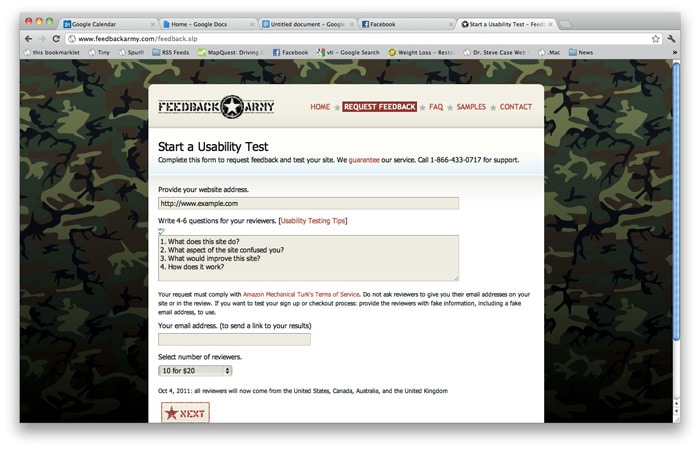
For 20 bucks you can submit your website to a group of reviewers in which you can receive 10 responses. You will have the opportunity ask specific questions about your page and what it does, Feedback Army provides some useful tips for what to ask. Ask both general questions and specific questions.

Unlike Crazy Egg or Google Analytics you are hearing the impressions of real people about your website. A word of caution: they can be brutally honest so submit your site prepared for a frank list of what you haven't quite done right. While they can be tough they are almost always helpful.

Once in a while a reviewer doesn't seem to care and isn't helpful with their review, you can reject their review in favor of someone who seems to have taken some time to offer genuine help. All reviewers are from English speaking countries, too.

The surprising part of this services how fast the reviews are. I had ten reviews completed for me in just two hours. That's instant feedback.

The web gurus call it a usability test. I call it a reality check.

Ratings: scale of 1 to 10

Cost: 5 (It's $20 for 10 reviews of your website,the most expensive option on here, but still worth the occasional investment)
Ease of Set up: 9 (it took two minutes to submit my site)
Ease of Use: 9 (simple, simple, simple and the feedback is very fast)

What can you do with this tool’s information? Hear from real people their impressions and thoughts about the experience of viewing your website. This takes the guesswork out of what may be wrong or not helping you on your website. A word of caution: have a thick skin because the reviewers can be tough.
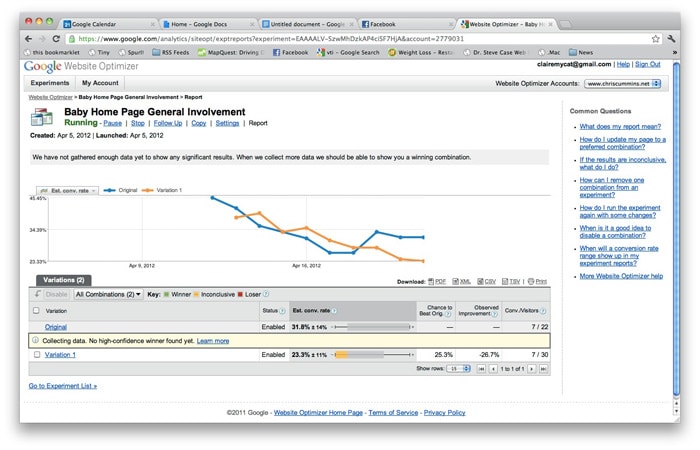
6) Google Website Optimizer

Chris Cummins | Google Website Optimizer

The very top performing websites out there like Amazon, Apple and Zappos are aggressive and constant testers of their web pages. They are always putting new ideas out there and testing them versus the old methods to determine which is better. Little guys like us can do it too. This is where Google Website Optimizer comes into play.

With GWO you can improve the effectiveness of your website by testing if changes to your website content are more effective in getting conversions. You choose what to test and which pages you want to examine.

Which is better? To have a large video autostart on your homepage or have a small video that visitors can click on if they want to watch? Is it better to have a contact form that requires visitors to submit their phone number or not? Use Google Website Optimizer to create two versions of the same page and it will send a portion of your site traffic to each version to help you determine which one your users respond to best. GWO provides reports and recommendations on which version you should use.

You can do A/B tests or multivariate testing. For photographers, I recommend sticking to an A/B test which is a classic marketing testing strategy. An A/B test means you have two versions of a specific page that have the same goal. To determine which version is better, you subject both versions to experimentation simultaneously. In the end, you measure which version was more successful and select that version for real-world use.

The GWO reports are straightforward and not overloaded with information like Google Analytics sometimes is. Installing the code on your website is no more or less difficult than a lot of the other tools listed here. Google has a very easy to use verification test for the pages you are looking at testing with GWO.

The only downside is the tests do take time. You do need to get a wealth of visits to be able to make reliable conclusions from the data in a short period of time.

Ratings: scale of 1 to 10

Cost: 10 (it’s free)
Ease of set up: 8
Ease of use: 9 (straightforward reports, no extra bells or whistles needed)

What can you do with this tool’s information? Test the crap out of your ideas, designs, galleries, images and quickly discover what is getting the job done and what may need tweaking and what needs to be put in the recycle bin.

How do these tools benefit you as a photographer? One big reason is virtually no other photographers are using them. In this business, if you aren’t doing what everyone else is doing, you’re doing something right.

The other big reason: you're working your tail off to get people to visit your site but you are very likely losing prospective clients and buyers after they go to your website because something isn't pulling them towards the specific thing you want them to do. Sometimes it is a big issue across the whole site that is hemorrhaging away your hard won visitors, it may be a very small issue that can be fixed in seconds.

You don’t know until you can get useful data to make informed decisions. Otherwise … it’s just a guess and your assumptions.

Which of these tools do you already use? Which ones were new to you? Discuss below!
Filed Under: Photography, Web/Tech Tagged With: business website, chris cummins, google, google analytics, kansas city photographers, low cost tool, photography website, photography websites, portfolio website, search engine optimization, tools, usability, web analytics, web design, Website, website visitors, wordpress

10 Things I Wish I Knew 10 Years Ago About Being a Professional Wedding Photographer

April 17, 2012 by Stephanie Zettl

Today's guest post is by Stephanie Zettl, a photographer from St. Louis, Missouri who specializes in photographing people. She got her start as a newspaper photographer and enjoyed photographing people and their relationship to the events around them. In 2003 she started her own business specializing in documentary styled wedding and portrait photography. Her husband, Peter, later joined her in the business as a photographer and business partner. Stephanie is a respected lecturer and mentor and enjoys watching new photographers improve their skills. Education is important to Stephanie and she believes that photographers should invest in themselves by studying both the technical and creative side of photography. She has just published The Nikon Speedlight Handbook.

I was as giddy as a school girl the day I signed my new studio lease and took the first step towards owning my own business.  While I had a lot of my ducks in a row, I really had no real clue what I was getting myself into or where this job would take me. I wish I could go back and have lunch with that young, eager photographer and share with her some of the things I have learned in the past 10 years.

Since I really haven’t been able to figure out the secret to time travel, I thought I might share with you ten things I wish I knew ten years ago when I started my business. There was some valuable time, energy and money that could have been put to better use if I’d just had a little more direction and wisdom. While I would not have changed my decision – I love what I do! – here are a few pearls of hard-won wisdom you might find useful and helpful no matter where you are on your journey as a photographer and small business owner.

Stephanie Zettle Wedding Photography

1. When you start a Photography Business, you are starting a business.

Make sure you understand what is involved in starting a business. It’s important to have a business plan, an understanding of sales and marketing, and a financial budget.  Being a starving artist gets very old very quickly. My biggest piece of advice to anyone new in the business is to take a small business class and get some sales training of some kind. It doesn’t matter how awesome your photographs are or how good your equipment is if you can’t sell your work. 

I spent the first seven years of my business thinking that my photographs alone would sell my work.  When the economy took a hit, I was faced with the stark reality that to book work, I needed to have a better understanding of business and sales. I knew I couldn’t lower my prices and I didn’t have additional income to fall back on.

I took a year-long sales training and business coaching course with Ken Stark of Sandler Training, which I chose for two reasons.

The first was that the company is known for training salespeople from all different types of professions. The second reason is that it was an extensive year-long course that included personal coaching and lots of reinforcement.  There was a lot of information I had to learn, understand and practice.A one-day “get rich quick” photography sales training course is never the solution.

Not only has Sandler helped me to be a more confident person, but by combining it with a lot of hard work, I was able to completely turn around my business in a down economy and accomplish my goals. I count it as one of the best things I ever did for my business. And to be honest, it has also helped my photography. Because I understand business and sales, I now have less stress and more time and energy to focus on my photography, making it better and more creative.

Stephanie Zettle Wedding Photography

2. Selling is not a dirty word.

The sooner you get over this idea, the better. Selling is what keeps a roof over your head and food on your table. Your photography needs to support you and you need to charge prices that will support you.

In the beginning, I hated selling because I really didn’t know what I was doing and therefore I had no confidence in it. To become successful, I had to change both my attitude and technique. In my sales training classes I learned not only how to properly sell my product, but I gained the right attitude about sales.

Stephanie Zettle Wedding Photography

3. Keep It Simple.

There are no shortcuts on the road to success. You have to do the work and put in the time. That being said, there are ways to make it easier. If you keep things simple and get it right in camera, it will save you more time and money than any action set will. Focus on learning to see the light, shape the light, create the light and capture the light. I wasted too much time trying to get a style in Photoshop when I should have been developing my style based on my photography skills and what I captured in camera. When I finally figured this out, it saved me a lot of time on the back end with production.

The same thing goes for the products you offer and type of photography you shoot. Remember that you are a small business owner and not a large department store selling everything from lawn mowers to toilet paper. Choose your products carefully and choose the ones that make you money. I no longer offer greeting cards because I found I was spending too much time on them; they didn’t make me a whole lot of money, and I didn’t like doing them. So I don’t offer them anymore, and that is okay.

By keeping things simple you will find your pathway to success is much more direct.

Stephanie Zettle Wedding Photography

4. Know what you like and what you want to do.  Life is too short to not do what you love.

Gone are the days of the big studios that do all things for all people.  Our industry is getting very specialized which is why it is even more imperative to have an understanding of what you want to do and why you want to do it.

People will tell you that you should be shooting kids or high school seniors or weddings. They will tell you that you should be selling wall portraits or albums or purses with your images printed on them. While there might be some financial gain in doing these things, if you have no joy in shooting them or selling them, you will find yourself in a funk and burnt out. Life is too short to not do what you enjoy.

How do you figure out what you want to do? I had to take some time and really reflect on my own personal style and my own personality. I started going through magazines and ripping out images that spoke to me.  As I laid them out, I would ask myself why I liked a certain image. I started to notice patterns. I love images that are clean, elegant, introspective, emotive and much more classic than trendy. I also figured out that I love photographing weddings and adults. I try to make sure that my clients are a good fit so that I can create images that we both love.

I also started listing the things I didn’t like to shoot and made sure that I was not advertising that type of photography by showing it in my portfolio. The result was that my work was improving because I was doing projects I loved which made it easier to give all my energy and creativity.

Find what you love to photograph and pursue it with all your passion and energy.

Stephanie Zettle Wedding Photography

5. My happiness does not depend on someone else's definition of success.

This statement became my personal mantra in 2011. It was the statement that had the most impact on my attitude about how I run my business.

Some photographers will tell you that you need to be photographing 50 weddings, 150 seniors, have a million dollar studio and go on a speaking tour to be successful and happy. Other people will tell you that you need to have a house in the country, work two days a week, have two kids, a dog, a cat and a white picket fence to be successful. Neither of these paths to success is my definition of success or happiness.

I had to develop my own personal definition of success and happiness. I don’t drive a fancy car, live in a big house, or have kids. But I have a wonderful husband, we get to travel, I have a job I love and good friends.  This is what makes me happy.

Having your own plans and goals and sticking to them is better than chasing someone else's dreams. It takes time to think about what is important to you, but figuring out your goals and writing them down is well worth it.  Writing down your goals gives you direction and makes you much more likely to accomplish them. I wish I had done it much sooner.

Stephanie Zettle Wedding Photography

6. Be fearless.

I could write several articles on this topic alone. Becoming fearless can involve so many aspects of your life. For me, being fearless meant getting over my unhealthy need for approval. We all need to have some need for approval; it’s what keeps us from being jerks. But when we require too much approval from other people we become paralyzed. We become too worried about what other people think of us, and we lose our own strength and brilliance.

Many artists have this problem. We put so much into our work – our heart, our soul, our vital energy – and then we put it out into the world to be judged. We want people to like it. We want people to appreciate it. We want people to approve it, and in effect approve us.

Besides having an emotionally paralyzing affect, it also has a bad business effect. What’s the best way to get people to like your work? Give it away at a discount or even for free. There were times that I would make a financial decision that would put me at a disadvantage or even hurt my business, because I had a desire for praise and approval. By gaining strength and confidence in my self, my work and business, that misplaced need for approval has been controlled. I know I have talent, expertise and a specialized knowledge, and know that I deserve to be appropriately compensated for that.

Stephanie Zettle Wedding Photography

7. Photograph something every day.

In his book Outliers, Malcolm Gladwell explains that it takes about 10,000 hours of practice to become proficient at something, anything. Whether you want be a star baseball player, a violin virtuoso, or an accomplished photographer, a large portion to your success requires simply putting in the time. For a photographer, that means we need to shoot every single day.

Shooting every day doesn’t mean having a paying client every day; we just need to be making images. Whether it’s the spoon in your cereal dish, your kids playing, or a personal project, find something to shoot and find a way to make it visually interesting. Never be content with what you shot the day before, try to make it better.  And don’t feel that you have to use pro equipment for your personal daily assignments. The most important thing is that you are constantly looking and exploring – watching the way light falls on a subject, looking for  life and emotion in your images, trying to convey a message with your work.  I use my iPhone all the time for such images. Any time I see something visually interesting, I take a quick photo of it. Oftentimes my iPhone photos become creative inspiration for future paid sessions.

Stephanie Zettle Wedding Photography

8. Take every opportunity to learn something new each week. The more you know, the faster you will grow.

I believe that we are currently living at a pivotal point in the photography industry. We have gotten to the point where the cameras are so good and so easy to operate that most people have the ability to create a properly exposed photo. To really stand out as a good photographer and make a good living (which I believe you can still do) you have to have a deep understanding of lighting, posing, composition, and exposure – this is the art and science of photography. To continue to excel in this, you have to invest in your education. You can never stop learning.

The best thing I ever did was study with David Williams. His “Almost Alone” workshop (approximately 10 people) was the most inspiration and influential course I have ever taken. After Dark Education is another one of the best hands-on workshops /conferences available today. It boasts 30+ of the best photographers in the industry as mentors at each event. The creative energy that flows throughout that event is addictive and inspiring. Another great conference to explore is Mystic Seminars, which features a more classroom-based experience, and offers some of the absolute best photographers in the industry as speakers.

Online photography forums can also offer a lot of support and education. Forums that I personally have found to offer valuable and legitimate information include the Digital Wedding Forum and the Foundation Workshop Forum.

Other photographers that you might consider studying with are: Storey Wilkins, Jerry Ghionis, Greg Gibson, Cliff Mautner, Chuck Arlund, Tony Corbell and John Michael Cooper. These are a few of the photographers that have been very influential in my photography and are very good teachers.

You might also consider looking into your local PPA organization for local learning opportunities. The print competition aspect of your local and state PPA groups is an amazing learning tool. It’s a good day whenever you learn something new.

Stephanie Zettle Wedding Photography

9. Give yourself a personal project.

You must feed your artistic soul.

Personal projects are the projects that you do for no other reason than because you want to. Having one gives you permission to play and explore things without pressure. You will find that your personal projects will be some of your best work because they are the projects you are most excited about. The excitement, energy and technique that you discover in your personal projects will pour over into your commercial work.

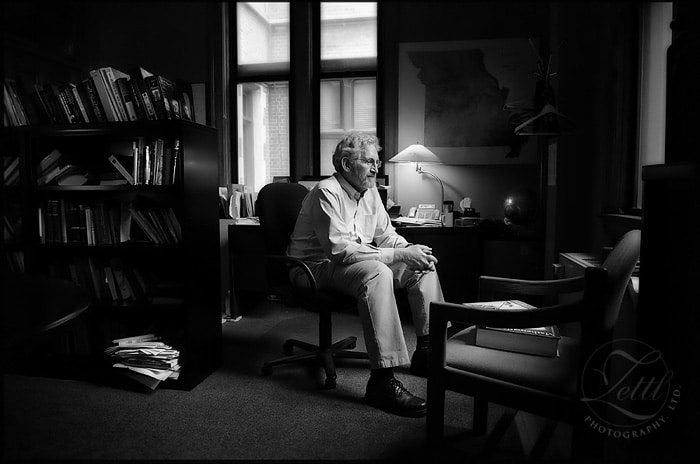
Stephanie Zettl | Mentor Series

I have a project I lovingly call my “Mentor Series Project.” I’m on a mission to photograph everyone who has taught me something influential in my life. The goal is to photograph them the way I know them and capture their personality. Truth be told, this will be a lifelong project. One of the biggest challenges of a personal project is completing it. It’s very easy to start one; it is very difficult to have the discipline and commitment to continue working on it and finish it.

Stephanie Zettle Wedding Photography

10. To be a great artist, stop worrying about success.

I sat in on a college photography class a few years ago. The professor, Jim Norton, spent the class reviewing the student’s work from that week. As he looked at one print, he turned to the student and said, “Quit being worried about being successful.”

Those few words have stuck with me. So many times we think we need to photograph things a certain way or do certain things to be successful. We chase after that hero print. But in the process we forget about what we are creating, why we are creating it and the actual journey we are on as a photographer.

Norton went on to explain that it is was better to have a print with potential than something perfect with no soul. Ideas cannot be corrected. You have to be psychologically ready to photograph. What is inside you?  What does your heart want to share? This is what you should focus on every time you pick up a camera, and not how many people you want to impress.

The truth is, life will give you many twists and turns. Being too caught up in an idea of success will destroy your opportunity to explore things that will really enhance your career.

All of this reminds me of a quote from Conan O’Brien that has become my approach to my career: “Nobody in life gets exactly what they thought they were going to get, but if you work really hard and you're kind, amazing things will happen.”

Truer words have not been spoken.

To see more of Stephanie's work, please visit her website at www.zettlphoto.com/blog

Stephanie Zettle Wedding Photography

Stephanie Zettle Wedding Photography

Stephanie Zettle Wedding Photography

Stephanie Zettle Wedding Photography

Ok, it's your turn. What do you wish you knew when you were starting out as a photographer? Between today and April 30, I'll randomly pick the best entries to win a copy of Sarah Petty & Erin Verbeck's new book called “Worth Every Penny.” It's a great read and I know as a business person, you'll want to get your hands on it. I only have a very limited number of copies to give away. Sorry, US residents only, though everyone is still invited to comment!

Filed Under: Photography

Do You Create A “Fragrance Of Heaven” For Your Clients?

April 12, 2012 by Seshu | Editor & Publisher

It was well past his bed time, but that didn't matter to him or me. Somewhat unusually, my son Ketan and I started to watch television documentary a couple of night's back.

The submarines in the deep blue ocean had both of us hypnotized. Moving gracefully and carefully from one section of the ship to the next was a robot. Ketan's jaw dropped. Boys will be boys, right? The guys in the submarine were ecstatic on what that camera on the robot was sending them back visually. Not fully realizing what was going on, my son laughed too.

Then came the animations and talk of an iceberg, a collision and the ultimate sinking of a ship. The tone changed and I could see a shift in Ketan's body language. He nuzzled up to me, looked at my face for approval and then returned his gaze back to the television.

On April 15, 1912, a 100 years ago in a few days, the RMS Titanic hit an iceberg and sank; finding its final resting place two and a half miles deep. 1,514 people died in that tragedy.

Please watch this clip from the documentary:

Bill Sauder is not a photographer. His name probably won't ring any bells unless you watched the recent National Geographic special on the Titanic. He is the Director of Research for RMS Titanic, Inc. and has worked closely with James Cameron, the movie director behind the movie “Titanic.”

What struck me most about Mr. Sauder was how, even as he was breaking down in that clip, he was so very clearly able to articulate his ‘WHY' – his reason for doing what he loves to do. His dedication to the Titanic project, was less about the stuff that could be brought up to the surface and more about the people behind those things.

He says that upon opening those perfume vials found on the Titanic, “… for those few minutes, the ship was alive again.”

As photographers, I feel there is a valuable lesson here. Speaking for myself, I know I am not a photographer to create tchotchkes for people, but to tell their stories through images that they can treasure. For me, like for Mr. Sauder, photography will always be about the human condition – who we are, how we relate to each other and what we find important to celebrate as a global community.

Even for Director James Cameron, the pitch he made to the Hollywood producers was simple and effective – “Romeo and Juliet on a boat that sinks.” It was about a love story and the tragedy that befell the people on the ship. If you think about it, the ship itself is really a backdrop in the movie. We are more interested in the people – their mannerism, the class structure or distinction and their social sensibilities. Sure the movie is a bit much in some spots, but there is a reason why it was the biggest grossing film for 12 years, not to mention the first movie to surpass the $1 billion mark in ticket sales worldwide. There is power in telling stories. There is even more power in telling people's stories.

The tangible products we produce need to be of such quality that a 100 years or more from now, people looking at them or feeling them in their hands can think about the people behind them. I want my client's future families to relive moments that they may or may not have experienced themselves. For the images to be truly successful, they must help reconnect them to their parents, grandparents, uncle, aunts, cousins, nieces and nephews. To be the one to create this artifact, no, family heirloom, is such a huge honor and a responsibility for us photographers. What's more, there is no way of telling what real impact those images may have down the road.

When I watched the documentary with my 4 year old son, I couldn't help get a little choked up too when I heard Mr. Sauder describe those perfume vials. For Mr. Sauder, it's a sense of smell that reconnects him to the people on that ship.

I had to ask myself, when my clients receive their prints or albums, do they experience that fragrance of heaven too? Isn't that what they truly deserve? Should we not take the time to educate our clients about the work we do, why we do it and how they will be remembered and celebrated? I think we owe them that much.

Sound off below to tell us what you thought of the clip above or whether you know your WHY. In all honesty, I haven't fully defined mine yet but this book by Simon Sinek called Start With Why, is helping me get there. It's an interesting journey.

Filed Under: Commentary, Photography Tagged With: bill sauder, body language, client experience, disaster films, fragrance, heaven, james cameron, movie directors, rms titanic, titanic

Has Kevin Kubota Gone Absolutely Nuts?

April 11, 2012 by Seshu | Editor & Publisher

As a photographer – whether you are just starting out or you are a seasoned pro – you can be easily overwhelmed by the dizzying array of Photoshop actions available in the market. I have used Kevin Kubota's actions for a very long time and for good reason. Here is why I LOVE Kevin's actions: they evolve.

Most other Photoshop action producers are quite happy churning out actions and then they stop making them better. No, not Kevin and his incredible team at Kubota Tools. Every photography convention I have met them, they are sure to show me how they have evolved their actions – made it beter and more efficient to run with the newest operating system or the latest version of Photoshop. And they constantly innovate too, bringing to us such options as a Dashboard for their actions, to make it easy for us to find, select and apply these actions. For this alone, I applaud them.

Now you are probably wondering what the headline is all about, right? Well, I just got an email from Kevin's team today saying they were temporarily dropping the price on some of their products, until the end of April. Yeah, totally nuts because they are easily three or four times their value IF you use them on a regular basis like I do. The Dashboard, for instance, allows me to use not only Kevin's actions but others as well.

Those who know me and know Tiffinbox also know that I typically don't promote products that I haven't personally owned or used extensively in my own photography business. Yes, as an affiliate, I do make a small commission. But I would be remiss if I did not at least alert you to this special sale going on only through the end of April.

Feel free to click on any of the product images below to order your own Kevin Kubota Photoshop action sets or the Dashboard, I've mentioned above. It's all good!

These artistic and production tools have saved me oodles of time:

These are also some of the products I highly recommend:

So, if you do buy one or more of the products listed, above, would you please come back here and tell us (1) why you bought it and (2) if you have used it for a couple of weeks, what your feedback would be for these products? Your opinion matters!

Filed Under: Photoshop Actions, Sales

Seattle, WA Photographer: Kirk Mastin

April 10, 2012 by Seshu | Editor & Publisher

Kirk Mastin and I connected through Twitter. It was only when I spoke to him (scroll down to see the video interview), that I discovered he and I shared a passion for story-telling and a background in photojournalism. Kirk uses film cameras of all types.

[blogshow id=9cb2 player=1 autoplay=0 toolbar=1]

In my interview, I ask him about that and the purported demise of film (especially as Kodak is now officially bankrupt). I also ask him about his experiences photographing wedding and engagement sessions. Check out his responses.

I caught up with Kirk when he was visiting San Francisco. So, the only connection to the Internet he had was through his iPhone. Please bear in mind that the interview has its moments; where I am convinced Kirk is in a kung-fu movie and the audio and video didn't quite sync up.

“The only thing I am selling is my vision, my art.”

Got questions for Kirk, ask them below in the comments section or on his Formspring page.

Filed Under: Interviews, Photography, Weddings Tagged With: interviewing, kirk mastin, mastin, Photographers, photographing weddings, seattle, story telling, video interview, Weddings

How Photographers Can Copyright, Manage & Protect Their Images

April 9, 2012 by A.J. Wood

An Adobe Community Professional, you can find A.J. posting video tutorials & reviews on his website, when he’s not creating content for Layers Magazine or GeekBeat.TV. This is his second guest blog post for Tiffinbox. Read his first post as well. Then follow him on Twitter.

First, I want to thank Seshu for having me back on his blog. My schedule is such that I really try to make time for these guest articles; it's truly a privilege to contribute to the community.

For today's post I wanted to discuss copyright, and what you're not doing about it. I'm constantly surprised at the number of photographers who don't register their image copyrights. If you consider yourself a professional photographer, act professionally for the sake of your business and register your images. It's easy and affordable ($35), especially when compared to the insane amount of money you spend on your equipment. It can also be done online through the Electronic Copyright Office (eCO).

As I re-read the above paragraph, I can see how I'm coming off a bit harsh. Not my intention, it's just lately I've come across more photographers who have seen their work used by someone else. It's easy for you to register, it's even easier for someone to grab your image and use it. Consider this recent example in which Will King Photography was blatantly ripped off by 367 Media. What I find interesting is the folks that stole Will's images are located in the same geographic area. Usually, when I hear of these cases, they occur in other countries or different states.

In a previous post Seshu suggests you secure your images, and provides a link to David Riecks security page. Those are all good suggestions for discouraging infringement.

Registering your copyright is going to be your go-to solution if infringement happens.

Copyright is a civil matter handled in federal court. Without proper copyright registration you may be entitled to actual damages, e.g., standard licensing fees, profits received from infringement, and little else. You will not receive any statutory damages without proper registration. Considering most photographers reading this are using some sort of DAM (digital asset management) for organizing photos adding registration to your digital workflow wouldn't be too hard. For Lightroom & Photoshop enthusiasts I've recorded two videos on adding metadata to your images. Not only is this a good idea for SEO purposes, it's also a great way to ensure your copyright info is embed in every image you post. Did I mention most thieves are lazy? Yup, you shouldn't be surprised how many times your image is reposted as is, without even a name change, metadata intact.

Lightroom SEO

Photoshop SEO

Here are some additional resources to learn more about copyright registration:

1. The PPA helps photographers educate their customers on why copyright is important.

2. Ken Kaminesky interviews Carolyn Wright aka The Photo Attorney who answers photographers burning copyright questions.

3. Jack Reznicki & Ed Greenberg produced the Photographers Legal Guide on DVD, which you can purchase through Kelby Training.

DISCLAIMER – I am not an attorney, nor is this article to be considered professional legal advice.

Do you copyright your images? Tell us about your process down below! You may want to consider a company like MyOWS to help you copyright and then manage and protect your images.

Filed Under: Business, Photography Tagged With: adobe lightroom, adobe photoshop, copyright, copyright law, digital asset management, images, library and information science, manage, photographer, professional photographers, property, protect, protect image, seo, Tutorials, united states copyright law, united states copyright office, videos

Photographers, Do You Get Coached?

March 24, 2012 by Seshu | Editor & Publisher

You probably already know that I work with a Business Coach.

More recently, I have considered working with a Life Coach (also known as a Personal Coach) as well. Why? Well, to help me get my priorities straight. I have just had two invigorating sessions with Bernadette Bolton of Exceptional Life. She works with clients far and wide. I would be remiss if I didn't mention my friend Arvind Devalia out of London, England, who is also a Life Coach.

If you are a photographer, I would also urge you to consider working with a Photo Coach. Two names come to mind – Selina Maitreya and Mike Davis.

So feed my curiosity a little will ya?

[polldaddy poll=6074082]

Having a Business Coach, Life Coach and or a Photo Coach could make or break your business. Do you work with a coach? If you do, tell me/us why? If you don't, why not? Do you know of Business, Life or Photo coaches who should be mentioned? List their names and their website links below in the comments section. Thank you!

Filed Under: Photography Tagged With: Business, business coach, coach, life coach, personal coaching, photo coach, photographer

Bangalore’s “Two Names, One Soul”

March 20, 2012 by Seshu | Editor & Publisher

This article was written by L. Romal M. Singh and reprinted, with permission, from Bangalore's Daily News & Analysis' You & I column. Mahesh Bhat, a photographer based in Bangalore made this republication possible. He is the co-author of Unsung, his first book. Read more about that book here.

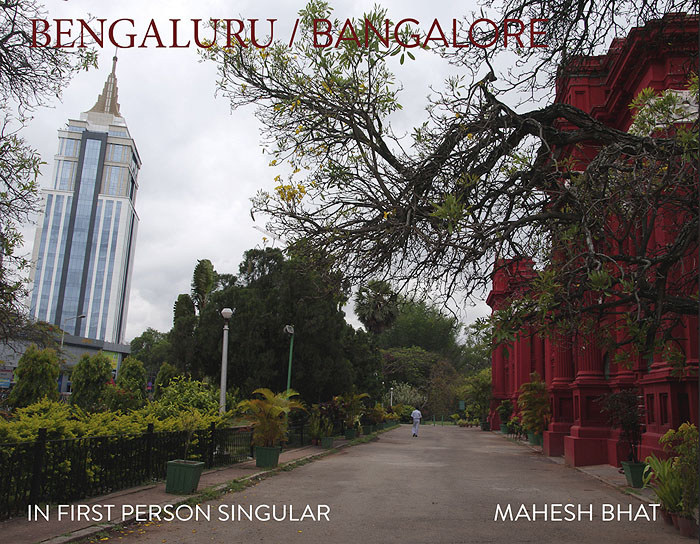
Mahesh Bhat's Bangalore Book Cover

“Two Names, One Soul”

It was this quote that inspired seasoned photographer Mahesh Bhat to look at Bangalore from the perspective of an outsider — an identity Mahesh Bhat gave up almost 20 years ago. “Bangalore is now home to me, but that wasn’t always the case. I grew up in Mangalore but moved here when I was quite young and now the city is home,” enthuses Mahesh, as we sit across a table at Koshy’s.

Koshy’s, so much a part of ‘identity’ Bangalore, does feature in the book that it brought about this meeting, and like many other Bangalore mainstays, the book inspires, records and chronicles a face of Bangalore that’s ever changing, but wonderfully constant.

“I was quite clear about what I wanted from this book — it took me four years to get down to finally putting it together and so I had enough time to ideate. I knew I wanted this book to be about transition — not about famous people and landmarks. Bangalore has always been about multiple identities, it really never has been the same city for any two people,” Mahesh tells us.

Bangalore has indeed been a city of many changes and the city has meant many things to different people, across the 900 years or so of the existence of this city. The powers have changed with almost each century, but the heart and soul of the city largely have remained intact. Bengaluru/Bangalore — in first person singular opens to a wonderful image of the Basavanagudi Bull Temple — an image that quite wonderfully captures the timelessness of this Bangalore.

“I began the journey for this book at Kalasipalya and then meandered through what remains of the pété, before the book halts temporarily at the Cantonment and all that it stands for — the Raj legacy included, before I finally make my way back to the layouts and newer areas that are now as intrinsically Bangalorean as Brigade Road,” shares Mahesh. As said, the book does journey through Bangalore in all its elements, giving you a fair picture of what the city was, is and is probably moving towards — all in one linear movement that personifies an energy now quintessentially known as Bangalore. One of the first images in the book is that of the Infosys pyramid, juxtaposed with slum-dwellings in Electronics City. The picture hits hard and quite succinctly portrays the economic divide in modern Bangalore.

“Bangalore changed after we became an IT city. We lost focus and wanted to be the next Singapore or Beijing. Change is important and inevitable, and don’t get me wrong, I am waiting for the metro as much as any other enthusiastic Bangalorean — but I am worried about the attitude behind this change. A city should be creative class friendly. It shouldn’t be about building infrastructure and then waiting for development — this should be a hand-in-hand process,” says Mahesh, quoting Richard Florida’s theory.

[blogshow id=9ca9 player=1 autoplay=0 toolbar=1]

Bangalore has indeed evolved in more ways than one and it often is the easiest option to just sit back and complain about how these changes are turning Bangalore for the worse. Mahesh however prefers to be more far-sighted in his opinion.

Quoting Narender Pani from his essay, Imaginations of Bengaluru, Mahesh says, “the dominant economic class has always decided what Bangalore will mean to the world and for some reason they have always done away with every trace of the city’s previous leaders. For example, the IT industry is now converting the city into India’s Silicon Valley, removing with it every trace of the city’s colonial past,while just before that the British did the same, by replacing every presence of the pété; with a larger-than-life Cantonment. It’s just how Bangalore functions and it may or may not be a great idea.”

Theme, ideas and motivation in place, we finally move on to parts of the making of this book that Mahesh fondly remembers. “It’s hard for me to decide. Each picture speaks so much to me and is equally precious, but if I had to choose, since you force me to, I would choose the picture of the Karaga festival. The festival is older than Bangalore in many ways and brilliantly captures the spirit of the people who call this city home. Imagine — a Hindu festival with a Telugu lineage, being celebrated by Tamils in a Kannadiga locality where the idols are placed in a dargah as a part of a great custom, proving that communities and religions can co-exist, live in peace and love one another.
I think that if there’s a definitive picture in the collection, it’s definitely this one,” Mahesh concludes.

Impressed and highly entertained, I take leave and rush back to my office where I take my time in absorbing each of these images — some strike a chord, some inform and some just bring the most genuine smile to my face. Bangalore is as much my city, as it is yours and if Bangalore was a song and the lyrics were the ages the city has seen— this book, quite incomparably, is the tune the city has been searching for all these years. P.S. And just in case, you are still looking for an answer to that question asked at the very beginning — read this book and wait for your eureka moment.

Mahesh Bhat says: People in North America can buy the book using Paypal and we'll ship it via DHL. The cover price is $30 and we just add another $5 for shipping.

Filed Under: Books, Photography Tagged With: analysis, bangalore, benguluru, books, daily news, document, electronics city, mahesh bhat, new books, singh, soul

Can You Help Me Light A Spark?

March 19, 2012 by Seshu | Editor & Publisher

As a photographer in Avon, Connecticut I have been reaching out to parents through my portraits website and to brides in Connecticut through my wedding photography website. I have volunteered my time, offered numerous portrait sessions for silent auctions and even photographed the Cub Scouts troop in town. All this to say, I am not going any where and I want to put roots down right where I live.

SPARK at Avon High SchoolOn March 23, I am going to join a group of other professionals in my town present to a select group of Avon High School students. Our presentations are meant to spark an interest in them for what we do, so that they may some day down the road do what we do now. And yes, the half-day program is called SPARK.

“Students will be exposed to a variety of topics beyond the usual classroom fare. The goal of the workshops is to introduce students to a wide variety of interesting topics; a day of exploring something new they may have an interest in learning more about or perhaps even finding a career or hobby.”

For the presentation, I plan on going back and giving the students a quick look at how I started in this business. I'll even go into my WHY. Slideshows are an obvious choice to get them engaged in what I will be talking about.

But I am here to ask for your help:

What should I impart to the students? What do you consider the most important thing that students, who are 14 through 18 years of age, going to need to know from a working professional about photography?

I need your help. In the comments section below, please take a moment and pen two suggestions. If you see someone else suggest something you had in mind, that's fine. Still, tell me. I figure if more people feel the same about a topic that must be addressed at this point and time, then I better hop to it.

So, can I count on you? I want to hear from photographers of all genres, if possible. I would love to understand your perspective on these questions.

Look, I value your time. In return for your suggestions below, you'll be entered (one entry per person only) into a drawing for one of two books by Jerod Foster called, Storytellers: A Photographer's Guide To Developing Themes and Creating Stories With Images.

The two best commenters (and their suggestions) win the two books that Jerod so generously offered to my audience. I'll decide on the winners by Thursday, March 22 at 3 p.m. EST.

Are you in? I am really looking forward to your input. With your help on March 23rd, it will be less MY presentation and more OUR presentation. Thank you!

Filed Under: Business, Photography Tagged With: avon, avon high school, connecticut, cub scout, Education, help, high school student, Lighting, Photography, Photography Business, student

Finding Your Butterflies … Again!

March 16, 2012 by Amanda Reseburg

Amanda Reseburg is a wedding and portrait photographer from Beloit, WI. When she's not photographing for clients she's hanging out with her kids, shooting for fun and blogging incessantly. In the spirit of personal passions, Amanda started Kindred Spirits Hospice Photography in 2009. Follow her on Facebook and on Twitter.

Starting a career in photography is a lot like dating.

In the beginning, the passion is ignited and you want to be with photography ALL. THE. TIME. Your camera is your constant companion and you will photograph anything that moves. You love photography. Photography loves you. It gives you butterflies. You will be together forever.

As you become more serious with photography, you begin to settle into a typical routine. Sure, you still love photography, but the passion has waned a bit. You have regular clients. Regular shoots. Regular poses. It’s all very comfortable. All very regular.

There may come a time when you become SO comfortable with your long-term love Photography that you start to hate the very sight of it. Everything your camera does starts to bug you and you just want some time to THINK … ok, maybe not … but, much like dating, if you don’t feed your relationship with photography … it will die. Those butterflies you felt in the beginning will go away, and what you’ll be left with is a JOB. Yes, I maintain that even at its most hectic I have the best job in the world. But, that doesn’t mean my passion for the craft couldn’t use a little pick-me-up.

Enter personal projects. Diving into personal work is a way to not only practice newly learned skills, but it’s the best way to really enjoy your craft again. With personal work, the rules fade away for the most part. You are shooting for yourself and yourself only. There are no clients to please and no deadlines to meet.

Last summer I started a personal project based on my love of turn-of-the-century children’s portraiture. I wanted to tap into what I call the natural “creepiness” of kids. It was a departure from what my portrait clients typically ask for, but it was FOR me, no one else. The project morphed into what people started calling “Creepy Kids.” It was met with mixed reviews. Some people LOVED the darker take on children’s portraits. Some people thought I had made the precious children look dead or evil. But, I was satisfied in the end that I had created something that I liked and in the process learned something new about my aesthetic.

[blogshow id=9ca3 player=1 autoplay=0 toolbar=1]

Tapping into a darker, moodier feel to my portraits changed my outlook on my regular client-based work. In that sense, stepping outside of my “9-to-5” to shoot just for me really changed my work as a whole. I could have continued shooting what easily sells, but I wonder how long I could continue to do that before I reached maximum burnout.

I challenge all working photographers to take time out to shoot for you. Reclaim your passion, embrace what others may find strange, and find those butterflies again.

Are you working on a personal project that you would like to share with other photographers? Tiffinbox welcomes your submission. Simply contact me if you are interested in guest blogging.

Filed Under: Call To Action, Photography Tagged With: amanda reseburg, avoiding burnout, beloit, butterflies, fashion photographers, finding, human interest, personal, personal photo, personal photos, personal projects, photographer, Photography, portrait photographers, projects, pursue, Twitter, visual arts

  • « Previous Page
  • 1
  • …
  • 40
  • 41
  • 42
  • 43
  • 44
  • …
  • 198
  • Next Page »

Subscribe To Tiffibox Treats!

Looking for a well-curated email newsletter that will leave you inspired and motivated about your photography business? Sign up below!

About Seshu

Seshu creates relaxed portraits of families and high school seniors in Avon, Connecticut. He also leads a successful headshot photography studio in Connecticut, helping professionals from a variety of disciplines project the very best versions of themselves. He created Tiffinbox as a way of inspiring photographers, to create better images and successful businesses. [Read More]

Email Templates For Headshot Photographers

Email Templates for Headshot Photographers

Recent Posts

  • How Capture One Changed My Event Photography
  • 10 Steps To Stay Positive In Times Of Great Stress
  • Why You Need To Read “Personal Branding For Photographers” Now
  • How To Master Your Website Content Step By Step?
  • Tony Taafe’s TNT Method For Headshot Photographers

Recent Comments

  • Stephen Davison on Are You A Business Owner Who Is Smart, But Stuck?
  • Ben A. on Don Giannatti Clinches The 8th Annual Tiffinbox Award
  • Dan on Don Giannatti Clinches The 8th Annual Tiffinbox Award
  • Donald Giannatti on Don Giannatti Clinches The 8th Annual Tiffinbox Award
  • Stephen Davison on G.E. Masana’s 6 Strategies For Wedding Photography Success
  • Naveen Kumar on Weddings In India Are More Than Being At The Right Place And At The Right Time
  • kartick on Weddings In India Are More Than Being At The Right Place And At The Right Time
  • Leonid Farbman on 6 Uncommon Trends To Grow Your Photography Business
  • Willow and Finch Wedding Photography on 11 Reception Tips To Help Your Wedding Photography
  • Web Designer Malaysia on How To Optimize Your Squarespace Website For Search Engines
  • Creastan on An Interview With Photojournalist G.M.B. Akash
  • Cindy Brown | Atlanta on An Open Letter To A Local Photographer

Become a Patron!

Copyright © 2026 · Tiffinbox · Site Design by Heather Mackan Creative · Built on Genesis