• Photography
  • Interviews
  • Business
  • Reviews

Tiffinbox

Inspiring Photographers

  • Home
  • About
  • Blog
  • Contact

How Photographers Can Make Their Customer Service Remarkable

June 15, 2012 by Nate Grahek

Today's guest post is by Nate Grahek, a professional photographer and founder of StickyAlbums.com, where you can create branded photo-album apps for your clients’ mobile devices. Follow Nate on Twitter.

We all know that to compete with other photographers, we have to differentiate ourselves. We have to have a competitive advantage: something we do that sets us apart.

Buisness textbooks talk about three main competitive advantages: Product, Price and Service. The most successful companies are really good at choosing one – and executing really well on that area. Apple is a great example of this. Their number one competitive advantage is Product innovation. They consistently introduce new products that are markedly better than their competition’s.

It’s nearly impossible to compete in all three of these areas. Of course there’s no way Apple could release amazing new iPads AND also compete on price. Why would they even try?

Contrast Apple with a company like Walmart, who focuses exclusively on Price. For better or worse, Wal-Mart’s obsession with bringing customers the absolute lowest price is core to the success of the company.

For either company, trying to do both Product and Price really well would mean giving up the thing that sets them apart.

To clarify: just because you’re focused on one area doesn’t mean the others can be garbage. Apple has their Genius Bars, Walmart sells organic veggies … but that’s not what those companies are known for. Apple makes the coolest devices. Wal-Mart has the lowest prices.

As pro-photography becomes a more and more saturated market, picking your competitive advantage becomes more and more crucial to your success. Like Apple and Wal-Mart, your competitive strategy needs to be baked into your brand.

Next week I’m going to explain WHY customer service should be your competitive advantage. Then I’ll give you some concrete action items–things you can do today or this week–to make your customer service so good your clients can’t help but tell their friends about it.

Meanwhile, I am giving away 3 – $100 credits towards StickyAlbums PRO. Enter using the widget below!

a Rafflecopter giveaway

StickyAlbums Coupon Code For Tiffinbox

Please Note: Contest & $40 Discount ENDS Tuesday 6/19 at Midnight

(Don't wait to see if you win) Winners who are already StickyAlbums-Pro members win the $100 in cash.

The albums are a great marketing tool: they’re like rep cards or brag books, but they’re always at hand and your clients won’t run out of them.

Mobile devices are changing how we live and how we do business. However, word-of-mouth referrals are still our most valuable currency. StickyAlbums gives you a way to leverage this mobile revolution into wow-factor referrals. StickyAlbums also helps you target clients who can afford premium photography – people who use iPhones and iPads have already demonstrated their affinity for premium/boutique products.

If you choose to check out StickyAlbums and end up upgrading to the PRO subscription level, contact me. If you provide them with my email address as someone who has referred you to them, both you and I receive TWO additional months added to our account. Pretty sweet, eh? Here is the email address to enter: orders AT seshu DOT net. Cool?

Good luck!
Filed Under: Marketing, Photography Tagged With: advantage, apple inc., Buisness, competitive advantage, customer, customer service, nate grahek, remarkable, stickyalbums.com, wal mart, walmart, your competitive advantage, your customer service

How You Can Optimize Facebook Marketing

June 11, 2012 by Craig Robinson

Today's guest post is by Craig Robinson. He works as Editor for a Facebook Ad manager tool called Qwaya. Besides writing about topcis like this one, Craig covers other trends within Social Media for Qwaya and he has studied Social Context and Media-Communication Science.

Facebook is a great marketing channel for small businesses. If you put some effort into creating and tweaking your campaigns, you may outperform bigger competitors who won’t spend as much time on a single niche. But it takes a lot of testing and result analysis to succeed. You can’t just put up an ad and wait for it to convert.

Before we go any further, let’s quickly look at the advertising options available on Facebook.

Social or Antisocial Ads

You could say that Facebook ads range from classic, banner-like online ads to social recommendations.

The first category consists of the ads you see to the right of your news feed. When you click them you’re usually directed to a company’s webpage where you’re supposed to sign up or make a purchase.

Remember, though, that you can still be quite creative when you make these ads even though there are rather strict rules regarding text length and image size etc. Here’s a short list with great tips on how to change things up.

Just keep in mind that you need to have material in the ad that is followed up when the person clicks through to wherever the ad is pointing. Forget “smiling ladies” and generic “persons standing around having fun together.” Use pictures and texts that really represent what you are about instead.

On the other hand of the spectrum we have sponsored stories, which is a mix between an ad and a recommendation from a friend to a friend. This could be that someone comments on your fan page and the comment is converted into an ad shown to his friends. It could also be a check-in at your studio, an RSVP to an exhibition or that someone likes or tags an image you’ve posted.

Basically anything can be turned into an ad/recommendation, and for people working in creative industries, social Facebook ads are often the best option. You highlight when someone does something on your fan page and this action is then spread to this person’s friends. People see that you are “liked”.

Facebook Ads Optimization

Facebook is packed with people. Everybody is there. So your problem as an advertiser is not how to reach out to as many as possible but rather how to reach out to the right people – people who will like you, visit your website or fan page, and in the end become a customer.

Because of this you have to use demographic features when you’re creating your ads, such as age, interests, geographic locations etc.

My biggest advice for aspiring Facebook advertisers is to test everything – different type of ads and different targeting. This is the only way to really find out what which your best target groups are and what kind of ads they respond to.

One such group could be women in Seattle who like photography and are between ages 25-35. If you approach them with both traditional Facebook marketplace ads as well as sponsored stories you’ll soon find out what ad type matches your business goals and then you carry on using the best-performing ads.

You can of course organize the ads yourself through Facebook, but it’s a bit of a hassle. You will have to keep track on your own which ads are running, when they are running, how much impressions they get and so on. After a while this can cause some problems as you are probably spending money on stuff you don’t want.

When you’ve started to run several campaigns simultaneously you might benefit from using a tool to help you keep track of where you are in the advertising process, and perhaps even more important, which ads that actually made profit or met your business goal in terms of number of likes etc.

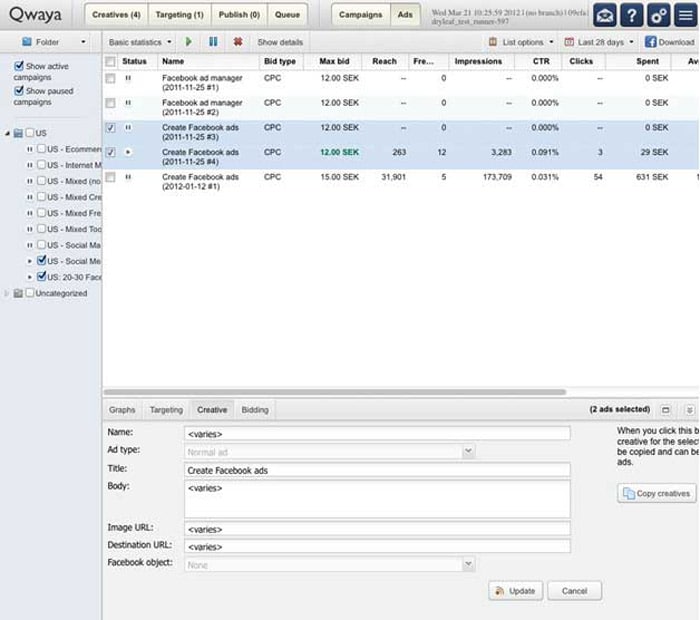
The only tool on the market today that provides a full self-serviced solution is Qwaya. The tool is completely browser based so that you can access it anywhere. Qwaya has direct access to Facebook’s API which means that it’s always updated with the latest segmentation features and demographic options.

Qwaya Campaign Interface

Most Important Thing When Making Ads

When realizing that Facebook is full of people with different interests and demographics it’s easier to create ads with them in mind. One key thing to remember is to always A/B test ads for the same demographic group and follow up on the result.

Don’t just run ads and hope for the best. You might improve the results if you tweak them a bit. Use the statistics that you get from Facebook, perhaps Google Analytics or some other tracking source. In doing so you will be able to quickly move your advertising budget to ads that perform well and cancel ads that just cost you money.

Again, the key is to start advertising to different people in different ways and then let the results dictate the future.

These are just some short tips on Ads for Facebook. If you are interested in learning more you can check out this page for more Facebook marketing strategy tips.

Would you like to win a month-long access to Qwaya's Premium Plan (valued at $149)?

Here is what you need to do to win:

1) Comment below, telling us how you would use your Qwaya account
2) “LIKE” Tiffinbox on Facebook – https://www.facebook.com/tiffinboxmedia
3) Tweet “I just LIKED #Tiffinbox on Facebook – http://seshu.me/JSOBYk – for a chance to win a month of Qwaya for my photography business. Please RT!”

I'll randomly pick one person who has commented below, LIKED Tiffinbox on Facebook and posted the Tweet as it appears above. Winner will be notified via Facebook on June 15th.

Filed Under: Marketing, Photography Tagged With: ad manager, advertising, blog software, facebook, facebook ads, facebook features, facebook marketing, facebook marketplace, facebook social, Marketing, marketing channel, marketplace ads, online social networking, social facebook, social information processing

How Photogs Can Work Smarter, Not Harder

June 4, 2012 by Angela Pointon

Angela Pointon loves creative people. She studied photography, but had a love affair with business and marketing in graduate school. She decided to combine all of it together when she started Steel Toe Images. She inspires photographers and other creative people to kick major butt through her consulting sessions, blog, emails, workshops and her first book (coming soon), called “A Swift Kick In The Pants: Business Smarts For Us Creative Types.” Angela resides just outside Philadelphia. She lives with her amazing architect husband and their two small boys. All of them are vegetarian (yay!), and they rock out to fantastically awesome music from time-to-time (especially on Friday nights).

If your photography business is like most, there is seasonality to it. Meaning, when it rains it pours and when it’s dry it’s a desert.

I know many of you are in your busy season now. Clients are calling, you’re spazzing, you need sleep, you’ve got too much to do.

The great news is: you can bring sanity to every season – busy or slow. How?

You need to create three lists.

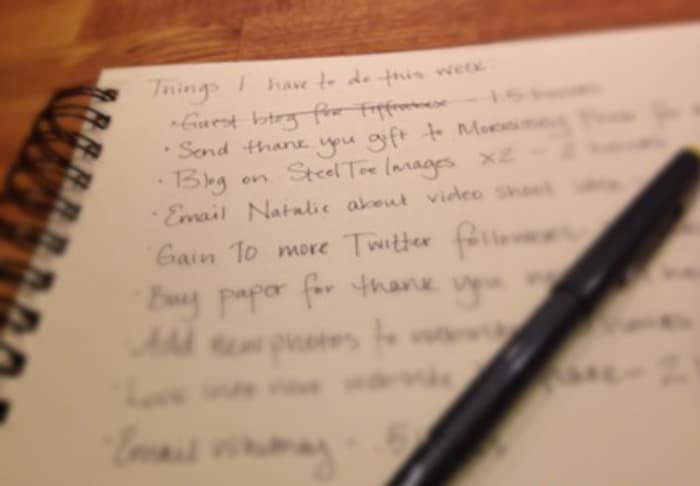
Angela Pointon | Making Lists

I don’t care if your lists are on a blackboard, a scratch pad or in a fancy color-coded excel file… but they have to be written down. This is important. Lists DON’T WORK if they’re in your head. As brilliantly creative as you are, you cannot keep an organized, separated set of three lists in that pretty little head of yours.

So once you figure out where you’re gonna store these lists, you need to create them. The good news is it’s super quick to do.

Listen up.

List #1: What I have to accomplish this week.

Every Monday morning you’re going to spend 15 minutes creating a list of what you HAVE to do that week. You’re going to write approximate time lengths next to each task so that you know how many hours of work you have ahead of you for that week. Add the hours up and make sure it isn’t going to kill you. If it is, see what makes sense to push to next week (or get some help… or a cloning machine).

List #2: What I have to accomplish today.

Each and every morning of the week you’re going to spend 5 minutes creating your list of what you HAVE to accomplish that day. In creating this daily list, you’re taking tasks off of your weekly list and you’re putting them on your to-do list for the day. Your weekly list is becoming shorter day-by-day. How delightful!

List #3: What I have to accomplish when I’m slow.

As you’re driving, in the shower, walking the aisles of the grocery store or talking to friends, you’re always coming up with “wouldn’t it be cool if” ideas of pure fabulousness. Don’t let these sparks of brilliance become dim and never see the light of day. Instead, put them on your “slow time” list so that you can refer to them as business is becoming slower. You can proactively plan to tackle these awesome ideas (using List #1 and List #2 in the same ways) when you have some spare time. Never again will you be waiting for the phone to ring, getting worried and depressed. Instead, you’ll be rocking out by creating something awesome that you thought of to improve your business, your brand, your photos, your service or whatever!

Now look at you! What an awesomely organized and well-managed person you’ve become. All with three simple little lists.

Filed Under: Business, Photography Tagged With: angela pointon, create listing, human interest, listing, management, organize, personal life, photographer, Photographers, planning, smart, stay organized, steel toe, time management, work

Introducing Design Aglow

June 1, 2012 by Seshu | Editor & Publisher

As wedding or portrait photographers in business, we wear many hats. We are marketers one day, networkers the next. On some days we have sales and ordering sessions, on others we are busy coming up with blog posts or communicating with our clients. At our core, though, we strive to make images that mean something.

There are some things I know I do better than others. What I have no time or inclination for, I typically outsource. I'll confess when I was starting out, the draw of doing it all was much greater. I was convinced I could design my own website, business cards, logo and marketing materials. But I soon came to the realization that designing was simply not my forté. I know great design when I see it, but I can't say I know how to go about creating a concept or crafting it. So who does? Well, a graphic designer who has dedicated their life to that pursuit usually is the best option.

You can work with a graphic designer who will custom design your brand or you could opt to buy a template created by a graphic designer, that you can modify to fit your needs. The first option is an investment with great returns IF you know what your brand is all about and you are willing to stick to that brand for a few years. Downloading a template and changing it to fit your needs, however, gives you the flexibility to change things around as often as you would like, at a reduced cost. Just as there are a great many graphic designers, there are also a great many online options to download templates.

The one I have trusted to deliver the very best products is Design Aglow.

What makes Design Aglow special is that it was co-founded by Lena Hyde, a children's photographer based in West Palm Beach, Florida. As a successful photographer, she knows what works and what does not. She is also acutely aware of what the market (in her case moms) are looking for, in terms of products. In addition to offering design templates, Design Aglow has a bevy of sales tools (like their ProSelect plugins) for professional photographers and productivity applications to keep your studio's workflow in check. For a while Design Aglow was publishing a truly awesome magazine. Perhaps they'll get back into the groove again. The magazine, which is how the site got its start, showcases studios and leaders in the industry through in-depth interviews. I recommend checking out the first 11 issues of the Design Aglow magazine. I am hoping that one of their future issues will be dedicated to photographers who document multicultural weddings. [grin]

As you can tell I am a fan. Nothing more. If Design Aglow has an affiliate program, I am unaware of it, so rest assured this post has not been solicited, nor does it contain affiliate links. As a fellow photographer, I just thought you should give Design Aglow a look-see for your own studio's needs. The downloads are instantaneous and should you hit a glitch, the customer service is top-notch. They are quick to answer questions and engage with you through their very active blog.

If after reading my recommendation, you do buy a product through the Design Aglow site, please come back here and share with us what you bought and how you intend using it. Good luck!

Filed Under: Art & Design, Photography Tagged With: aglow, Design, design templates, designing, graphic design, lena hyde, photographer, portrait photographers, productivity, professional photographers, templates

5 Steps To Creating And Marketing And Marketing … Nonstop!

May 30, 2012 by Shuva Rahim

Today's guest blot is by Shuva Rahim, a photographer in Eastern Iowa. Read her first post on Tiffinbox, “9 Tips For Clear & Consistent Client Communication.” When she's not focused on her photography business, she teaches businesses about how to effectively use social media. Follow her @shuvarahim.

Marketing IS never-ending. Some photographers are awesome at it, some aren't. I think I fall somewhere in the middle. But I know how to work hard and am not afraid to put myself out there. When I first proposed this post for Tiffinbox I was all gung-ho about it. I accidentally created a marketing “formula” without realizing it. Then after the first few drafts of this post I felt less certain, only to realize the only person who can expertly speak about my marketing is me. The following is what I did for one session. It's not the “right” way or the “wrong” way but it's my way. It hasn't made me millions (yet), but it's gotten me attention and free press and business … and allows me to create with a level of honesty, heart and love that fulfills me as an artist.

I introduced a new session last fall called Beloved, an unposed session aimed for longterm couples focusing on who they are instead of what they look like. I had been shooting Beloved-style since 2010, but it wasn't until 2011 I decided to really start promoting it. The marketing required a lot of thought, planning and time.

1. Promo video. After more than a year of photographing Beloved, I approached two different couples to photograph complimentary sessions, and hired a videographer. For me, this was a 6-month project (mostly because of scheduling). One of the sessions was videotaped and interviews were done with both. The end result was a short promotional video I was able to share on Facebook, Twitter, LinkedIn, YouTube and my blog. You can watch it below:

2. Media outlets. Once I had the video, I contacted various media outlets in my area and used it to pitch a story about me and Beloved as a product that was unique and celebrated relationships. My first media exposure to this was a newspaper interview in November (about a month after releasing the video). The second was a live TV interview on Valentine's Day (four months after releasing the video). The more recent was a feature in a business newspaper (five months after the video). All these media exposures are free publicity, and I blogged about each one, and subsequently created a link on my blog showing the promo video along with the media exposure. Again, something I share multiple times on Facebook, Twitter and LinkedIn. As a former reporter I knew media staff are busy. So if I didn't hear back I would followup.

3. Silent auctions. I created a 12×18 mount with a Beloved image, with my name and contact info on it. I provide that to whatever charity is holding a silent auction. In addition, I make a custom certificate (8.5×11 paper) laminated for each auction, in which the bid winner takes home. The certificate states a deadline – usually 10 days after the event – in which item must be validated. Validation for me means to contact me to set up an appointment. Every time I've had this strict time clause, the session has been validated. (A great tip I got from Sarah Petty's Joy of Marketing). Previously if I put a deadline of 6 months or a year, I got nothing.

4. Blogging. Blogging. Blogging. I was a newspaper reporter for 6 years prior to becoming a photographer, so this part was easy for me. However, it does require an immense amount of discipline. Not only do I blog my sessions, I blogged about my products. Before the promo video was done, I also blogged about the individual interviews we did with the couples. I also posted status updates on social media about the progress of the promo video before it was released. It was a way for me to tell people what I was working on and create anticipation. Since then, I blog about the silent auctions I'm participating in where Beloved has a presence.

5. Getting out there. Earlier this year I made a goal of connecting with at least 6 different people each day, Monday through Friday, whether they were already old contacts or new. I'll be the first to admit I've slacked off … some. But it's kept me on my toes, and in people's minds. To some degree, I consider myself a reserved individual. But I'm confident in my service and product, and I use that to leverage how I approach people. I've been in and out of various business groups since i started. Finding a good group of people you connect with takes time, much like building a relationship. But it's always about the other people, not you. Learn about everyone else, what makes them tick and what they like to do for fun. Then talk about you.

Marketing for Beloved is never “done”. In the end, as long as I believe in the experience and the product and love what I do, Beloved may very well be a longterm endeavor.

What steps are you taking to market your photography? Discuss below!

Filed Under: Marketing, Photography Tagged With: beloved, blogging, create image, five steps, Guest Blogging, images, Marketing, photographing couples, promo video, promotional videos, session, social media

The Value Of Honesty

May 15, 2012 by Brian Hirschy

Today's guest post is by Brian Hirschy, a photographer & designer living in the Tibetan regions of western China who has a passion for teaching photography, participating in the growing photographic community and working with Asian NGO's to communicate their stories. In 2009 Brian helped start Plateau Photo Tours, a company that facilitates socially-conscious  one-of-a-kind photo tours throughout Tibet – providing socially responsible and culturally non-destructive photo opportunities throughout the region as well as creating sustainable job opportunities – all in an effort to actually help rather than simply complain. You can see Brian's work at BrianHirschy.com or follow him on Twitter @BHirschyPhoto.

Brian Hirschy Travel Photography

Last week, I ran across a video of my friend Zack Arias talking about the need for honesty and perspective as photographers (check it out there). It was a refreshing conversation about honesty and stood in stark contrast to often unhelpful conversations that we constantly see in this industry. Zack's video was a punch in the gut, and I haven't been able to stop thinking about what Zack said since.

I've spent the last three years working as a photographer in western China. In 2009, I started a company called Plateau Photo Tours with a desire to engage the Chinese photographic market by running culturally appropriate, unique photo workshops in the Tibetan areas of western China. I wanted to live somewhere that pushed me as a person and as a photographer. Having traveled these areas extensively for the better part of a decade, living here continues to be a fantastic experience.

But there's so much more to the story than that.

Here's some honesty: Over the last three years, I've spent a disproportionately large amount of time schmoozing Chinese officials for permission to keep working in this area—largely for no return. There's nothing like kissing butt for no reason. Since starting the company, we've had to call off five tours. I've watched our filled tours (of great participants) get cancelled due to political and social stresses, as well as a devastating natural disaster. I've seen what I thought were amazing opportunities pass just out of reach. Recently, I've been banned for months at a time from exiting the city in which I currently live. I've been followed around by plain- clothed police officers — an interesting experience. The local government constantly tells me where I can and cannot takemy camera and where my “foreign face” isn't welcome despite having official government permission. I've dealt with all sorts of political and social insanity just to keep a company afloat in a tough and variable market.

Here's some more honesty: I've made more money as a web and print designer and consultant over the last year than I've made as a photographer. I'd love for every person who visits my website to think that I'm making it entirely with my photography. But I'm not. I've relied largely on my gracious wife's job for parts of our income. I'd love for you not to know that. Depression, questions of identity, future, and my photographic ability have started to steal more and more of my thoughts and sleep. I'd love for you guys to think that I'm bursting from the seams with confidence.

This is not a pity party, and this is not a rant. Above all, I'm certainly not unique.

It's hard. No matter where we are in our careers, it's going to be hard. It should be hard. If it's not hard, you're in that dangerous place of not pushing far enough or hard enough. Or maybe you're in the wrong industry. Maybe you?ve set your goals too low.

The more I hear photographers get real with each other, the more I'm happy to discover what I already suspected: I'm not the only one fighting fights and getting black eyes in this industry. The black eyes I get from running a business in western China are just as painful and just as real as the ones everyone else is getting—despite where they are in their careers or what part of the world they live in. You deal with bridezilla, and I deal with drunken Chinese officials. By my count, we are even. It's hard to run a business—let alone one that is focused on photography. It's hard to be an entrepreneur in a service industry. It's hard for me. It's hard for everyone.

The point is this: We should want to learn from others? black eyes. We should learn from each other?s hard times—learn how to dodge the pesky left hooks of the industry. We should try and help the young and upcoming photographer become the best he or she can be and avoid what pain can along the way. But for some reason, we as an industry are so busy trying to convince everyone else that it was easy, that there were no hard times, and that the black eyes simply don't hurt. Maybe we want everyone to think we are special, naturally talented, smarter than the rest—so much so that we managed to navigate the minefield of this harsh industry with perfection and ease. And now everyone else needs to pay attention to us. Hell, some of us have it so figured out that we've formulated the industry into a “top ten list.”

It wears on me, this façade. It's tiring because not only have I been a willing participant, but also because I see hundreds of other photographers daily pushing something that isn't real, something that isn't personal, and mostly something that just isn't at it's core fully honest.

Maybe more honesty in our industry would result in fewer stretched families, fewer people going into debt because they were convinced they had to have some product in order to compete, fewer tired and burnt out photographers trying to keep up their image. Maybe honesty just makes for better stories. Maybe we'd actually spend more time shooting (remember, that thing we all profess to love so much?) now that we are, finally, allowed to be who we really are and where we really are in the industry.

I'm talking about more honesty in ourselves as photographers — more perspective on where we are in our photographic journeys and more willingness to share the successes with the failures. I've personally found that the more honest I am with myself, the more capable I am of falling in love with what I do. After all, that's really the point – loving what we do.

This article is the culmination of thoughts brought on by Zack?s amazing video (Kudos to Zack, Atlanta Creative Mornings, and Matchstic for producing it). If you haven?t watched Zack?s video, I strongly suggest you carve some time out to do so (here). These are simply my very personal and honest gut reactions to something that I?ve seen in myself for quite some time and something that I?ve seen more and more photographers bring up – it?s not meant to be a rant, an angry fist in the air, or a bemoaning of the self- promoting nature of the photographic industry. Zack says this infinitely better than I do and deserves credit for raising this subject in my mind and beyond that, being one of the most honest, generous, and gracious voices in the industry.

[blogshow id=9cd0 player=1 autoplay=0 toolbar=1]

Filed Under: Commentary, Photography Tagged With: brian hirschy, china, honesty, photographer, Photography, teaching photography, travel photography, true love, value, western china, Zack Arias

Mark Wallace’s Speedlights 101 At CreativeLive

May 14, 2012 by Seshu | Editor & Publisher

Ever since Mark Wallace picked my name out of a hat to win a pair of PocketWizard Mini TT1/Flex TT5 units, I have been a fan of his.

Just kidding.

I always enjoy the way Mark teaches photography, especially lighting. His technical acumen about big studio lights or little on or off-camera speedlights is phenomenal.

While his YouTube channel is full of great videos explaining how he uses light, from May 18 through the 20th, he is going to be doing a bit of a brain dump through CreativeLive. So, sitting in the comfort of your home, you can tune in online to view Mark talk about Speedlights for FREE. On those days alone, it is a live event.

I have watched and bought several CreativeLIVE courses and they are all very well produced. Also, knowing Mark, I expect his attention to detail and his dedication to teaching to come through. What's truly awesome about CreativeLIVE is, as it is happening, you can ask the instructor questions or comment on what you are learning. You do need a Twitter account and the right hashtag to do so. If you enroll now for Mark's class, I am sure you will be emailed some instructions on what to do.

If you can't make the online event or the nightly re-broadcasting of the show, then you can buy the download for $99 – a small investment for your business or hobby. If you know the in's and out's of using your speedlights this course may not be a good fit for you. But if you are like me who wants to know all the functions, say, a Nikon SB900 provides, then I would recommend tuning in (hey, it's FREE) on May 18th, 19th and 20th.

If you miss Mark's CreativeLIVE presentations, you can hopefully catch him during one of his photography workshops this year. He is going to start in his hometown of Phoenix, then goes to Seattle, Los Angeles, New York, Dallas, Miami and Houston. Other cities may be added to the list. So, keep an eye out for that on his workshop site. Mark is offering 4 distinct workshops at each stop. Check them out! I hope to go to the ones in New York, unless of course, he decides to bring the workshop to Boston, or better yet, to Hartford, Connecticut.

Filed Under: Lighting, Off-Camera Flash, Photography, Reviews, Workshops Tagged With: flash photography, mark wallace, nikon, photographic lighting, pocketwizard, speedlight, speedlights, studio lighting, Teaching, teaching photography

Low-Cost or No-Cost Ways To Increase Traffic To Your Wedding Photography Website

May 14, 2012 by Marit Snowball

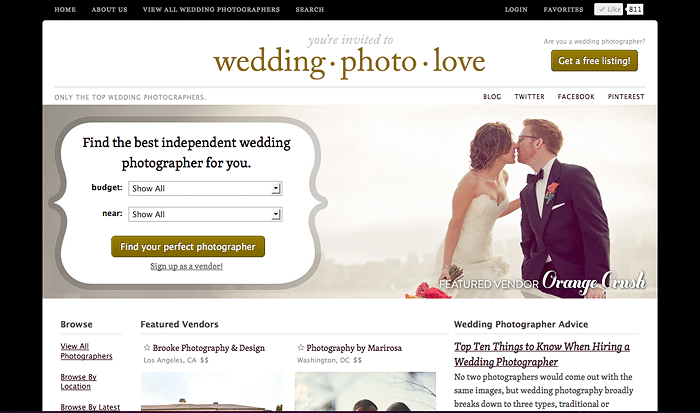
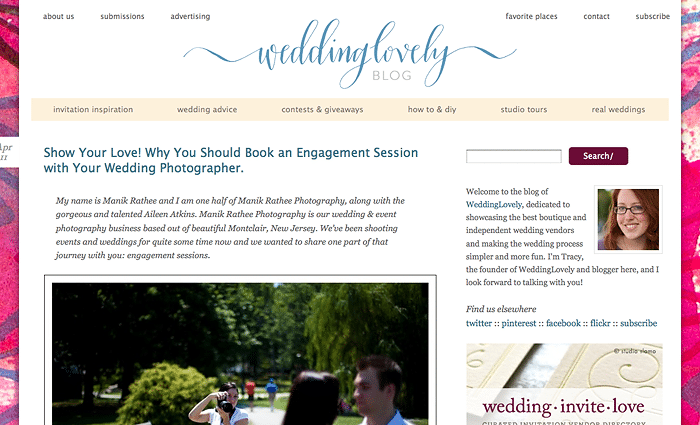
Howdy Tiffinbox readers! My name is Marit and I'm the Creative Director for WeddingLovely – we help brides all over the world plan a stress-free wedding and find vendors that match up to their budget and location. That's where you come in! We have five vendor specific directories, one of them being WeddingPhotoLove, our directory and community dedicated to wedding photographers. We want to help you improve your business, and have a few tips to help you out!

WeddingPhotoLove

There are lots of ways to increase traffic and customers to your website for free. Not everyone has huge budgets for advertising, so you have to get scrappy and promote yourself wherever you can! Here are some ways to increase your visibility:

Get Social!

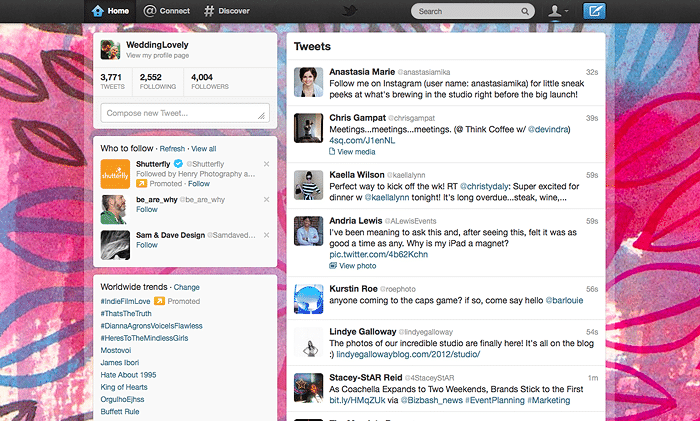
WeddingPhotoLove Twitter

Blogs are an awesome place to share your work — do you have one yet? Do a small teaser post for each wedding or engagement shoot you do, and get your clients to share it with their family and friends. 

There are many other ways to connect directly with customers and let your personality shine through. Create a Facebook page for your business and encourage your clients and friends to “like” you. Make sure to post your photographs in albums on Facebook for potential clients to browse and share! You might have a website, but let's face it– people love Facebook and will likely see your presence more there!

Twitter is also great for building an audience around your personality and likes/dislikes. Since Twitter is so time based, you can use it to drive traffic to your blog posts (make sure to post once in the morning and once in the evening so the most people will see your tweet). Also use Twitter to share industry related news and tips with fellow photographers.

Pinterest is somewhat new on the market, and there are a lot of worries about Pinterest stealing images and removing credit. We'd recommend to use it to share your very best work to promote yourself, and make sure it's watermarked just in case something goes wrong. Pinterest is amazing for driving traffic, so don't ignore it!

Create Free Profiles on Directories to Drive Traffic

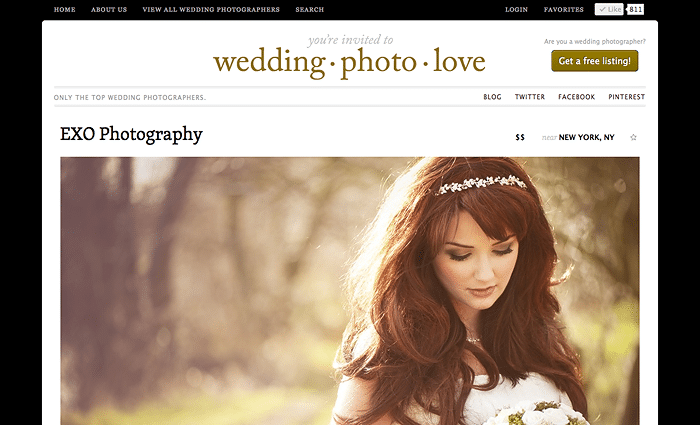
WeddingPhotoLove Photographer's Profile Page

We built WeddingPhotoLove because it sucks to search for a wedding photographer on the internet. With Google, you get a ton of results, but the results are overwhelming! Not to mention, most vendor lists on blogs cost a ton of money and only list a few photographers. We wanted a beautiful, easy-to-use directory that welcomes every wedding photographer, regardless of a couple's budget.

So of course, we'd recommend signing up for a free account on WeddingPhotoLove! In addition to traffic, your website is linked to directly, which can improve your SEO. Here are four tips for creating a compelling profile to maximize the number of people clicking through to your website:

1. Choose one image that shows your style. In a basic profile you are only given one image so choose one of your best — we made the images large so people can really see the detail in the photo!

2. Stand out from your competition. Take a look at what other people are sharing. Browse your favorite portfolio images and select the one that differentiates you from the rest. Revisit the site from time to time and update your image! This will draw attention to your profile from regular visitors.

3. Be personable. Let's face it. You're all making a profile for the same reason, which often results in profile descriptions sounding alike. Make sure you profile your company in a way that sets you apart from other photographers. Perhaps you can mention what you love most about weddings? Better yet, rather than profiling yourself – profile your ideal couple. Get creative and make it fun to read!

4. Contact past clients. Never underestimate the power of a review. Ask couples to post a review on your profile, whether it's a sentence or two about their experience or a detailed explanation on how awesome you are. 

Promote Your Weddings on Wedding Blogs

WeddingPhotoLove Blog

A lot of wedding bloggers love to promote beautiful weddings, and they'll link to you and send you extra traffic to boot! On the WeddingLovely Blog, we feature real weddings and engagement shoots, wedding photographer interviews (linked to your WeddingPhotoLove.com profile), as well as guest blogs from photographers for brides … since you're the expert in wedding photography, not us! 

There are a ton of other resources to submit photos to — we particularly like Two Bright Lights, which will take your submissions and let you send them directly to hundreds of bloggers. Two Bright Lights charges though, so if you have a budget crunch, try making a list of wedding bloggers and contacting them directly!

We Hope That Helped!

There are a lot of little things you can do to promote your business on the internet, and we hope our tips will help get you going!

If you'd like to become a WeddingPhotoLove vendor, we'd be stoked to have you join! To get a profile, just head here. And if you decide you want to upgrade your profile, here's a little gift for you: enter PARTNER20 in the promo field to receive 20% off forever. 

If you have questions or would like to give us more tips about using the internet to promote your business for free, you can email me directly at marit@weddinglovely.com. I'd love to hear from you!

Filed Under: Marketing, Photography, Web/Tech, Weddings

Selling Your Photography Without Shame

May 12, 2012 by Seshu | Editor & Publisher

Without a sale, you don't have a business. You have a hobby. Which, by itself may be where you want to be, but most readers of Tiffinbox are either professionals or aspiring professionals, so I figured I give you a head's up on this short video by Kristen Kalp introducing her new product offering called Sales Without Shame.

Some of you may recall that I reviewed Kristen's e-book, Circus Circus. If you follow Kristen's popular blog – BrandCamp Blog – you'll immediately grasp what she is trying to convey thanks to her lucid writing and her humor.

Sales Without Shame promises to be another remarkable and useful guide for those of us who are shy about in-person selling. If your online sales are off the charts, then you may not even need this guide. If, however, you are not seeing great results with that strategy and want to try selling your services and products to your clients face-to-face and don't know how, Kristen's guide is your ticket.

Personally, I do very little online sales. All of my portrait clients now expect to come in to meet with me after their session so that they can see all of the images I created for them and it gives them an opportunity to fully describe what it is they are looking to buy. Selling, to me, isn't about pushing products on unsuspecting clients. It's about having a good understanding of what my clients may need now and in the future and then suggesting a few valuable options to them.

While I have not had a chance to see the final version of Kristen's new guide, I mention it here because I find her writing and advice for photographers so very valuable. I trust that Sales Without Shame will teach me a few more ways to help my clients better appreciate the art that I create for them. And lucky for you, if you order Sales Without Shame, you get to learn from her as well.

So, here's what you should do next: Go to Sales Without Shame and enter your email address. Once you do that, you'll be sent a “sampler,” which in itself is chalk-full of great info that you can put to use in your business today. Then, at the tail end of this month (May 29th or so), you'll get an email inviting you to purchase the full version. Bingo!

UPDATE: Sales Without Shame launches on May 30th for $247, until June 8th when it goes up to $447. So jump to it!

Filed Under: Business, Photography, Portraits Tagged With: circus circus, client, emotions, guides, kristen, kristen kalp, portrait photographers, portrait photography, Portraits, sales, selling, shame

Tara Gentile: Infrequently Asked Questions

May 1, 2012 by Seshu | Editor & Publisher

Tara Gentile, a thought leader and creative business coach. She brings creative thinking to branding, product development, and marketing that incorporates both strategy and high touch design. Her approach to business in the You Economy resonates with MBAs, PhDs, and graduates of the school of life. She writes frequently for the Daily Worth, Design*Sponge, and Etsy. Bestselling author, Jonathan Fields, named her blog a Top 22 Single-Voice Business Blog of 2012. She’s the author of several popular digital guides including her latest on the relationship between personal art and money, The Art of Earning.Visit her websites: Reclaiming Wealth and KickStart Labs

Tara Gentile | Kickstart Labs1) You project a tremendous sense of discipline. Who do you attribute this trait to? Your mother, as you say, instilled in you the habit of saving. So, she would be my first guess.

I think you're right – my mama taught me discipline. Her business – she supported my brother & I as a seamstress – was driven by her values & personal priorities. She wanted to be present in our lives as much as humanly possible: picking us up from school, attending softball games, being there when we were sick.

So naturally, she found the discipline to work at the wee hours of the morning to get a batch of alterations complete or the strength to canvass the wealthy neighborhood a few minutes away with flyers about her business.

I think her disciple also emanates from just how much she loves & is challenged by her work. She still owns a sewing business even though she doesn't need to work. She truly wants to be at her sewing machine crafting new garments & altering old.

My discipline is very much the same. I want to work as hard as I do. I want to provide for my child. I want to model entrepreneurship & self-determination for my child. I'm also driven to discipline by my clients because I want to serve them at my highest level all the time.

But my personal discipline is also paired with a deep appreciation for time off. I don't push myself through “not feeling like it.” If I don't feel like it, there's a reason and I respect that reason. I do something else instead — even if that something looks frivolous on the outside.

I work hard & I play hard. It's a good life and one I'm happy to lead.

2) If I can speak for photographers as a collective, I would say we sincerely believe we can be both profitable and pursue our art. But we also a lot that gets too easily derailed. What would your advice be to stick to the path we initially imagined we would be on?

First, make sure you're not trying to do more than you can for the sake of money. Photographers (and web designers and web developers) all fall into the category of trying to work too much. As in, you try to accumulate too many billable hours. You work more to make more money because that seems to be the easy way to do it.

How can you make more money working less? Charge more for what you do. Create other revenue streams (i.e. sell prints at the right price, create books, diversify your services). Run your business smarter (i.e. create systems for referrals)

Second, make sure you're differentiated within the market. If where you shine is taking pictures of families with small children, make sure everyone knows that's your specialty. If you're the master of black & white, show that on your website and have a “no color” policy. You'll be able to charge more for your best work instead of making less doing more things.

The average joe doesn't know the difference between you and the 50 other photographers in your geographic area. Make it obvious. Show average joe that you understand his unique needs. Be the best match or tell him to go somewhere else.

Tara Gentile | The Art Of Earning3) In your seminal ebook, The Art of Earning, I get the feeling you are giving us artisans permission to pursue our dreams, which includes honing our craft and creating a sustainable lifestyle for ourselves and our families. Am I reading that right?

Yes! And right there you've hit the nail on the head. It's a two fold mission in becoming a thriving artist:

a) Hone your craft. Get better at what you do. Don't just learn about business — learn to become a better artist! Keep up with trends, invest in equipment, learn new skills.

b) Create a sustainable lifestyle. Make the money you need to live the way you want to live. Nothing is out of your grasp if you name it & work towards it. Don't aim for getting by, don't aim for working 100 hours per week. Aim for sustainable and thriving.

4) You say “transformation is valuable” and I agree. But who gets to place value on that transformation? Let's say a wedding client of mine is looking at a picture I took of her and her late grandmother on the dance floor. How does one put a dollar value to that emotion the bride is feeling at that moment? And how is that value conveyed to my client without sounding like a used-car salesman?

This is one statement from the book I might back pedal on a bit today. Not because it's untrue but because it needs context.

People don't actually buy “personal transformation.” No one believes there is a lump sum of money they can plop down & become better, smarter, richer, or prettier because of the service they've just bought. However, overall transformation is something that can be broken down into its parts. Those parts can be bullet-pointed, named, and price tagged.

For a photographer, transformation may be seeing yourself as you've never been seen before. It might be capturing the beauty of friends & family gathered 'round. It might be providing the best souvenirs from a moment in a child's life.

No kidding, there is no set fee for “the bride & her late grandmother on the dance floor” but that doesn't mean the fee should be low just because it's a beautiful moment either. Charge what you need or want to charge and then back it up with the language that you use to describe the service that you offer.

Break what you do down into tangible bits. Let people feel into having you as their photographer and give them a sense of what both the experience of being photographed & the experience of seeing the photos will be like.

Don't worry about sounding like a used car salesmen. This is ridiculous! You're not a used car salesmen. You weave beautiful stories when you talk to friends about what you do – weave those same stories for your potential clients.

Then say with confidence, “This is my fee.” And give them the space that they need to say, “Yes.”

5) Is having or making that “third choice” – beyond saving/investing or spending it on “stuff” – the driving force behind the art of earning? Also, do you recommend you declare this third choice to your clients so that they understand WHY you are doing what you are doing for you and your business?

Yes, the art of earning is always about earning with purpose. It's not about earning more for the sake of earning more — and it's not about earning enough to “get by” or “have just enough.” If you've built your business with a big ambition, and I hope you have, then earning money is a byproduct of working towards that big ambition.

The more you serve, the closer you come to your ambition, the greater your realize your purpose, the more money you stand to earn. Not in a drain-'em-til-they're-dry way but in a whole-hearted people-see-the-value way.

6) In a world where there are other artisans also providing a similar service, how does one distinguish oneself? Is it by clearly defining how we will deliver either an experience or product full of meaning to the client?

First – let me say – differentiation is so important! It's probably the biggest thing standing in between you and more money, you and better clients, you and full artistic self-expression. It's true!

I could talk all day about differentiation but I want to define it in two ways today:

First, your values define you. What are your values? How do you prioritize? What makes you stand up and say “yes!”? My values include wisdom, excellence, and equality. I know I resonate with someone else's work when I see those same values echoed back at me. I can instantly align with both their purpose & their modality.

Talk to me in values. Tell your story in values. Explain your process in values. Give me something to say “yes!” to.

Second, your value drives you. What are you really selling? What are people really paying for? Understand your value from your customers' perspectives. Interview them about how they received your services and what was important to them in the experience.

Don't paint in broad strokes. Use fine detail. Share others' experiences and allow me to see myself in their examples.

Tara Gentile | The Art Of Earning7) How much does faith personally direct you to help people?

Great question. Up until about 6 months ago, I didn't realize how much my faith & my previous academic study of that faith had carried over into my business. My faith not only directs me to help others but has shaped my whole outlook on business & the commercial system.

Especially observant folks have noticed that I have “Bonhoeffer chick” in my Twitter bio. Bonhoefferchk was my first blogging handle. But the theology of Dietrich Bonhoeffer is also the theology I ascribe to personally. That theology has also directly impacted my approach to business.

Bonhoeffer posited that “Jesus is a being for others.” Jesus' sole purpose was to live his life for others. While great self-love & self-acceptance is a necessary part of that kind of faith, it manifests itself outwardly in service. That's the kind of business I know seek to run and the kind of business I direct my clients to run, as well.

Yes, you must self-express through your great work. Yes, you must have a high self-worth to increase your net worth. But in the end, it's service of others that pushes you onward. It's service that defines your success. Your work exists for others not merely for yourself.

Those are the kind of businesses I want to see in control of the new economy.

Are YOU part of the “new economy” that Tara mentions? I highly recommend you follow Tara Gentile on Twitter. Sound off below to tell us what you thought about this interview. If you would like more such interviews, please help me spread the word. Thank you!

Filed Under: Business, Interviews, Photography Tagged With: Art, Business, competition, creative business, kickstart, kickstart labs, labs, personal art, photo business, Photography, tara gentile, the art of earning

  • « Previous Page
  • 1
  • …
  • 39
  • 40
  • 41
  • 42
  • 43
  • …
  • 198
  • Next Page »

Subscribe To Tiffibox Treats!

Looking for a well-curated email newsletter that will leave you inspired and motivated about your photography business? Sign up below!

About Seshu

Seshu creates relaxed portraits of families and high school seniors in Avon, Connecticut. He also leads a successful headshot photography studio in Connecticut, helping professionals from a variety of disciplines project the very best versions of themselves. He created Tiffinbox as a way of inspiring photographers, to create better images and successful businesses. [Read More]

Email Templates For Headshot Photographers

Email Templates for Headshot Photographers

Recent Posts

  • How Capture One Changed My Event Photography
  • 10 Steps To Stay Positive In Times Of Great Stress
  • Why You Need To Read “Personal Branding For Photographers” Now
  • How To Master Your Website Content Step By Step?
  • Tony Taafe’s TNT Method For Headshot Photographers

Recent Comments

  • Stephen Davison on Are You A Business Owner Who Is Smart, But Stuck?
  • Ben A. on Don Giannatti Clinches The 8th Annual Tiffinbox Award
  • Dan on Don Giannatti Clinches The 8th Annual Tiffinbox Award
  • Donald Giannatti on Don Giannatti Clinches The 8th Annual Tiffinbox Award
  • Stephen Davison on G.E. Masana’s 6 Strategies For Wedding Photography Success
  • Naveen Kumar on Weddings In India Are More Than Being At The Right Place And At The Right Time
  • kartick on Weddings In India Are More Than Being At The Right Place And At The Right Time
  • Leonid Farbman on 6 Uncommon Trends To Grow Your Photography Business
  • Willow and Finch Wedding Photography on 11 Reception Tips To Help Your Wedding Photography
  • Web Designer Malaysia on How To Optimize Your Squarespace Website For Search Engines
  • Creastan on An Interview With Photojournalist G.M.B. Akash
  • Cindy Brown | Atlanta on An Open Letter To A Local Photographer

Become a Patron!

Copyright © 2026 · Tiffinbox · Site Design by Heather Mackan Creative · Built on Genesis