• Photography
  • Interviews
  • Business
  • Reviews

Tiffinbox

Inspiring Photographers

  • Home
  • About
  • Blog
  • Contact

Oh $&!#: Our Biggest Business Mistake

January 13, 2012 by Lauren Lim

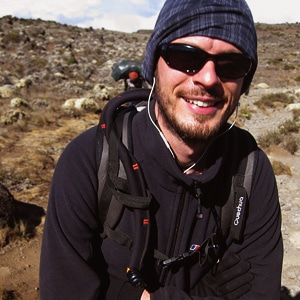
This guest post is by Rob & Lauren, who are photographers, educators, travelers, and all-around fun-loving folks. They spend their time teaching on Photography Concentrate and creating portraits of fun people. They are currently obsessed with espresso and robots. Follow them on Twitter.

Vancouver Seagull | © Robert Lim

Once upon a time we made a really big mistake in our business. The kind of mistake that still comes back to haunt us on a regular basis. A real forehead-slapping, bad-word-saying, doozy of a blunder. 

But before we tell you what we did, let's take a second to talk about mistakes. 

We're human. So are you. (Unless you're a robot, and then you don't really need to read this.) Human beings make mistakes. All. The. Time. If you haven't made a big mistake in your business yet, chances are pretty good that you will.
 
And so a big part of being a business owner is getting your mind in the right place to handle the inevitable missteps. Here are a few steps to take care of those problems when they pop up:

Step 1: Understand that you will make mistakes.
 
You're not perfect and mistakes will happen. When you accept that, you'll feel a lot less anxious and worried! You may even come to embrace mistakes when they happen! Maybe…

Step 2: Admit the mistake.
 
This is a big one. It's easy to hide from your mistakes, and pretend nothing is wrong. Bad move. They have a way of getting worse over time, and you lose your ability to nip the problem in the bud. So when you make a mistake, acknowledge it. Write it down to make it real if you have to. Just admit you messed up, and you'll be in a much better place to fix it.

Step 3: Look at the mistake objectively.
 
When it's your business it's easy to get emotional, and think the mistake is much more dire than it really is. Take a step back, get some big picture perspective, and figure out just what went wrong. Be honest.

Step 4: Fix it. 

This might not always be easy, but do your best to figure out how to fix the mistake. Make things right with clients, with your business, and with yourself. Every mistake is different, so there's no single answer to this one. But now that you've admitted the mistake, and looked at it objectively, you should be able to figure out how to fix it.

Step 5: Learn from it. 

After you've worked to fix the mistake, now comes the most important part. Learn from it!! This is the silver lining, and the big reason why it's ok to make mistakes. They are amazing learning experiences in disguise. If you figure out how to prevent the mistake in the future, you end up growing as a result of making it in the first place. Win!

Step 6: Move on. 

Remember, it's ok to make mistakes. After you've learned from it, then move on. Dwelling on mistakes you've made doesn't help you at all. Focus your energy instead on doing great things in the future. You can't change the past, after all! (Unless you have a time machine, and if so we should talk.)

So, now are you ready to hear about our big mistake? Let's do it.

After a couple of years of shooting weddings in our hometown of Edmonton, we thought it would be a great adventure to move to another city (Vancouver) and set up shop. We went out there to look around, and even did a bunch of networking with local photographers. 

Then, the big mistake: we announced that we would be moving on our blog. 

And never moved.

But all of our clients and potential clients thought we weren't going to be in Edmonton anymore. They stopped contacting us, referring us, telling people we weren't shooting here anymore…you can see why this was a big mistake. 

When we decided to stay in Edmonton we did post about it, and sent out a newsletter, but we never really admitted just how big the mistake we made was. We didn't take the “fix it” stage seriously enough. We didn't put in enough effort to make sure everyone knew we were staying.

And so fast forward a few years, and we still regularly get asked when we are moving, or hear statements like “Oh you're still here! I thought you had moved!”. Bummer.

Luckily it didn't send our business down the toilet, but that was a very real possibility. We've now learned to never make big announcements online unless we are absolutely, positively, 100% sure about it. 

So, have you made a big mistake? Did you admit it and fix it? Or ignore it and have it grow into a big issue like ours? What did you learn from your boo boo? Share with us in the comments now!

Need to learn how to use your camera, edit images in Lightroom, design wedding albums in InDesign? Robert & Lauren Lim are passionate about teaching you through their website and products. Buy them here using these affiliate links so that you may support Tiffinbox as well.

Filed Under: Business, Photography Tagged With: Business, error, knowledge, lauren lim, Learning, mistake, photography concentrate, rob lim, Teaching

A Perspective On Photo Book And Album Manufacturing

January 12, 2012 by Dhiraj Kacker

This guest post is by Dr. Dhiraj Kacker, CEO and co-founder of Canvera, an online digital photography company based in Bangalore, India. Dhiraj has numerous patents and publications to his name in the field of Digital Imaging. Dhiraj can be found online on twitter, his company blog or his personal blog.

With the advent of digital photography and the simultaneous rise of the Internet the entire photography landscape has been revamped in the last decade. This audience knows these changes quite well so I won’t dwell on all of them but rather I’ll focus my post on the technology and craft that goes behind a product that was spawned by this revolution: Photo Books.

I don’t know how many people actually sit back and think about it but it is quite remarkable that today we can actually get a single copy of a book printed at a reasonable price and turned around fairly fast. In the traditional book publishing world the economics just would not make sense unless there were at least say a 1000 copies of a book to be printed. There are many services that provide the ability to print one-off books:

a) Consumer grade photo books by companies such as Shutterfly, Snapfish, Kodakgallery

b) Self publishing service providers such as Blurb, Amazon etc. that focus on generic publishing not just photo content

c) High-end photobook and album manufacturers such as Graphistudio, Asuka, Queensberry etc. that provide a much richer variety in covers, papers, finishing and other customizations. These are the favorites with professional photographers because they best showcase the work of a pro.

Canvera falls in the last category and we have slowly but surely added more and more options as we engaged with more photographers and understood their needs. There is however a constant tension between how many options we can offer versus producing a high quality output and keeping fast turnaround times. What makes this difficult is that there are many different pieces that have to come together in an exact sequence without requiring any one person or set of people to keep track.

Take for example a flush mount book with a custom cover and a personalized box with pictures. The inside of the book is printed on a silver halide machine and bound. The cover and the box wrap are printed on a wide-format printer (in Canvera’s case). The cover goes for separate finishing and then through barcodes is matched at a separate station with the book block and then bound together. The same happens with the custom box. Now there are complications in the process: the silver halide printer and wide-format printer have to be producing the same colors at all times, we can’t afford to have anyone trying to match colors on a book by book basis; individual sheets may have to get re-printed for a variety of reasons; QA may reject the finishing of one of the pieces and that may have to get re-done and matched back with the remaining finished pieces.

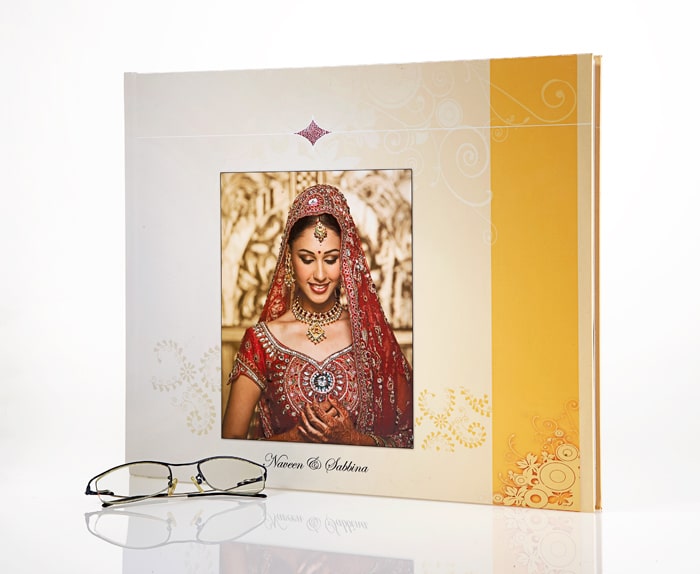
Canvera Albums

None of this is possible to do at scale without significant automation and technology. But adding options brings with it significant complexity as well. Even seemingly simple things such as adding more cover varieties, paper types or hot foil stamping fonts requires us to think through the full workflow: what equipment do we need, where will the raw materials be available on the production floor, how will quality analysis happen etc. We keep trying to push the envelope in adding choices (and at times have gotten burned!) but it is a balancing act.

At Canvera our driving philosophy behind everything we do is as follows:

a) 80% of what makes a good photo book or album is the photography! No matter how many digital photography touch-up tools have been created and how many effects one can do, the pressure on a pro to produce great pictures is as high as ever. In fact I’d argue that with an explosion in images fueled by the web and multitude of capture devices, consumers have subconsciously developed a greater appreciation of what makes a good picture.

b) Fast turnaround time matters a lot. Take the case of wedding photography: For the bride and groom 90% perfect pictures and album received within 10-15 days of the occasion are much more valuable than the absolute perfect set received 6 months after the event. At Canvera therefore, once we get an order we try to put it in the mail within 48 hrs.

c) Quality of printed products should be high and predictable. It is not good enough that the samples are great, but every single product produced every single time without requiring any special treatment should be produced at high quality.

With these driving principles, we focus more on turn-around-time and end-to-end workflow to ensure speed and quality while hopefully letting the photography do most of the talking. This does not mean that we don’t keep adding options, but we do try and think through the full implications first.

Here are things for you to consider when choosing a photo book or album company (beyond of course liking the samples):

1) What kind of front end tools (web or client based) do they provide to capture the order correctly? If there is complexity of choices in the order that the front end tools are not capturing and you are sending instructions over email/phone, chances are that mistakes will happen..

2) As the company grows, do they have processes in place to maintain their turn-around-times and quality at high volumes or are they better off as a low volume hand-made producer?

3) Do the variety of options on the books and albums lend themselves to more mistakes? Is the company ready to handle that much complexity?

4) What kind of color consistency is there in their production work flow?

Canvera Albums

As I said earlier, at Canvera we are taking the approach that first and foremost the photographs should do the talking. That’s key. And we as the photo book and album manufacturers should get out of the way by quickly turning around a high quality product with the right colors morning, evening or night, even if it means in the short term compromising a little on the variety we offer.

What do you think? How do you pick your photo book and album company? Do you agree/disagree with this thinking?

Filed Under: Album Design, Photography Tagged With: Album, album company, album manufacturer, book, book printing, books, canvera, ceo, digital photography, eastman kodak, manufacturing, mass media, perspective, photo, photo book, photo books, photobook, photograph, photograph album, Photography, printer, printing, publishing

In A Rut? Photograph Something Different

January 11, 2012 by Aaron Hockley

Happy New Year! You are probably feeling energized and ready to get into a whole host of new projects, right? Some of us, though, may still feel like we are stuck in a rut. That's natural but there is a solution. And Aaaron Hockley is about to give us a solution. Read on. This is, of course, Aaron Hockley‘s second guest post on Tiffinbox. I hope you read his previous post before you got started with the new year.

What's your genre? Do you normally photograph weddings? Are you a fine art photographer? Do you make headshot after headshot?

Think different. It's not just an Apple marketing line.

I've found a great way to expand my view of the photography world, increase my technical knowledge, and stretch my creative brain is to photograph a subject that's outside of the realm of my usual set of work. In my case, professionally I'm most often found photographing business conferences and events, corporate work, and portraits. I recently had the opportunity to engage in something new: sports photography.

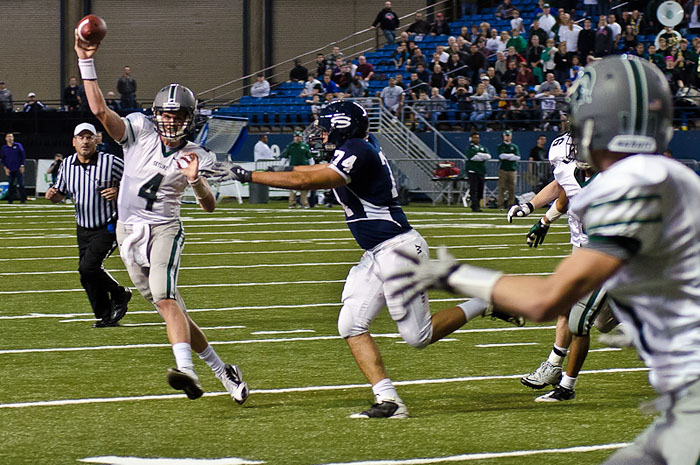
A photographer friend was able to help me obtain credentials to photograph the state high school football championship and it gave me a chance to create images in a new environment. Previously I've never done any serious sports photography, but it was a good exercise in flexing my photo skills for a new situation.

Aaron Hockley | High School Football

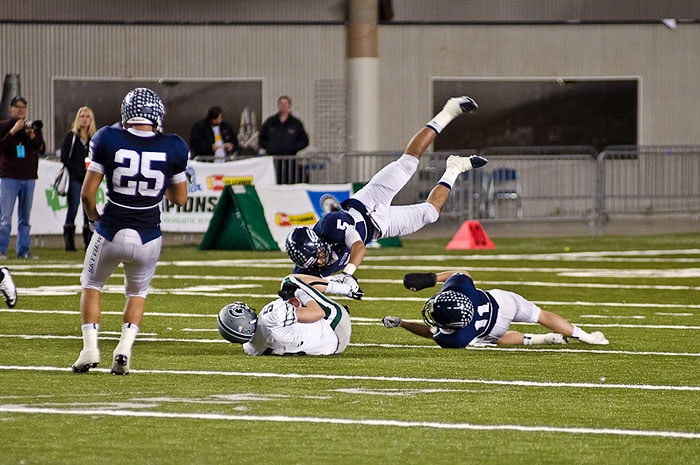
I found that the technical aspects (the indoor domed stadium's lighting and the fast-moving action) were handled without much challenge, but the difficult part was in the football-specific moves, plays, and activities that kept me on my toes. It wasn't too hard to start producing football photos which were correct from a technical standpoint but that were otherwise dull. Producing something *interesting* meant that I had to get my head not just in the photography game, but in the football game as well. Compelling images meant thinking about the football plays, anticipating where the ball might be thrown, looking at where a runner might travel, and ensuring that my camera was pointed in the right direction to capture the moment.

Aaron Hockley | High School Football

While the specifics of my football game were sports-oriented, a similar creative exercise would exist if a sports shooter were to photograph children, or a wedding shooter were to spend time making images of a product, or a photojournalist were to work with studio portraiture.

Avoid getting stuck in a rut by photographing something different; you might be pleasantly surprised with the results. At worst you'll exercise some new ideas, at best you might find something you really like and want to explore as a new side of your photography adventures.

Filed Under: Photography Tagged With: aaron, find photographs, fine art photographers, hockley, photograph, photographer, photographing weddings, rut, something different, sport photography

Getting Your Business Financially Prepared For The New Year (Sponsored By Outright)

December 30, 2011 by Jennifer Dunn

Today's timely guest post is by Jennifer Dunn of Social Street Media. She writes for a variety of clients, including Outright.com, the easiest way to manage your small business finances online!

No doubt you’ve already started the task of organizing everything for the end of the year. Or, at least, you’ve thought about it a lot! It’s never a fun thing to do, especially since it comes during one of the busiest times, the holidays.But considering your photography business’ future is very important at the end of the year. During the rest of the year it’s easy to put things off until later, including evaluating where our ventures are headed. When the New Year stares us down, it’s easier to commit to working a plan.

So what tasks are ahead for the savvy freelance photographer? Let’s take a look.

Take Photos

Hey, who would’ve thought? But these aren’t the usual beautiful landscapes and portraits you usually take. These are plain old boring office and workstations photos! Nonetheless, these pics can help you when it comes time for taxes. Your home office and/or workstation may be available for deductions from your small business. But if you don’t have evidence of anything you use daily for your work, it does nothing for you. Furthermore, your tax agent will know all the deductions you can feasibly pull off, but only if they know what you have set up for your office. While you’re at it, take stock of all your equipment as well. Along with your receipts, they will help authenticate the deductions you’re taking from your taxes.


Outright.com - Free Yourself from Accounting
Go Over Receipts and Contracts

Speaking of receipts, you’ll want to get all those in order before the rush of the tax season approaches. Times are tough, especially for those doing it on their own – naturally, you’ll want to squeeze every dollar you can out of your taxes. That’s why it’s important to have an up to date and accurate record of your exploits in 2011.

Do you know how much money you made and from where? Have you calculated all your expenses and categorized them properly? What about that DSLR you invested in earlier this year, did you take that into account? Everything has to have physical proof for it to work as a deduction, and every job you worked should be properly inventoried.

Going over receipts and contracts is especially important this year because of upcoming changes to your taxes like the PayPal 1099.

PayPal 1099

If you haven’t heard of this mysterious document, the PayPal 1099 is the newest tax document you may encounter in 2012. A lot of freelancers and small business owners operate through PayPal and other payment processing services like it, which means a lot of money is exchanged through these services. The IRS has taken notice, and now requires PayPal to report to them. This means you may get the new PayPal 1099 form. However, there are a few stipulations that may exclude you. For one, you must have made 200 or more transactions through PayPal. Also, those 200 transactions must have netted you $20,000 or more. If this sounds like you, then you’ll get the new form.

Luckily, it’s nothing complicated, just another tax form. However, it may mean you should wait until you actually get the form to start your taxes. Nothing like a little procrastination, huh? Check out the Outright Tax Center for more information on the PayPal 1099 and other important tax info for self-employed photographers.

What else do you typically do to ready your business for the New Year?

Make 2012 a win-win year. Did you know you can support this site by signing up for Outright? It takes just a few seconds. Outright.com – Automate your bookkeeping so you're always organized and ready for taxes.

Disclosure of Material Connection

Filed Under: Business, Photography Tagged With: Business, ebay, economics, finance, freelance photographer, jennifer dunn, outright, paypal, Photography, Photography Business, preparation, receipts, tax, tricks

5 Questions For Strobox

December 29, 2011 by Seshu | Editor & Publisher

Images are created in fractions of a second and our memories are often too poor to remember how we set up a particular shot. Indeed there is a part of us that probably feels confident in achieving the same look and concept, if only we knew where and how the off-camera flashes were placed, how they were modified or what our settings on the camera were. Well, a couple of weeks ago I connected with Janis Lanka, who founded Strobox.

Strobox is a place for all types of photographers to share how they set up that amazing photo! The easiest way to learn is to look at photos and their lighting diagrams so you can see for yourself how they were created.

Here is a, um, snapshot of the questions I peppered Janis with during our conversation. If you have other questions for him, please post them in the comments section below.

1) It's great that in such a short span of time, you have been able to create a community of photographers interested in presenting their work and getting it critiqued. How do you, however, qualify the images? Is it a free for all – anyone can post to the site regardless of quality?

While currently there are few basic rules that I screen each photo for, we are continuously adding measures that help us filter through spam or unqualified photos. It's important to note that Strobox is about a community that raises everyone’s awareness about photography lighting, and as a such, the quality control should be a part of community effort. The ultimate goal is that work displayed is a result of a joint effort from our community rather than just from one or two individuals who happen to have access to MySQL db!

Janis Lanks | Strobox.com2) Tell us a little bit about yourself – are you a professional photographer? Why or rather how did you see the need to create a website like Strobox for photographers?

Just like most who reads this, photography has been a hobby of mine taught to me by my dad with a Zenit camera. Fast forward almost two decades, my learning curve needed some improvement and I purchased a book about portrait photography which explained how each photo was made by giving technical information as well as sketches of lighting diagrams. That is when I asked the question on why such a thing is not available online. The idea was born and it took another 2 years to make it happen. An iPhone app, a community site, and a book later I still see it as a fun experiment.

Currently my day job consists of being a Strategy Consultant at digital agency “Blast Radius” and by evening I'm trying to coordinate a group effort to make Strobox happen – someone from Canada contributes their design skills, from Slovakia their CSS skills, from Lithuania their programming skills, and from England their editor skills, etc. The Strobox core team members are volunteers and not necessarily professional photographers. We continuously need more help (PHP anyone?) so if you want to join us, let me know!

Strobox 2010 Book3) I received Strobox 2010, your first book which is more of a compilation of some of the best work your site has seen in 2010. Books aren't typically huge money makers for their authors. So why take that risk?

No, making a book has not been our revenue strategy. First and foremost it's a celebration of our community and their efforts to help each other raise awareness about photography lighting. While this was yet another one of those enthusiastic experiments which resulted in hundreds of hours spent trying to figure out different legal and logistical things in the book-publishing world, it was totally worth it! Not financially, but the emotional reward is there when you hold that book in your hands for the first time. This book seeks to showcase our community’s achievements during 2010, acknowledge our top contributors, and most importantly, attempting to help us financially sustain our online community. On top of that, we’re also sharing 40% of the book’s profit with the top ten photographers who joined us for this initiative. This has been our first attempt at publishing, and we hope that we'll be able to do this every year and show our appreciation to our community this way.

4) Technique and using tools is one thing. Being able to craft images by collaborating with your subjects is another story. Do you think your site will ever shift the focus every so slightly to discuss that collaboration? That almost intrigues me more than what kind of a light modifier was used in the process of creating an image. Am I in the minority on this?

You are probably in the right minority by asking this excellent question! I would say that story and emotional response it creates is what makes a photo stand out from the others. Lighting technique is merely a tool to help you with that goal. I love listening to other photographers share their techniques and stories of collaboration – those things can't be methodologically systematized as lighting diagrams can. So, in a rather simple way the Strobox community is trying to do one of those “un-sexy” things and geek-out about photography lighting to help each other get the basics right so that sites like yours could take them to the next level.

5) I suspect with sites like 500px.com and Sylights.com, competition keeps you in check. What would you say Strobox does differently and better than those other sites?

Both of your mentioned sites do an amazing job and each of them excel at different things. Without getting in too many details, focus of Strobox should be changing a bit so stay tuned! Additionally, because this is mostly a volunteer experiment that is not based on generating revenue or trying to entice customers, I would rather ask a question of what keeps us doing this. It's our community members who write us and thank us for a useful iPhone app, it’s our Facebook fans who encourage us and like to hear what we’re doing, and it’s our community members who help us with moderation.This started as an attempt to get educated about photography lighting by looking at other examples. But it has turned into a platform for learning. When you learn something, we’ve done well.

Thank you for help us not just create lighting diagrams but also curate them and share them with others. We'll be sure to follow you on Twitter to hear more of your experiments and new features on Strobox.

Filed Under: Lighting, Photography Tagged With: camera, diagrams, janis, lanka, light diagram, Lighting, photographer, Photography, photography lights, portrait photography, professional photographers, questions

  • « Previous Page
  • 1
  • …
  • 76
  • 77
  • 78
  • 79
  • 80
  • …
  • 164
  • Next Page »

Subscribe To Tiffibox Treats!

Looking for a well-curated email newsletter that will leave you inspired and motivated about your photography business? Sign up below!

About Seshu

Seshu creates relaxed portraits of families and high school seniors in Avon, Connecticut. He also leads a successful headshot photography studio in Connecticut, helping professionals from a variety of disciplines project the very best versions of themselves. He created Tiffinbox as a way of inspiring photographers, to create better images and successful businesses. [Read More]

Email Templates For Headshot Photographers

Email Templates for Headshot Photographers

Recent Posts

  • How Capture One Changed My Event Photography
  • 10 Steps To Stay Positive In Times Of Great Stress
  • Why You Need To Read “Personal Branding For Photographers” Now
  • How To Master Your Website Content Step By Step?
  • Tony Taafe’s TNT Method For Headshot Photographers

Recent Comments

  • Stephen Davison on Are You A Business Owner Who Is Smart, But Stuck?
  • Ben A. on Don Giannatti Clinches The 8th Annual Tiffinbox Award
  • Dan on Don Giannatti Clinches The 8th Annual Tiffinbox Award
  • Donald Giannatti on Don Giannatti Clinches The 8th Annual Tiffinbox Award
  • Stephen Davison on G.E. Masana’s 6 Strategies For Wedding Photography Success
  • Naveen Kumar on Weddings In India Are More Than Being At The Right Place And At The Right Time
  • kartick on Weddings In India Are More Than Being At The Right Place And At The Right Time
  • Leonid Farbman on 6 Uncommon Trends To Grow Your Photography Business
  • Willow and Finch Wedding Photography on 11 Reception Tips To Help Your Wedding Photography
  • Web Designer Malaysia on How To Optimize Your Squarespace Website For Search Engines
  • Creastan on An Interview With Photojournalist G.M.B. Akash
  • Cindy Brown | Atlanta on An Open Letter To A Local Photographer

Become a Patron!

Copyright © 2026 · Tiffinbox · Site Design by Heather Mackan Creative · Built on Genesis