• Photography
  • Interviews
  • Business
  • Reviews

Tiffinbox

Inspiring Photographers

  • Home
  • About
  • Blog
  • Contact

Photographers – Don’t Use Email Marketing To Market!

August 30, 2010 by Guest

Dean Levitt, AvatarThis is a guest post by Dean Levitt, Mad Mimi‘s Chief of Culture. Based in Brooklyn, Dean spends altogether too much time thinking about email, people, music and hanging out in the park.

I've always been a huge fan of poetry, especially the sonnets of Edna St. Vincent Millay. I think that the “aha!” moment with poetry came to me at the Boston Museum of Fine Art while strolling through a photography exhibit. I saw some line somewhere about photography capturing a moment in emotion (or the other way around depending on your outlook) and it kinda hit me how similar the two arts are. Poetry (at least the kind of poetry I enjoy) is a wordy photograph.

No one understands better how one medium can be two things than photographers. There's a world of difference between a “photograph” and a snapshot, miles between prose and poetry and a gulf between an email that “markets” and an email that reaches out and connects. That's what we do! We connect… Think of your email marketing service as a way to share, touch, explore and exhibit. Whether your art form is expressed professionally as a portrait or wedding photographer or in purely aesthetic shots for the joy of it, you can utilize the available tools to stay visible and grow (as a business and as an artist).

Poetry is a wordy photograph.

Our entire culture has moved into a system of immediate sharing. Via Flickr, Facebook, Twitter and email, we're constantly sharing and updating. This only gets annoying when we're bombarded by advertising, marketing and spam. Anyone still use MySpace? It's like trying to add a slogan into a rhyming couplet! Take a step back and think about the beauty inherent in the social mediums rather than the possible benefit to yourself.

Building an email with Mad Mimi provides an easy way to share with hundreds (or thousands) of people in moments but it's only really sharing when it's personal and sincere. Take advantage of these tools in our lives to give a moment of your time to tell your friends, clients, customers and potential customers what's on your mind, what you're thinking and what is coming up professionally and personally. It makes receiving an email more like a coffee break with a good friend.

Mad Mimi Email Marketing

Emails provide a lovely way to exhibit your latest works by embedding images directly into the email accompanied by the story with it; whether is the story of a lifetime captured in a portrait, or the love shared at a wedding. Your email becomes a gallery. It's like a wormhole really – an gorgeous powerful email received at a desk whips the reader into a gallery where the photographs transport the viewers out of their moments into the moment captured by you.

So stop marketing and be a photographer, even when you're being an email marketer.

Please do email me and I'd be happy to help you with the boring technical bits of building lovely emails!

Dean and Mad Mimi have been instrumental in my launching MANTRA, a monthly e-newsletter about my wedding photography. While an in-depth review of the service and my experiences will be published soon here, I went ahead and became an affiliate of Mad Mimi. If you were to click the links or the image in this post, I do get a small commission. Thank you and thanks to Mad Mimi.

Filed Under: Marketing, Photo Biz, Photography Tagged With: Business, dean levitt, e mail, email marketing, fine art, mad mimi, Marketing, newsletters, photographer, Photographers, photography exhibit, poetry, Wedding Photography, world wide web

A Snapshot Into SnapKnot, A Brief Introduction

August 19, 2010 by Guest

This is a guest post by Michael Rheaume, co-founder of SnapKnot.

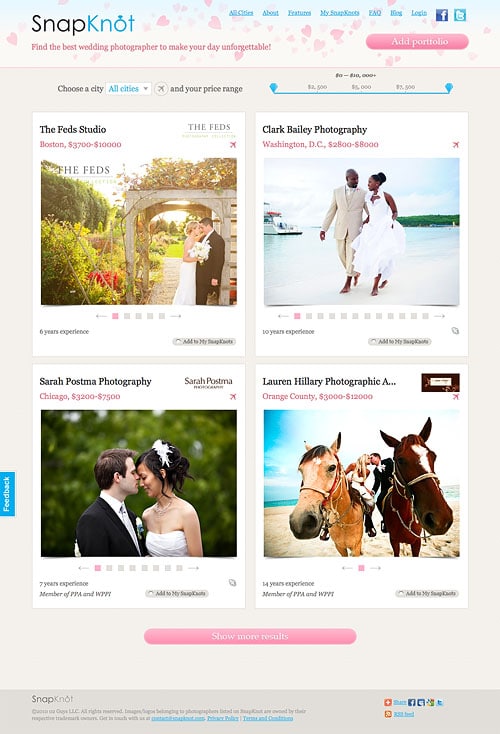
SnapKnot is a website dedicated to helping engaged couples find the perfect wedding photographer. SnapKnot is photo-centric, showcasing the work of photographers such that a bride can compare and contrast style and quality side-by-side. Couples can select their location and budget range and browse through photographers who match their criteria.

SnapKnot Site

SnapKnot is easy, fast, and fun to use, and free for interested couples to contact photographers they like.

SnapKnot was founded by Mike Rheaume and Reid Warner. We were freshman year roommates at Dartmouth College and have remained good friends since. Most people ask if we are photographers or have experience in the wedding industry – neither, in fact!

Reid was married in 2007, and he and his wife had a very frustrating experience trying to find a wedding photographer. They spent a lot of time and effort in their search, only to be disappointed time and again by photographers they liked who they later discovered had prices that were out of their budget. (Fortunately they ended up with a great photographer who they were very happy with: Jim Kennedy

Because of that largely frustrating experience, Reid felt that there was a better way for couples to start their search for a wedding photographer. This is how the SnapKnot idea started. Mike used to work for a small marketing firm, and was looking to use his knowledge and experience in a new venture. We jumped in with both feet from there!

We launched the site in February of 2010 and have experienced tremendous growth so far. We have just over 1200 photographers on the site worldwide. This makes the site a great resource for just about any couple planning a wedding in either the US or abroad.

Our primary focus over the last few months has been increasing our bridal-related traffic to the site, to get more potential clients to view photographers on the site. To this end we are engaged in a variety of strategies, including website SEO, online advertising, partnerships with bridal blogs/websites, and a particular emphasis on social media marketing through our presence on Facebook, Twitter, StumbleUpon and Flickr.

In fact, we have been pleasantly surprised by the number of photographers who range from active to *very* active in social media. Perhaps this is because of the largely independent nature of the business? We were immediately able to tap into an extended network of photographers, and in turn we are able to more easily promote new content such as new engagement shoots, weddings, special offers, and more to our own growing network of engaged couples. One of the benefits our Premium members receive is that SnapKnot acts as a marketing extension, effectively amplifying their brand's voice in the marketplace.

One of the benefits our Premium members receive is that SnapKnot acts as a marketing extension, effectively amplifying their brand's voice in the marketplace.

SnapKnot makes it easier for couples to find and contact photographers who match their criteria, and it's also quick and easy for photographers to create an account (5 minutes or less).

In addition to the online world of social media, we've also found that “old school” networking has worked wonders for us as well. Fresh out of the gate we made it to WPPI in Las Vegas this March, where we were fortunate enough to connect with some great people in the industry.

We met Becker of the [b] School, and recently appeared on his weekly Study Hall.

Mike was able to attend the Beantown Bride and Two Bright Lights event in Boston, in July.

Folks like Mark Stagi of Digital Photo Buzz, Chris Gampat of The Phoblographer, and the guys over at BridePOP have been very helpful and supportive as well.

We appreciate you all! It's a great industry to be working in.

We encourage any wedding photographers reading to at least create a Free account – test out the service and see how you like it.

For those interested in trying out the Premium version we are offering a special discount code for Tiffinbox readers: SESHU1 (only applies to new Premium accounts & upgrades; expires August 31, 2010). Use this code to receive 1/2 off your first month of Premium service for $24.95.

You can read about the details of Free vs. Premium features.

Please leave a comment below with any questions or general feedback, and also do not hesitate to email us: contact@snapknot.com

Filed Under: Photography, Web/Tech, Weddings

What Can You Expect To See At JVS’ Lighting Workshop?

August 18, 2010 by Seshu | Editor & Publisher

JVS just me this video that I had to share with you. It gives you a glimpse of what to expect at his workshop. If you are coming to his Boston workshop, please let me know in the comments. Only a few spots remain.

If you are interested in joining us in Boston, use this link to register. Please enter “PICSESHU” in the “Enter Promo Code” box during step one of three on their shopping cart. The cart will automatically apply a $50 discount for the first 10 people to register.

Check out these links to learn more about JVS' Lighting Workshops and Wedding Photography:

Off-Camera Flash
1 Day Speedlites Workshop
JVS Wedding Photography

Filed Under: Lighting, Photography, Workshops

Brides: Are You For Real?

August 17, 2010 by Seshu | Editor & Publisher

Sometime this afternoon, on Twitter, I came to know about a gallery of images on Brides magazine's website called Real Brides' Favorite Wedding Moments.

Let me be very clear at the outset that I have nothing personal against Brides magazine, its editors and publishers. I am just voicing my opinion here and being pissed off doesn't come easy for me.

Now have you had a chance to look at the gallery? What did you find? Or, rather, what did you NOT find?

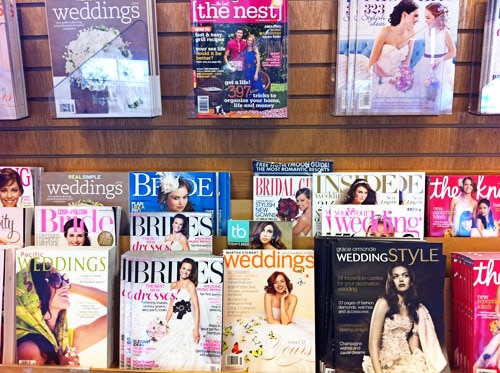
Bridal Magazines by Jigar Champaneria

As a wedding photographer, I immerse myself in a couple's celebration regardless of their background. It's what makes my pulse beat a little faster. There are times when two different cultures come together. I recognize there are all kinds of people in the world who wish to have nothing more than a great celebration of their wedding and work with a photographer who is mindful of their presence to document their event in an elegant manner. And some even want me to find those real moments and capture them as they occur without being obtrusive.

Yes, couples come in different hues and shades of color, with very different expectations. When I saw this Brides magazine gallery, I was quite frankly, appalled. No, the images were spectacular. In fact, I was happy to see two of my friends – Scott Lewis and Robert & Kathleen Trenske‘s images were part of this selection (they are truly great people). What got me in the gut was what was missing. The magazine had not picked even a single bride from a different cultural or racial backgroun, for their selection of “real” weddings.

Chelo Keys, a photographer in New Jersey responded by saying: Wow! I guess Brown/Black/Asian women cannot be “real brides”.

That was my reaction as well. My question to Brides magazine and others in the industry is a simple one – how accurate or “real” of a representation do you have in your magazine of couples from different backgrounds, faiths, sexual orientations? Is Brides being inclusive or exclusive when it chooses not to acknowledge other types of brides?

Denying the presence of other cultures is nothing short of a travesty. No, I am not asking that magazines shift gears and start publishing images of just a few Indian weddings from time to time. That would be patronizing. What I am demanding requesting is that magazines, blogs and other outlets that claim to showcase “real” weddings take a bit of time to understand what that might mean to people across the spectrum before laying claim to the term “real weddings.”

“What to Look For In a Photographer” is directed towards photographers, but I suspect the message in that blog post can be reiterated to magazines that fail at every turn to showcase brides and couples from all walks of life.

Are the rise of magazines like South Asian Bride or blogs like Maharani Weddings a direct response to how most of these widely read publications are shunning multicultural, ethnic or gay couples? I understand the need to focus on your niche, but is that just a clever way of saying “I am going to segregate and serve only one type of client over another based on their skin color or sexual preference?”

As publishers of magazines and bridal blogs that are read widely, you do have the power to dictate what is truly happening in the wedding industry. And you also have the responsibility to represent all brides in an equal manner. But will you?

Imagine the African American bride or the Indian bride or the Chinese bride who may just stumble onto your magazine and website, only to find what you have published simply does not relate to them. Or, that all they have access to when planning their wedding is what you supply to them. It scares me that a couple's or culture's visual history will be but a fading memory, while clearly only one dominant culture continues to highlight its celebrations all the time.

Why is it that other cultures get sidelined? What perverse rationale is used to NOT acknowledge that other people exist among us? I ask these questions not to point fingers but to really figure it out. I am sure other people have these thoughts running through their brain too.

Even I am not infallible. My galleries were once segregated to “Eastern Weddings” and “Western Weddings”. My website has this on the front – “Seshu Is A Documentary Wedding Photographer Serving Multicultural, Ethnic & Interfaith Clients In Connecticut, New England and Around The World”. This will be changed pronto to make it more inclusive. I am a documentary wedding photographer of ALL people. Period.

A good friend and I have talked about this a lot. A wedding is a wedding and the documentary approach I use isn't going to be any different because the clients are different. Makes sense to me, so I thought about it and have decided to display the very best images from all my weddings, regardless of what traditions my clients have chosen to follow. In the end, it's about telling everyone's story – not just Indian, Japanese, Iraqi or French couples. Get my drift?

Perhaps I have been naive all along. But folks, it's 2010 and I say let's mix it up. It's more fun that way!

*The above image was created by Jigar Champaneria, a photographer in the Bay Area. Check out the covers. Isn't it indicative of what this blog post is about? Thanks, Jigar!

Filed Under: Commentary, Culture, Photography, Weddings

Working With An Elinchrom Quadra System

August 13, 2010 by Guest

Justin Van Leeuwen, AvatarThis is a guest post by Justin Van Leeuwen, an Ottawa-based portrait and wedding photographer trying to find his way through the sea of part time photo mommy-bloggers and seasoned, grumpy, veterans of the wedding profession. As a father of two photogenic sons, he loves spending his time with a camera in one hand and a beer in the other. In his spare timework week he labors for a local charity making sure they raise lots of money but was once fired from Best Buy for giving his supervisor the “double-middle” – which he does not regret.

I’ll preface this article to say that I’m new to the world of wedding photography, lighting, and portraiture in general. I have no classic schooling and have just studied, sought inspiration, and worked my butt off to the point that I’m at; and at this point, there’s a lot of room for improvement. I think, though, that I can help a lot of you out who are interested in a similar style of photography but just haven’t taken that plunge.

The Elinchrom Quadra System

This blog post will be about the Elinchrom Quadra system that I recently used at a wedding. The first question a lot of people ask me is why I got Quadra’s?  There are a million different light options out there and all I can say was that this was the right choice for me. You’ll have to do your own research when it comes to using lights more powerful than a speedlight.

In my own research I found blogs like www.strobist.com, www.zarias.com, & www.joemcnally.com invaluable – as I do every day.

Why not just use speedlights?

I can tell you, quite simply, it comes down to power. A Nikon or Canon or “other” speedlight just can’t come close to the quantity of light that a more powerful strobe like the Quadra’s can produce. If photography is all about ratio’s and f/stops of light that increase by doubling numbers then you’d need to double up your speedlights pretty fast to get the same power output that a Quadra system will offer you. If you’re thinking a good flash is $500 – how many of those flashes are you going to need to bungee together to just get one pop the equivalent of the Quadra’s? 4 … maybe 8? Right there you’ve paid for the bigger set with cash left over; so the decision is easily made to grab a good portable Elinchrom System.

Another thing I like about the Elinchrom lights is that it IS a system, a system that pre-exists with snooths, and grids, and softboxes that have been refined and perfected over the years. And with a few adapters I have access to every light modifier Elinchrom makes.

But, at this point I’m working on a very limited budget, I can’t very well afford every piece out there, and with limited (read: no) rental options available to me, it’s buy and try. Luckily there’s help if you know where to look: I put a Tweet out to the pro’s and asked, if they could have just one light mod for the Elinchrom system, which would it be?  Overwhelming response was the Deep Throat Octa (sexy no?).  The deep throat is great because it’s big, produces a wonderful quality of light close up, and can be easily used backed up to throw a strong (still pleasing) harsher and powerful light in the direction of your subjects.

That’s what I was working with going into this wedding: 1 Elinchrom Ranger Quadra set, 1 Deep Throat Octa, a light stand, a broken budget (don’t tell my wife!), an assistant, and a really windy day.

Lighting The Wedding Day

I’m determined to use quality lighting at my clients weddings. I think it brings a dimension that is not as easily replicated (as in you need the gear and know how to use it) and will help set me apart from other weekend warriors.

Elinchrom Quadra System

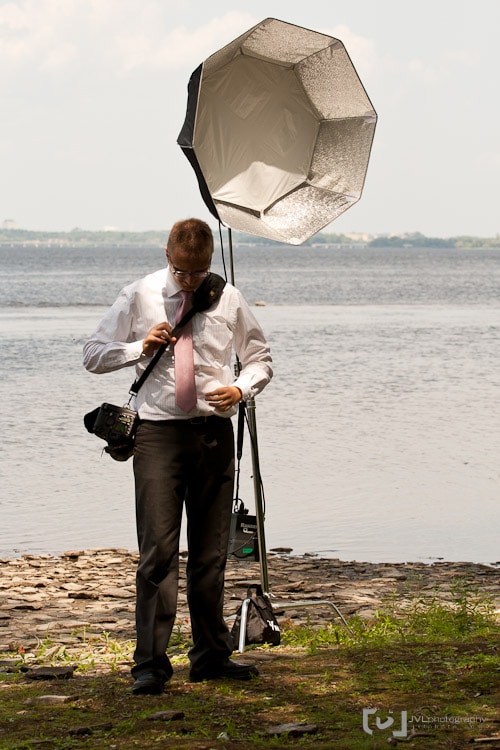
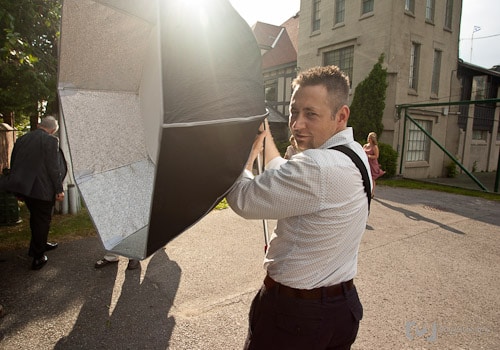
Pictured: me adjusting my blackrapid R-strap, with the Ranger Quadra & Deep Throat Octa (outer diffuser removed) on an Avenger C-stand. Photo by David Hicks.

As you can see in the above image, aside from me needing to lose some weight, I’ve removed the outer diffuser of the softbox. The reason for this was that the material does absorb about a stop of light, and since the day was quite sunny (though we weren’t shooting in full sun) I wanted the latitude to change my exposure on the pack and use less power. Using less power per flash would mean a faster recycle time and more “pops” on this formal portraiture shoot.

Setting all this up was dead-simple, the heaviest component being the C-stand (and you want a really good heavy stand when you spend this kind of cash credit on lights). It was sandbagged but, with a giant wind-sail like the Quadra attached it didn’t matter, it was a very windy day and we required someone to hold the stand at all times.

Elinchrom Quadra System

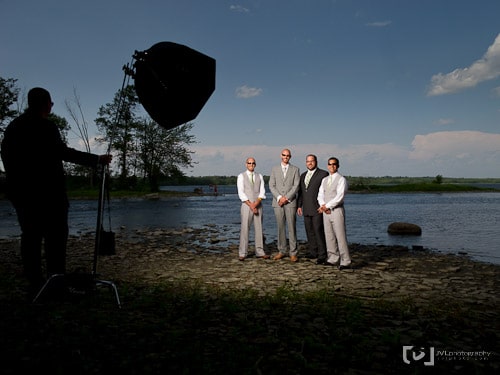
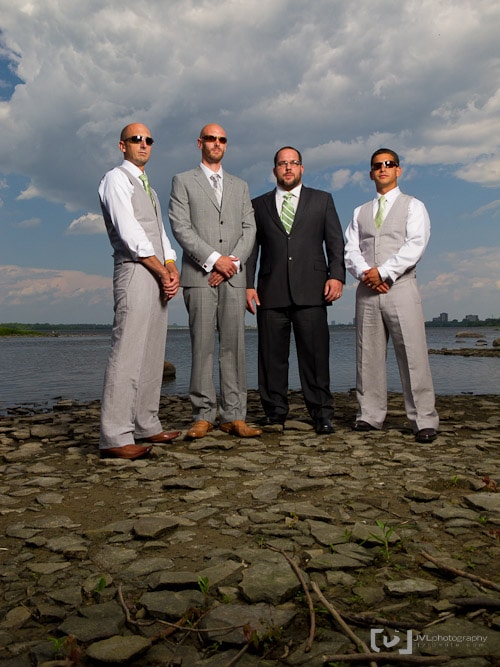
Pictured: The groom & his boys. Photo by Justin Van Leeuwen

I love the contrasty look that you can get by under-exposing the background of a daytime scene – it makes the blues of the sky so much richer, like how I remember them, or how I want to remember them.  It also serves to separate the foreground the lit elements (the wedding party), from the ambient light of the day: this really makes your subjects “pop” out of the image.

Bride and Elinchrom Quadra System

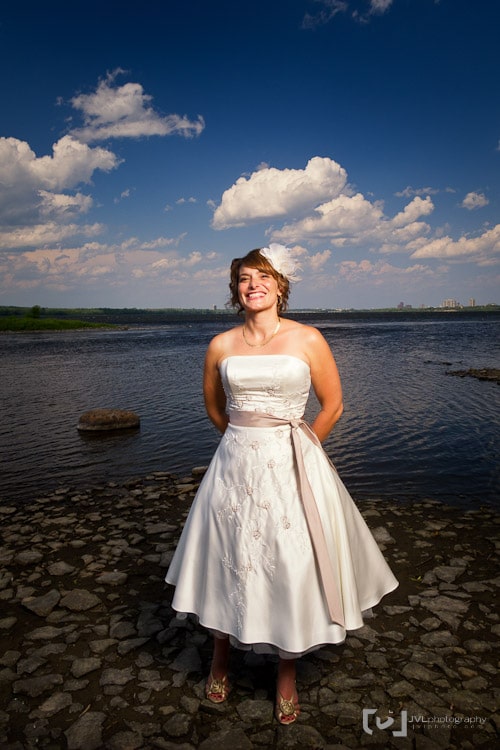
Pictured: The bride. Photo by Justin Van Leeuwen

There are some tricks here and I’ll run you through them.  Most people know by now – thanks to visionary teachers like David Hobby, Joe McNally, Syl Arena, and many others – that the ambient exposure is your “available” light and your flash can come in as a key light to add some ‘pop.’ The means to control how much pop is there is pretty simple – your shutter speed will control your ambient light (so 1/60th will let more ambient/available light in, and 1/250th less) while your aperture will control how much flash gets in (so f/2.8 will be brighter than f/8 assuming your flash power stays consistent). And the combination of these two that you choose will all be according to your tastes. Some like to keep the flash and ambient levels balanced to create a more natural look, while others, like me, like to pop it up.

Most digital SLR’s are limited in their ability to sync the flash with the shutter speed. 1/250th is pretty typical, though a lot of 5D users are more in the 1/160th range and others fall in-between. For your model be sure to RTFM. The reason for this is that your shutter doesn’t move fast enough to capture the full power of your flash – leaving a black, or dark, area having only exposed for the ambient light. But there are a few ways to cheat this and even use it to your advantage.

One way, when you’re shooting manual (which I always do for my lit portraits when not using a TTL flash system) is to just crank that shutter speed up anyways. 1/250th? HA – I LAUGH AT YOU! It’s called cheating the sync and, when done right, it looks like a strong vignette on your image.  When done wrong you have a horrible black bar across the frame. The thing to know is that whatever shutter speed you choose, will still expose the ambient, it’s the flash that won’t get captured in the region (the bottom of the frame).  So you can use it like I did here to still expose, but create a natural vignette highlighting the area of the subjects I wanted to focus on.

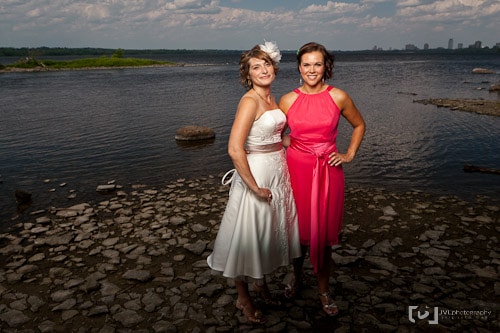
Bride and bridesmaid photographed using the Elinchrom Quadra System

Pictured Bride & Bridesmaid the heavy vignette at the bottom is due to cheating the sync to 1/400th of a second, thus the flash exposure was never recorded at that lower portion of the frame. Photo by Justin Van Leeuwen

Others can manipulate this technique by turning their camera’s upside-down and letting that vignette hit only the sky – which is usually brighter anyways – or compose in a way that they’ll crop later.  Shooting on a now ancient 1DMKII, I didn’t have the MP to spare to crop down.

Another way to cheat the sync, and this I love, is to use a different kind of camera.  Point and shoots aren’t SLR’s right? So they’re not bound by the same “rule” of a max shutter speed because there’s no shutter – just a sensor. Sadly, i find, the cameras are still limited in their firmware to a number that is much lower than they’re capable of – if you’re using a TTL system a camera like the G11 is still limited to 1/250th or so. A camera like the G11 (or the Panasonic LX3 which I’ve also used) has a hot-shoe which allows me to put a remote trigger in it (like the Elinchrom skyport that triggers the Quadra flashes: very similar to a Pocket Wizard). The G11 was able to reach the shutter speeds I needed for the day (1/400th), to darken the sky, without the burden of worrying about a shutter vignette. In fact, I could have gone with an even FASTER shutter speed, effectively turning day to night if I really wanted to. To sweeten the deal, the G11 is 10MP (2MP more than the 1DMKII) or if you had a G10 that’s 15MP to put to use.

Groomsment photographed using the Elinchrom Quadra System

The groomsmen were shot at 1/1000th of a second. Two other images (above) were also shot with the G11.

Once I’ve figured out my ambient and ideal working aperture the rest of the shoot goes like any other, lock in your settings and keep the distance of light to subject consistent… except when the clouds cover the sun and you’re effectively starting from scratch because your ambient just went down a hole…

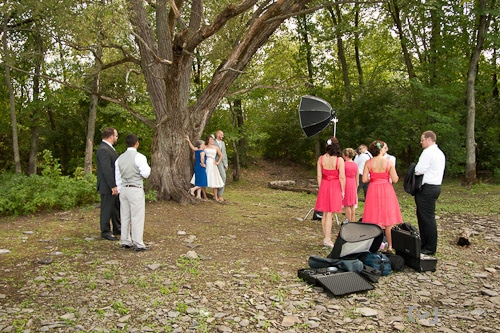
Lighting the Group

One thing a single speedlight can’t do very well is light a large group… heck, even a medium group it’d be struggling with if they were spread out.

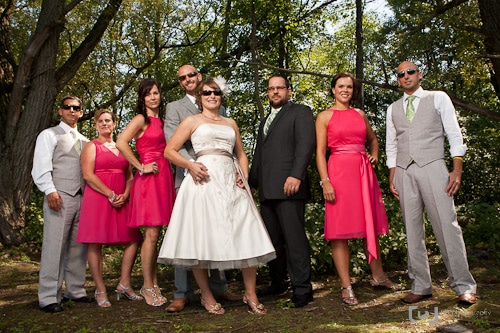
Using the Elinchrom Quadra system to photograph a group

Pictured: The Bridal Party. Photo by Justin Van Leeuwen

Another advantage to removing the outer diffuser panel of the Octa was that it also gave the light a bit more spread – not only would it carry farther, it would spread wider – allowing me to light the group who, otherwise, would have been in shade, unevenly lit and definitely not standing out.

Tearing Down

Packing up the Quadra is as easy as it is setting it up, except you’re no longer balancing exposures, you’re racing off to the ceremony that starts in 30 minutes.

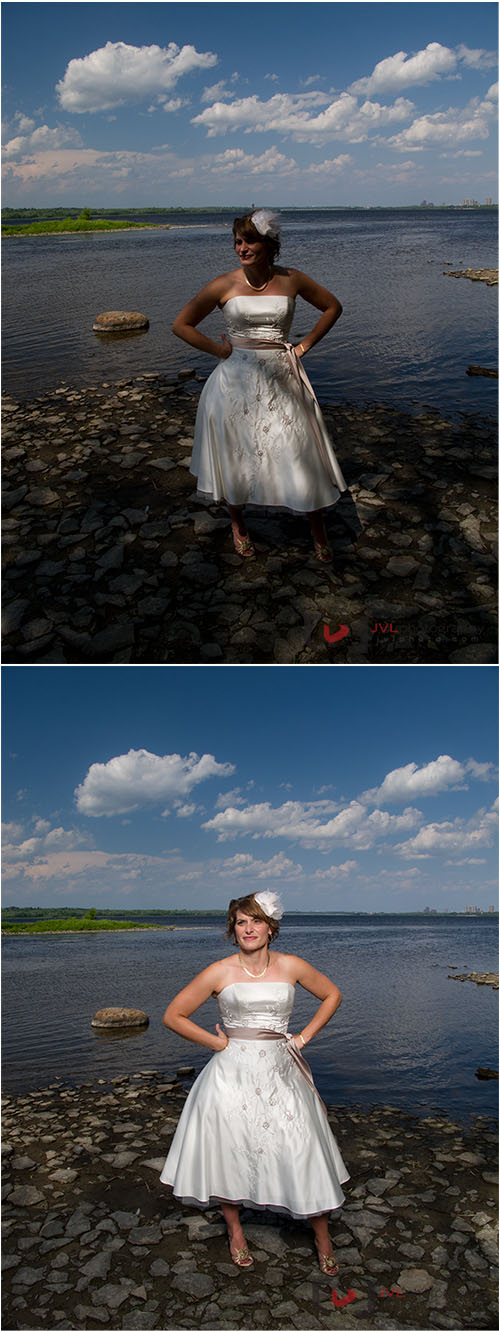
Bride photographed using the Elinchrom Quadra system

For posterity, here’s a shot of the bride with the flash off, and the next on.

After the ceremony we were able to put the Quadra to use again in larger groups for the family formals.

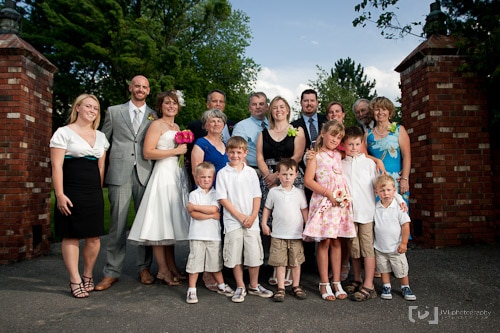
Group portrait using the Elinchrom Quadra system

The bride’s family.  Photo by Justin Van Leeuwen

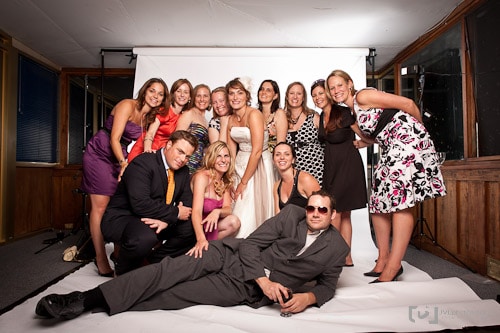
Finally, I also added a “Photobooth” as an add-on benefit for your clients and a great point of sale for your business.  But I found that I need a good amount of clean, wrapping light to do it right – also to get a small enough aperture to capture depth in case someone does something crazy.

Group portrait using the Elinchrom Quadra system

Wedding revelers don’t fit my 10’ seamless (which wasn’t seamless after this shot)

Full disclosure: Admittedly, I was inspired by “The Image is Found” Nate & Jacyln Kaiser who rock the Crazybooth like nobody’s business – actually they rock it like THEIR business. And you can buy their secret sauce recipe for how to do it right (which I don’t – YET) here.

What did I need?

An awesome assistant and second shooter.  Dave saved my ass that day; he held my lights up in some serious wind, and shot a bunch of photos that I would not have been able to when he wasn’t a living land-sail.  I’d argue a good 2nd shooter is always a valuable resource to have at a wedding for both you and your clients – they can also be someone to hold your lights – even better!

Holding Deep Throat and The Elinchrom Quadra System
Pictured: David Hicks. Photo by Justin Van Leeuwen

Just to be clear, I did not use the Quadra, or any sort of strobes for many other parts of the wedding.  They were just a tool that I utilized to give my client a bit of a “studio” experience while producing images that, I hope, will set me apart from some of my competition.  The capital outlay wasn’t much more than some of those “L” Lenses I look at (and own), plus it gave us some images that were must haves for the wedding album, and even 12×18 print orders.

I still have a long way to go before I get what I’m really aiming for – these images aren’t perfect – and I can pick them apart.  I also welcome you to – seriously – let me know what you think, how they could have been improved, a light in the rear for separation? Shallower dof (you’d need ND filters for that) Just no comments on the subjects okay? They all look awesome.

If you have questions about this or anything else, I also welcome them.  You can reach me on twitter @justinvl or by email at justin.vanleeuwen AT gmail DOT com When I’m not taking care of my two kids and taking pictures of them, you can sometimes find me on my photography blog.

The Elinchrom Quadra System

Filed Under: Lighting, Photography

  • « Previous Page
  • 1
  • …
  • 94
  • 95
  • 96
  • 97
  • 98
  • …
  • 164
  • Next Page »

Subscribe To Tiffibox Treats!

Looking for a well-curated email newsletter that will leave you inspired and motivated about your photography business? Sign up below!

About Seshu

Seshu creates relaxed portraits of families and high school seniors in Avon, Connecticut. He also leads a successful headshot photography studio in Connecticut, helping professionals from a variety of disciplines project the very best versions of themselves. He created Tiffinbox as a way of inspiring photographers, to create better images and successful businesses. [Read More]

Email Templates For Headshot Photographers

Email Templates for Headshot Photographers

Recent Posts

  • How Capture One Changed My Event Photography
  • 10 Steps To Stay Positive In Times Of Great Stress
  • Why You Need To Read “Personal Branding For Photographers” Now
  • How To Master Your Website Content Step By Step?
  • Tony Taafe’s TNT Method For Headshot Photographers

Recent Comments

  • Stephen Davison on Are You A Business Owner Who Is Smart, But Stuck?
  • Ben A. on Don Giannatti Clinches The 8th Annual Tiffinbox Award
  • Dan on Don Giannatti Clinches The 8th Annual Tiffinbox Award
  • Donald Giannatti on Don Giannatti Clinches The 8th Annual Tiffinbox Award
  • Stephen Davison on G.E. Masana’s 6 Strategies For Wedding Photography Success
  • Naveen Kumar on Weddings In India Are More Than Being At The Right Place And At The Right Time
  • kartick on Weddings In India Are More Than Being At The Right Place And At The Right Time
  • Leonid Farbman on 6 Uncommon Trends To Grow Your Photography Business
  • Willow and Finch Wedding Photography on 11 Reception Tips To Help Your Wedding Photography
  • Web Designer Malaysia on How To Optimize Your Squarespace Website For Search Engines
  • Creastan on An Interview With Photojournalist G.M.B. Akash
  • Cindy Brown | Atlanta on An Open Letter To A Local Photographer

Become a Patron!

Copyright © 2026 · Tiffinbox · Site Design by Heather Mackan Creative · Built on Genesis