• Photography
  • Interviews
  • Business
  • Reviews

Tiffinbox

Inspiring Photographers

  • Home
  • About
  • Blog
  • Contact

Light It, Shoot It, Retouch It by Scott Kelby

September 7, 2012 by Eileen Earnest

This guest blog is by Eileen Earnest, an expatriate photographer who lives in Abu Dhabi. Follow her on Twitter.

Light It, Shoot It, Retouch It is the latest in the Kelby Training Series. I am a fan of Kelby’s how-to books for several reasons. The first and best is that Scott Kelby is funny. I find it fairly impressive to make an instruction manual entertaining, and he does just that. His writing tone gives the impression that is just how he comes across in a conversation. Quite a skill to have and I gravitate to his books because of that ability to make me laugh now and then amongst fairly dry material.

I own two other Kelby books, one on Photoshop and the other on Lightroom. They both provide clear, easy to follow instructions and many, many photos. They are good books. But Light It, Shoot It, Retouch It is different-good. Here’s how: In any type of instruction book, typically the author starts with the most basic, foundational stuff. Then they build, build, build. If I am interested in a specific aspect of the program I am reading about, it might be page 193 before I get my answer. Light It, Shoot It, Retouch It gives photographers exactly what they need, each step of the process, and it’s complete from start to finish in under 20'ish pages. Some chapters are even shorter, but still chock full of all the information and detailed instruction on getting the best photo, during and after the shoot.

The Info Before the Info and the Info After the Info

Each type of shoot is described in the book as it’s own chapter. However, before we even start the first lighting set up, Kelby gives us eleven things we need to know prior to diving in. He has some equipment suggestions and points the reader to his online companion to the book.

Every chapter is accompanied with detailed photos of the background and lighting configuration so Scott also explains how to read these. These eleven tips are followed by an equally important list of ten tidbits that he wishes he had known before using studio lights. And yes, I also wish I had known these things, so thank you, Scott! On a personal note, I’ve only worked in a studio for the last 4 months. Setting up the lighting and making the transition from only natural light photography is no small task. This quick section of the book is well placed and very important to any photographer who is getting his or her own studio off the ground.

Towards the end of the book, there is a look at each of the setups with hot shoe flashes instead of strobes. In addition, there is a comprehensive gear list as seen in the different shoots. Scott Kelby shoots Nikon, which I have decided to not hold against him, but it is easy to figure out the comparative Canon equipment when necessary. (Also, he flip-flops between using a Nikon and Canon body for the back-of-camera photograph in each chapter so no one feels left out. The list of modifiers was incredibly essential to me as I find myself randomly buying gear at times. I would have made better choices with a little more direction before purchasing. This is a perfect wish list of studio equipment.

Chapter By Chapter, Shoot By Shoot

The next twelve chapters describe in thorough, but concise, detail each different style of photography he is shooting. We begin with a 3-Light Classic Beauty Setup, and continue through eleven other types of lighting. I imagine Scott started with the 3-Light Classic because it’s such a common set up in the studio. My favorite “style” in the book, however, is the 3-Light Sports Setup. It’s so simple but the final image is evokes a sense of strong, silent power. The full length set up was particularly helpful, as I tend to struggle with evenly lighting from head to toe. With each of the twelve set ups, we get to see Kelby actually shooting the subject and the light configuration, including the power settings on the strobes. There is literally no better way to explain how he took this photo than by showing us a photograph of how he took this photo. Actually, FOUR photographs for each lighting set up. Plus, each chapter starts with the final image placed next to the contact sheet from the shoot. Seriously, it could only be more helpful if Scott Kelby himself came to my studio, set up my lights and held my camera for me!

Wait! It Gets Better!

What comes next, however, was even more eye-popping. Scott details his retouching, step by step. Not in a general, “if you’d like to remove a blemish you might choose the spot healing tool…” but in a, “I am removing this blemish on this eyelid with this tool,” method of instruction. Combine this level of detail with Scott’s conversational writing tone, and it’s as if he’s standing over your shoulder pointing to the right keystrokes! I can only imagine the depth of his love of teaching and sharing of knowledge that Kelby must have to go into such detail as he shares his tricks of the trade. Even if you feel pretty confident in your lighting ability and your shooting is sharp, the quick, specific and step-by-step Photoshop aspect of this book is worth its weight in gold. Ok, this man is the President of the National Association of Photoshop Professionals, and he clearly knows Photoshop much more thoroughly than the rest of us mere mortals. Still, he makes it look so darn easy and intuitive! I came away from the book believing if I can read, I can make these edits happen.

Does It Work?

To test my “literacy is the only requirement” theory, I decided to choose a lighting set up and follow Scott’s directions as closely as my equipment will allow. My test will sample the 3-Light Classic Beauty Setup. I don’t have a beauty dish, so I am using a 24×24 soft box. My bottom light is a 24×34 soft box on a strobe.
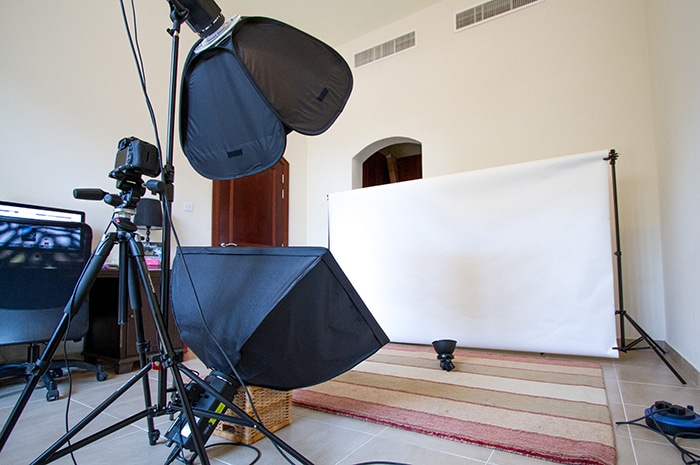
Eileen Earnest Portrait Set Up

The first hiccup: No flexible arm on my light stands. To remedy this, I had to remove the boxes from the stands and prop them on the floor. My model would have to kneel … not ideal, but it worked! The photo [PHOTO 1] below shows the position of the lights and backdrop.

Ok, here is the straight out of camera (SOOC) image:

Eileen Earnest Portrait Straight Out Of Camera Image

I have a few disclaimers to make about following Scott’s steps in Photoshop.

#1. I am a self taught PS user. Before upgrading to CS6, I found everything (I thought) I needed in Elements. This is another reason why LI, SI, RI is the perfect tool at this stage in my learning process.

#2. I have a horribly unsteady hand and do not typically retouch this much because I do not shoot glamour or beauty shoots. Really, I am the perfect candidate for this test because I am basically a novice user. I followed step by step, skipping only that did not apply to my photo. The blemishes were removed, skin softened, dodged and burned, eyes brightened, unsharp mask applied.

Suzanne, my willing model, has long dark, wispy hair as you can see from the image below:

Eileen Earnest Portrait Enhanced Image

I didn’t remove as many wisps as Scott may have, but instead focused on smoothing down above her head and removing flyaway hairs on her face. Again, I think a more experienced user could do a better job. However, the question is, can someone follow along with the instruction in the book and get a decent result? I believe yes! The steps are there; the technique and ease will come with a lot of practice.

At the end of the day, we have so many books to choose from as photographers. Picking one that will literally come in handy on a weekly basis ensures my time and money is not wasted. I feel confident that Light It, Shoot It, Retouch It by Scott Kelby will not get dusty on my shelf nor will it on yours.
Filed Under: Books, Photo Books, Photography, Review Tagged With: 3 light, abu dhabi, eileen earnest, light photography, Lighting, national association of photoshop professionals, natural light photography, retouching, scott kelby, shooting, studio light, the shoot

Bangalore’s “Two Names, One Soul”

March 20, 2012 by Seshu | Editor & Publisher

This article was written by L. Romal M. Singh and reprinted, with permission, from Bangalore's Daily News & Analysis' You & I column. Mahesh Bhat, a photographer based in Bangalore made this republication possible. He is the co-author of Unsung, his first book. Read more about that book here.

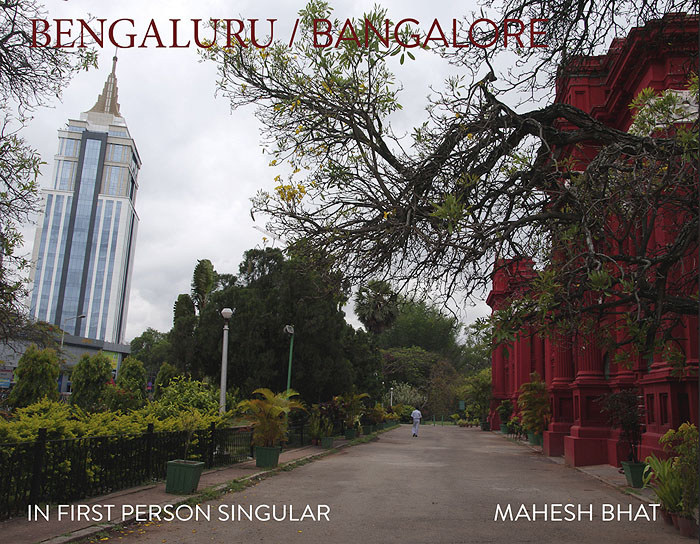
Mahesh Bhat's Bangalore Book Cover

“Two Names, One Soul”

It was this quote that inspired seasoned photographer Mahesh Bhat to look at Bangalore from the perspective of an outsider — an identity Mahesh Bhat gave up almost 20 years ago. “Bangalore is now home to me, but that wasn’t always the case. I grew up in Mangalore but moved here when I was quite young and now the city is home,” enthuses Mahesh, as we sit across a table at Koshy’s.

Koshy’s, so much a part of ‘identity’ Bangalore, does feature in the book that it brought about this meeting, and like many other Bangalore mainstays, the book inspires, records and chronicles a face of Bangalore that’s ever changing, but wonderfully constant.

“I was quite clear about what I wanted from this book — it took me four years to get down to finally putting it together and so I had enough time to ideate. I knew I wanted this book to be about transition — not about famous people and landmarks. Bangalore has always been about multiple identities, it really never has been the same city for any two people,” Mahesh tells us.

Bangalore has indeed been a city of many changes and the city has meant many things to different people, across the 900 years or so of the existence of this city. The powers have changed with almost each century, but the heart and soul of the city largely have remained intact. Bengaluru/Bangalore — in first person singular opens to a wonderful image of the Basavanagudi Bull Temple — an image that quite wonderfully captures the timelessness of this Bangalore.

“I began the journey for this book at Kalasipalya and then meandered through what remains of the pété, before the book halts temporarily at the Cantonment and all that it stands for — the Raj legacy included, before I finally make my way back to the layouts and newer areas that are now as intrinsically Bangalorean as Brigade Road,” shares Mahesh. As said, the book does journey through Bangalore in all its elements, giving you a fair picture of what the city was, is and is probably moving towards — all in one linear movement that personifies an energy now quintessentially known as Bangalore. One of the first images in the book is that of the Infosys pyramid, juxtaposed with slum-dwellings in Electronics City. The picture hits hard and quite succinctly portrays the economic divide in modern Bangalore.

“Bangalore changed after we became an IT city. We lost focus and wanted to be the next Singapore or Beijing. Change is important and inevitable, and don’t get me wrong, I am waiting for the metro as much as any other enthusiastic Bangalorean — but I am worried about the attitude behind this change. A city should be creative class friendly. It shouldn’t be about building infrastructure and then waiting for development — this should be a hand-in-hand process,” says Mahesh, quoting Richard Florida’s theory.

[blogshow id=9ca9 player=1 autoplay=0 toolbar=1]

Bangalore has indeed evolved in more ways than one and it often is the easiest option to just sit back and complain about how these changes are turning Bangalore for the worse. Mahesh however prefers to be more far-sighted in his opinion.

Quoting Narender Pani from his essay, Imaginations of Bengaluru, Mahesh says, “the dominant economic class has always decided what Bangalore will mean to the world and for some reason they have always done away with every trace of the city’s previous leaders. For example, the IT industry is now converting the city into India’s Silicon Valley, removing with it every trace of the city’s colonial past,while just before that the British did the same, by replacing every presence of the pété; with a larger-than-life Cantonment. It’s just how Bangalore functions and it may or may not be a great idea.”

Theme, ideas and motivation in place, we finally move on to parts of the making of this book that Mahesh fondly remembers. “It’s hard for me to decide. Each picture speaks so much to me and is equally precious, but if I had to choose, since you force me to, I would choose the picture of the Karaga festival. The festival is older than Bangalore in many ways and brilliantly captures the spirit of the people who call this city home. Imagine — a Hindu festival with a Telugu lineage, being celebrated by Tamils in a Kannadiga locality where the idols are placed in a dargah as a part of a great custom, proving that communities and religions can co-exist, live in peace and love one another.
I think that if there’s a definitive picture in the collection, it’s definitely this one,” Mahesh concludes.

Impressed and highly entertained, I take leave and rush back to my office where I take my time in absorbing each of these images — some strike a chord, some inform and some just bring the most genuine smile to my face. Bangalore is as much my city, as it is yours and if Bangalore was a song and the lyrics were the ages the city has seen— this book, quite incomparably, is the tune the city has been searching for all these years. P.S. And just in case, you are still looking for an answer to that question asked at the very beginning — read this book and wait for your eureka moment.

Mahesh Bhat says: People in North America can buy the book using Paypal and we'll ship it via DHL. The cover price is $30 and we just add another $5 for shipping.

Filed Under: Books, Photography Tagged With: analysis, bangalore, benguluru, books, daily news, document, electronics city, mahesh bhat, new books, singh, soul

11 Ways You Can Improve Your Photography

December 1, 2011 by Seshu | Editor & Publisher

There are several phases of being a photographer. The obvious ones are beginner, amateur, professional and, perhaps at a stretch, “master.” You may disagree with that progression and that's fine. But I suspect you will agree with me when I say that at every level (yes, even if you self-proclaim yourself the Grand Poobah of photography), you are constantly learning.

Yes, that's right. Educating yourself never ever stops. It's what I find most exciting about photography. Every day, I am learning something new about the art and also ultimately about myself.

Several weeks back, I announced the 1st annual Tiffinbox Award winner. That photographer is David DuChemin, an author, blogger, teacher and foremost a visual explorer. I urge you to check out his blog and his books.

David is also the visionary behind Craft & Vision e-books for photographers of all stripes. Each of these books is $5. They are a fast read and are chalk-full of great tidbits of useful information that you don't just save in your head but are forced to go out and try out for yourself. To say that I have fallen in love with these e-books would actually be a bit of an understatement. They are exquisitely designed and of course contain some of the best photography I have seen. I eagerly wait for each new e-book because they are so remarkable.

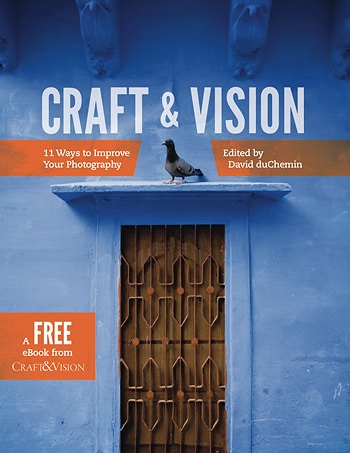
Craft & Vision Free E-Book | 11 Ways To Improve Your PhotographyToday, Craft & Vision is doing something different. They are actually giving away their latest e-book, 11 Ways You Can Improve Your Photography.

So, why is this 69-page e-book free? What's the catch, you wonder? There is none. Think of this book as a sampler. The authors of these chapters are representative of the breadth and depth of the topics you will find on the Craft & Vision website. The writing is lucid and engaging. The images are spectacular. If you are even remotely inclined to educate yourself or even elevate your photography, these e-books are a must. Being e-books, I carry them around on my iPad 2 and flip through them when I want a quick burst of inspiration.

I bet you are curious to know what those 11 ways are right? So here they are, in the order they appear in the free e-book (yeah, download it now):

1) Make Your Images More Dynamic by Piet Van Den Eynde
2) Tame Your Digital Exposures by David DuChemin
3) The Power Of The Print by Martin Bailey
4) Learn To Direct The Eye by Michael Frye
5) Understand The Stages by Alexandre Buisse
6) Create Projects And Collaborate by Andrew S. Gibson
7) Refine Your Composition by Nicole S. Young
8) The Power Of The Moment by Eli Reinholdtsen
9) Forget Lens Stereotypes by Piet Van Den Eynde
10) Slow Down And Learn To See by Stuart Sipahigil
11) Make Stronger Portraits by David DuChemin

Buy one or two, or better yet, buy them all (and save 20%). With the Christmas season around the corner, I don't think there is a better set of gifts than these e-books for the budding or experienced photographer in your life. I know I would appreciate it, if I was presented this incredible opportunity to learn from the very best in the industry.

Disclosure Of Material Connection

Filed Under: Books, Photography Tagged With: better photography, books, david duchemin, e book, E-books, educate, imaging, improve, photographer, Photography, vision, visual arts

Nebraska Cornhusker Football Fans Get A Photography Book – Farewell Big 12

September 27, 2011 by Ken Jarecke

After nearly a month-long hiatus, I am thrilled to publish Ken Jarecke's guest blog post today. You may remember Ken's very popular (it received 133 retweets) first guest post, “A Photographer's Life Is a Juggling Act.” He is a world-renowned photojournalist and a founding member of Contact Press Images. Like before, I urge you read his blog, Mostly True.

As I search my memory, I find there was never a time when I was not a Cornhusker fan.

The awareness of the University of Nebraska’s football team precedes any understanding of the actual game of football itself. Around the age of five or six, when one starts to sort out how geography works. The idea that grandma lives in a different city, but the same state, or that although it looks similar when you cross over the Missouri River you’re really in Iowa, and that there’s a place called Oklahoma which is populated by people who are not to be trusted.

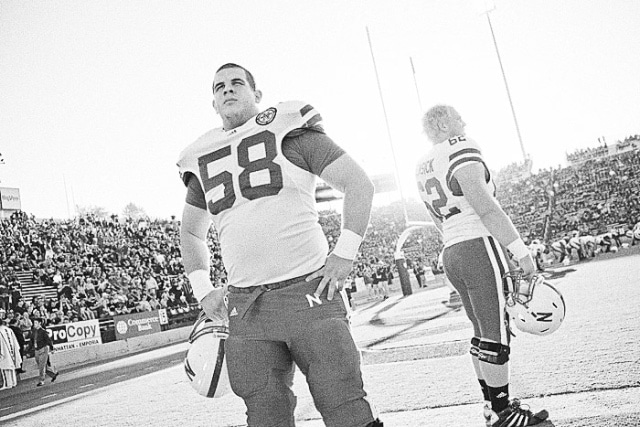
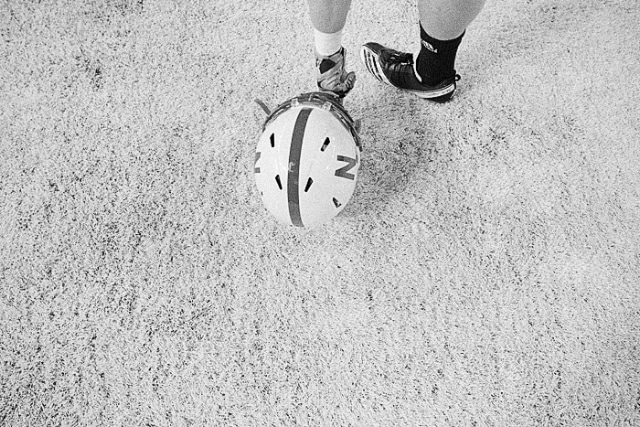
© Ken Jarecke - Nebraska Cornhuskers

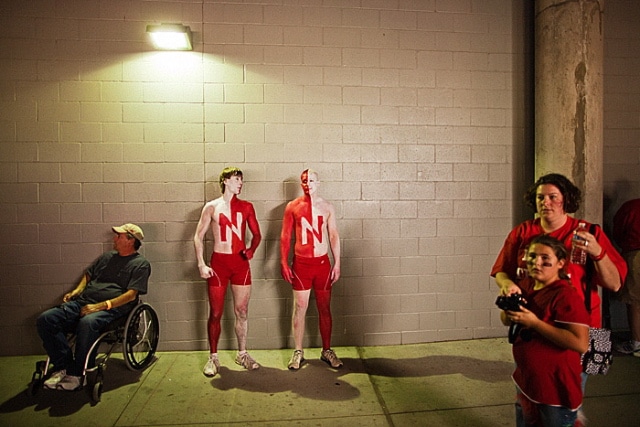
© Ken Jarecke - Nebraska Cornhuskers

That's how it happened, not that there was much of a choice. Back then, before the internet, or cable TV the only other team you’d hear about was whoever the Cornhuskers were playing that week.

Normally, there’d be two games broadcast during the regular season. One early in the year and the Oklahoma game on the day after Thanksgiving (to decide who won the Big 8 Conference and got to play in the Orange Bowl). When the game wasn’t on TV, you and everyone else in the state would listen to Lyell Bremser’s unique color commentary/play by play broadcast on KFAB. If you walked down the street, into a store, or worked in your yard, you’d hear the game whether you had a radio or not. When the game was on TV, you’d turn down the TV set and try to reconcile Lyell’s interpretation of the game with what your own eyes were telling you.

Often times Lyell’s version would win.

Sunday mornings, before church, before getting dressed, but at some point after Davey and Goliath, a mad dash, sans shoes or socks, would be made to retrieve the Omaha World-Herald from the mailbox. The sports section, its black & white images with player’s names (helpfully?) pasted right on the photos and the infernal white arrow chasing Johnny Rodgers down the field (maybe that’s why he was running so fast) would be studied. Special scrutiny would be reserved for the one or two plays, recorded with the high-capacity Nikon (loaded with fifty feet worth of Tri-X) from the top of the stadium, that would be sequenced across two pages in the middle of the sports section.

Heaven help that photographer if he missed a crucial fumble, or a long touchdown run. Perhaps that’s why the chief photographer would assign himself this duty?

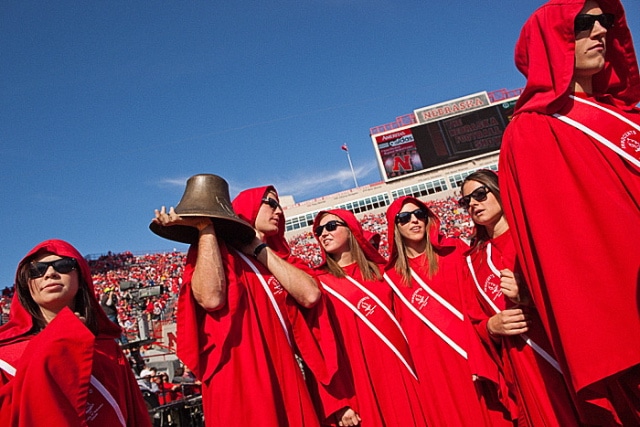
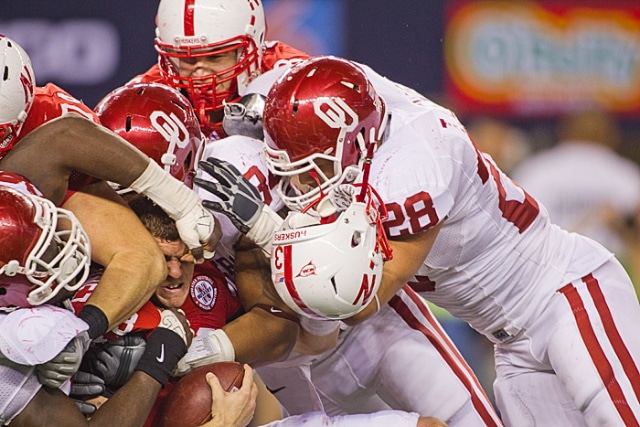
© Ken Jarecke - Nebraska Cornhuskers

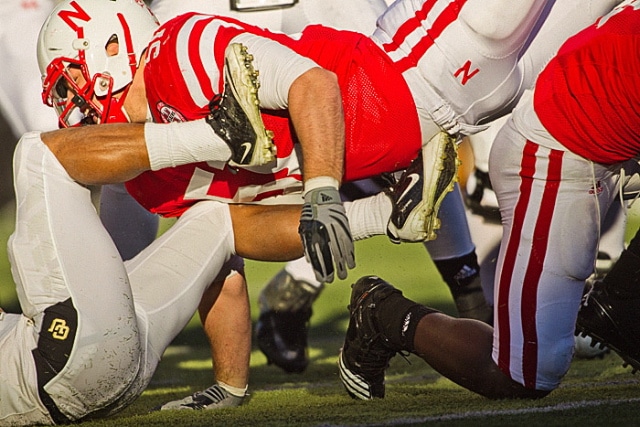
© Ken Jarecke - Nebraska Cornhuskers

Personal memories of experiences shared by generations of Nebraska fans. Sure, like I said, we didn’t really have a choice. There were no other programs, college or pro which could compete for our attention. Choice or not, a community was built. Someone coined the term “Husker Nation” which works well since we’ve now migrated across the country.

About a year ago, as the historic Big 12 conference was starting to break up (historic for no other reason than being born out of the Big 8), I decided to document the Husker’s final season before they moved on to the Big Ten conference.

© Ken Jarecke - Nebraska Cornhuskers

© Ken Jarecke - Nebraska Cornhuskers

Husker Game Day 2010 Book CoverThe resulting 256 page, 12” x 9 1/2” coffee table book, Husker Game Day 2010 – Farewell Big 12 will be going to press in the second week of October. The book is designed and printed in Omaha. My publishing company, eyeQ Press will continue to take pre-orders until Oct. 11 at the discounted price of $49.95. We’re only printing enough copies to cover retail and direct orders and books will be shipped right after Thanksgiving.

You can see work by me from every Husker game this season at www.eyeQpress.com. There’s a link to the shopping cart on the lower, right-hand side of the page. Or you can just click here to go directly to the shopping cart.

The companion book, which I start shooting this weekend in Madison, Wisconsin will document the Husker’s first season in the Big Ten.

When I started this project, I didn’t think I’d be creating my own publishing company, getting a license with the CLC, or driving over 20,000 miles to the games. My goal was to create the perfect book for myself, or perhaps the fifteen year old me who loved photography and football, and it turned out exactly how I imagined.

© Ken Jarecke - Nebraska Cornhuskers

© Ken Jarecke - Nebraska Cornhuskers

I couldn’t have done this without the support of my family. Projects like this keep a person away from home for too long. My beautiful wife Souad keeps our family and home together. I’d be nowhere without her.

Webster Design and Barnhart Press of Omaha have also been very supportive. It’s amazing that one can still produce such a high quality book completely in Nebraska.

Canon Professional Services has been outstanding. If you’re not a member, I would encourage you to become one today.

Be sure to check out the video below where Ken Jarecke goes into even more detail about this incredible, self-assigned project.

Tell us about your Cornhusker Football moment. A play-by-play works or wax nostalgic about what it was like to go to a Nebraska game. Either way, when you comment below, you may win a copy of Ken Jarecke's book, “Farewell Big 12”. Winner chosen on October 7. So, what are you waiting for?

Filed Under: Books, Photography, Photojournalism Tagged With: big 12 conference, books, cornhusker, cornhuskers fan, fans, football teams, footballs, ken jarecke, nebraska, nebraska cornhusker football, nebraska cornhuskers, nebraska cornhuskers football, photography book, photography books, photojournalist, sports, sports in the united states

You Got Extremely Essential Camera Skills?

August 22, 2011 by Seshu | Editor & Publisher

Right around the holidays last year, just about everyone I know bought or received a camera. No, these weren't the point & shoot variety (hey we have our iPhones for that right?). These were DSLR‘s or digital SLR's. The excitement over opening the camera was palpable. I know because I received several emails soon after asking me … “So, I got a DSLR, but my images still suck. Why?”

My first response was always, “did you read the manual?” The silence at the other end was quite telling. Most of us, I know fail to read our manuals. When I bought my first Nikon DSLR, which I believe was the D70, I don't remember diving into the manual either. On the one side, there is a new toy to play with and on the other, my ego was saying to me: “Yeah, I can figure this out. No problem.” That's until I started seeing images I'd be ashamed to show my mom.

Essential Camera Skills TutorialSo, if the manual is way too daunting, or even boring, what do you do? Until today, you could have scoured the interwebs and patched together a bunch of the info that may have helped elevate your game. That too is time consuming and unless you are nuts about photography or pursuing as a professional, chances are slim you would be inclined to curate that information, digest it and then deploy it on your next go around with your DSLR.
Rob & Lauren Lim, the duo behind Photography Concentrate, have just published Extremely Essential Camera Skills. I was one of the few lucky ones to receive a review copy gratis. Having seen some of their earlier tutorials – Photo Editing Skills and Album Design Skills, I knew this one was going to be special.

Think of Extremely Essential Camera Skills as the foundational course you forgot to take when you started experimenting with your camera. It's exquisitely designed – consistent with their other tutorials and extremely engaging website (which you must bookmark). When you open up the PDF, you are presented with a set of colorful tabs for the different chapters such as: The Camera, Focusing, Exposure, Lenses, Depth of Field and Camera Settings. I found the built-in navigation to be very helpful as it makes it easy to skip pages or navigate back to the ones you want to read again.

Extremely Essential Camera Skills Navigation

Unlike other tutorials that teach but fail to train, what I loved about Rob & Lauren's latest offering is that they are serious about making sure you get the concepts they have just taught before moving on to the next chapter. They do this through tips, exercises, videos (more on this in a bit) and pop quizzes. Though it is incredibly thorough, Extremely Essential Camera Skills is not a read it and forget it kind of manual. The lessons you will learn, each one at your own pace, will stick with you for a lifetime. The definitions and demonstrations are easy to understand and absorb.

As a professional, most of the concepts were familiar to me. But that's only because I use my camera every day, so it does become intuitive. Having a guide like Extremely Essential Camera Skills will help you get to that point where you too can easily make images you are proud to show your family and friends.

If there was one area where I could see the authors develop more content, it's the section on using an alternative to that pesky flash that everyone insists on deploying. To their credit they do say this: “The built-in flash on cameras generally sucks.” So true. May we see a sequel to this guide that will dwell on off-camera flash? I hope so, but I do believe this guide will lay the foundation for better images using flash. So, I do urge you to get this one first.

Extremely Essential Camera Skills Videos

The 7 videos by Lauren are fantastic. Her even, conversational tone and excellent examples helped me better understand the concept behind exposure compensation. So, the take aways are many. With Rob & Lauren's permission, I am considering using this guide book for photographers (I really don't want to call it a manual) in the beginning photography class I teach high schoolers. Yes, it's that good and it is perfectly fitted to meet the demands of amateurs and semi-professionals too.

As I have already stated, I received a review copy Extremely Essential Camera Skills and loved it. If you are struggling to use your DSLR, this guide book will help you get comfortable. For the next two weeks starting today, Rob & Lauren are offering a launch sale. You can get Extremely Essential Camera Skills for $29.97, that's 40% off the regular price of $49.99. In addition to the 89-page PDF and videos which you can view on your computer or your iPad, you will receive the Extremely Essential Camera Skills Field Guide, which you can print and tote around while you are photographing.

Full disclosure: As an affiliate, I receive a commission on the sale of this PDF to support Tiffinbox. If you enjoy the content on this site, I ask that you use the links in this post to buy Extremely Essential Camera Skills. Thank you!

Filed Under: Books, Photography, Tutorials Tagged With: camera, camera flashes, camera settings, cameras, digital photography, digital single lens reflex camera, dslr, ebook, essentials, extremely essential camera skills, Flash, guide books, guides, manual, PDF, Photography, photography concentrate, rob & lauren lim, skill, technology, tutorial

  • « Previous Page
  • 1
  • …
  • 4
  • 5
  • 6
  • 7
  • 8
  • …
  • 18
  • Next Page »

Subscribe To Tiffibox Treats!

Looking for a well-curated email newsletter that will leave you inspired and motivated about your photography business? Sign up below!

About Seshu

Seshu creates relaxed portraits of families and high school seniors in Avon, Connecticut. He also leads a successful headshot photography studio in Connecticut, helping professionals from a variety of disciplines project the very best versions of themselves. He created Tiffinbox as a way of inspiring photographers, to create better images and successful businesses. [Read More]

Email Templates For Headshot Photographers

Email Templates for Headshot Photographers

Recent Posts

  • How Capture One Changed My Event Photography
  • 10 Steps To Stay Positive In Times Of Great Stress
  • Why You Need To Read “Personal Branding For Photographers” Now
  • How To Master Your Website Content Step By Step?
  • Tony Taafe’s TNT Method For Headshot Photographers

Recent Comments

  • Stephen Davison on Are You A Business Owner Who Is Smart, But Stuck?
  • Ben A. on Don Giannatti Clinches The 8th Annual Tiffinbox Award
  • Dan on Don Giannatti Clinches The 8th Annual Tiffinbox Award
  • Donald Giannatti on Don Giannatti Clinches The 8th Annual Tiffinbox Award
  • Stephen Davison on G.E. Masana’s 6 Strategies For Wedding Photography Success
  • Naveen Kumar on Weddings In India Are More Than Being At The Right Place And At The Right Time
  • kartick on Weddings In India Are More Than Being At The Right Place And At The Right Time
  • Leonid Farbman on 6 Uncommon Trends To Grow Your Photography Business
  • Willow and Finch Wedding Photography on 11 Reception Tips To Help Your Wedding Photography
  • Web Designer Malaysia on How To Optimize Your Squarespace Website For Search Engines
  • Creastan on An Interview With Photojournalist G.M.B. Akash
  • Cindy Brown | Atlanta on An Open Letter To A Local Photographer

Become a Patron!

Copyright © 2026 · Tiffinbox · Site Design by Heather Mackan Creative · Built on Genesis