• Photography
  • Interviews
  • Business
  • Reviews

Tiffinbox

Inspiring Photographers

  • Home
  • About
  • Blog
  • Contact

“Upstate Girls,” A Project By Brenda Ann Kenneally, RIT & The Visual Studies Workshop

July 8, 2013 by Seshu | Editor & Publisher

I love how connected the photojournalism world is. A few weeks back, I interviewed Chicago Tribune photojournalist,Scott Strazzante for his project, “Common Ground” (which, by the way was funded). Following his Twitter stream, I noticed a Tweet about Brenda Ann Kenneally‘s project, “Upstate Girls.”

Figuring he knew her, I sent him an email requesting him to introduce us.

A few days later, I heard from Brenda and so, what we have here is a frank chat about her nine-year project that follows the lives of two adolescent girls in Troy, New York. The project is now a collaboration with the Rochester Institute of Technology and The Visual Studies Workshop.
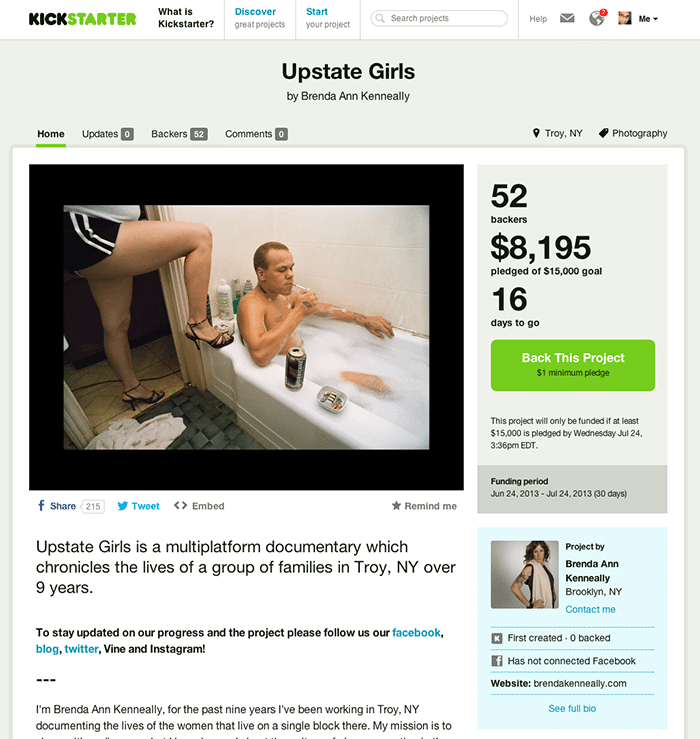
Upstate Girls by Brenda Ann Kenneally

Please do watch and listen to Brenda, as she describes how and why she started this personal photography project:

“The Upstate Girls Project is not only a document of the America that we all share with these women, but more importantly a story of the emotional connections that are universal to being human.”

It probably seems that week after week, I am here asking you all to support the work of yet another documentary photographer. The fact is this – newspapers and magazines are flexing their accounting muscles and shuttering entire photo departments or downsizing them to a point where community stories (that's stories about us) aren't narrated anymore.

If you find the work of Scott Strazzante or Brenda Kenneally personally moving, then step up and do something about it. These two (and trust me there are many more) are so passionate about pursuing long-term photography projects that by doing so tehy bring meaning into the lives of their subjects, for themselves and to the community as a whole, when their stories are shared with us all.

Brenda has 16 days to go before her Kickstarter caampaign closes. She has a little over $7,000 to raise to hire a web designer that will bring these gutsy stories to all of us online.

However small or big, can I count on you to make a contribution?
Filed Under: Video Interviews Tagged With: A Project, Brenda, Brenda Ann Kenneally, photography project, project

Why It Is Essential For Photographers To Learn To Write Persuasively

July 1, 2013 by Seshu | Editor & Publisher

I struggle to write. No, it's true. Given the choice between writing a paragraph and finding an image to photograph in a bare 200 square foot room, I'll choose the latter any day. That's just the way my brain works.

I visit many blogs each week. If they are any indication, I suspect other photographers are very much like I am; choosing to publish images more readily than text.

But it doesn't have to be that way.

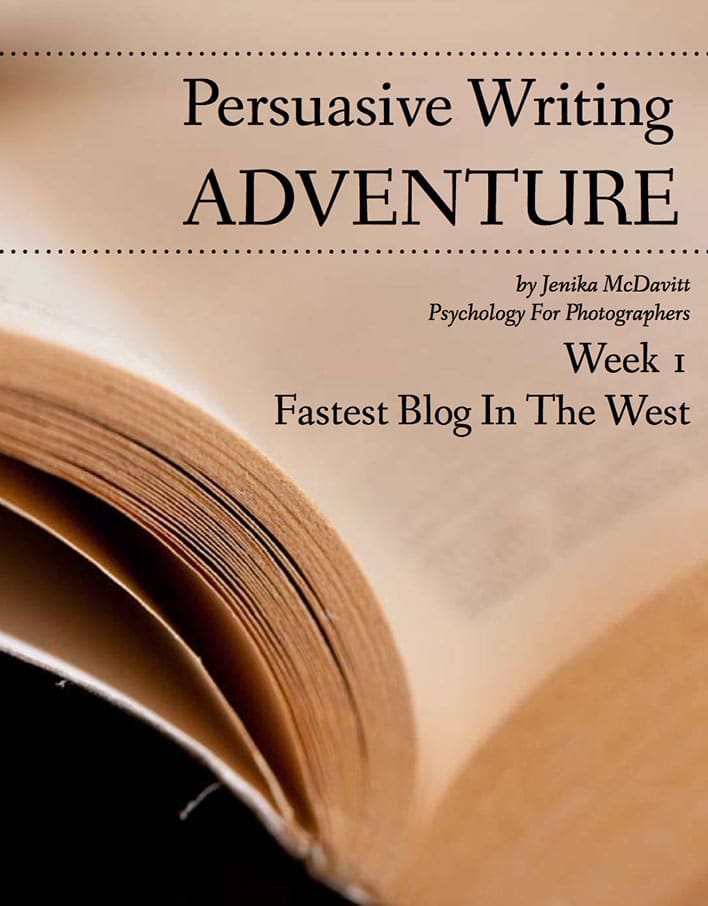
When Jenika McDavitt of PsychologyforPhotographers.com posted an invitation to join her for four weeks to learn to write persuasively, I jumped at the chance to learn from her. Perhaps you feel you could use a bit of a lift too.

Writing Persuasively - A Course By Psychology For Photographers

Why am I recommending this course? Let me be wholly transparent with you and say that I gain nothing more than good karmic brownie points. No money has been exchanged and in fact, when I signed up for , I paid the full price.

Like Tiffinbox, Jenika runs a “Top 10” photography blog that I have come to respect. Her course “From Portfolio To Profit Engine: How To Build An Absolutely Irresistible Photography Website” is something I have recommended (as an affiliate partner) in the past because the systems and strategies she teaches has borne results for scores of photographers. Read more about it here.

So, why is it essential for photographers to learn how to write? Isn't it sufficient to take amazing images and post them to our blogs or websites and have our “art” do all the talking? Good question.

Sorry to break your bubble, though. Your images have to rock. No doubt about that. But something amazing happens when you marry your images with powerfully engaging text. When images and complimentary text are both presented, the value of that work goes up. Still not convinced? When was the last time you picked up a National Geographic magazine that was nothing but images in it? Yeah, probably never.

Want another example? It's probably not very obvious, but Spencer Lum, Zack Arias, Joe McNally, and David Hobby are great photographers. Guess what else they have in common? Yep, fantastic images AND blogs with very descriptive and in-depth posts.

The other, perhaps more obvious, reason you should learn to write is because you may want to rank higher in all the search engines. They weigh text much more heavily than images when making their decisions on where you stand compared to your competition. Want to beat your competition: write.

Ok, back to Jenika's course on writing persuasively. It starts on July 8th and wraps up on August 2nd. Registration, though, closes on July 4th. She and I recently riffed on the subject of photographers and writing in this video below:

So, why not sign up to take this course with me? At the time I wrote this post, there were only six remaining seats left.

Here's what's included:

– 4 weeks of writing instruction, delivered via PDF once a week
– 2 Skype Writer’s Dates with Jenika
– 2 Short Writing Assignments (e.g. website pages or blog posts) edited by Jenika
– Private Facebook group for after-hours help
– Surprise gifts & in-group contests

All that with a total value of $836. You can, however, sign up for this course for only $399. But knowing how quickly those 8 seats were taken (yes, she will only work with 14 of us), I wouldn't wait any longer if you feel a course on writing persuasively will elevate your profile online and help you beat out the competition (who will invariably continue doing what she/he always did before, which is to simply photograph and post those images up on their sites).

Hopefully, I've managed to persuade you [grin], but it's totally your call!

Filed Under: Home Middle Right, Photography, Writing Tagged With: Jenika, Learn How To Write, Learn To Write, Photographers, Writing Persuasively

With Preveal, Photographers Can Now Show & Sell Images Easily

July 1, 2013 by Seshu | Editor & Publisher

If you are a regular reader of this blog, you are likely a semi-professional or professional photographer. That means you are either looking to make a living at photography or already are making a living at it one way or another.

If that's the case, you probably don't need to be told how crazy and competitive things are in the industry. You have two choices – continue going about your business and eke out a living or find a way to stand out so much that you can't be missed and you are the obvious choice for most people in your community.

How do you stand out in a crowded marketplace? Focus on these two words – customer service. A popular post here already discusses why giving away your images on a CD or DVD is terrible mistake. What's been forgotten by a lot of photographers is that we are in service of our clients – from the moment they call you on the phone till it's time to deliver their images to them.

It was when I spoke with Chris Scott of Preveal recently, that he hit home the idea that to truly serve your clients you need to be their guide all the way to that point where you even help them hang their images on their walls. Taking them through all of their options where they get to enjoy and experience their images every day should be your ultimate goal.

Here is more of my chat with Chris. He touches on the exciting new features that have been added to the next version of his iPad application, Preveal, that launches on July 8th. More importantly, he showed me how photographers can benefit by using Preveal in their own businesses, to show and sell images that their clients want for their homes.

Now, Preveal isn't inexpensive ($74.99), but I am going to take Chris' word that photographers like you and me can easily make double or triple what we are making by using this application in service of our customers. You see, that's an important point to highlight. It's not merely a tool to show of your work or to make selling easier. There are portfolio applications that do that just fine.

What Preveal does and does very well is it provides your clients a visual facsimile of what their own images can look like on their own walls. You will agree this is extremely powerful as it takes the guesswork out of the sale and ultimately reduces and eliminates the perceived risk your clients are likely to harbor when doing business with you.

When you know as plain as day what you can expect to receive from your photographer, what client isn't going to see it as a big win for them?

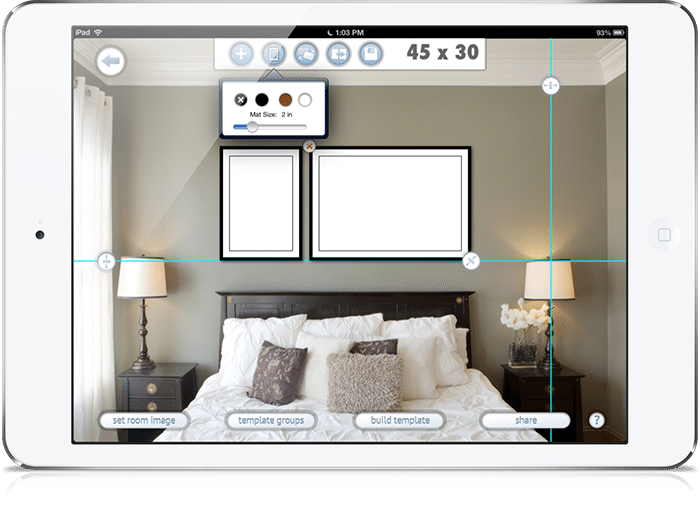
Use the application to show your client's images with frames or as canvas prints:

Preveal Version 3 | Guides & Frames

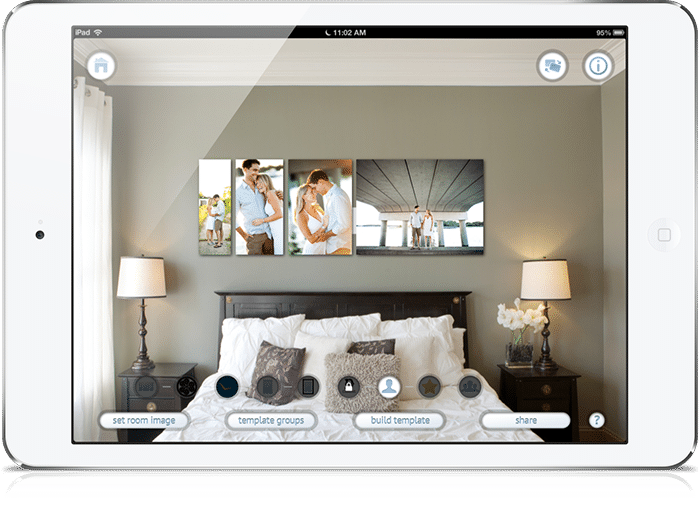
Here is an example of finished canvases in a bedroom:

Preveal Version 3 | Finished Canvases In Bedroom

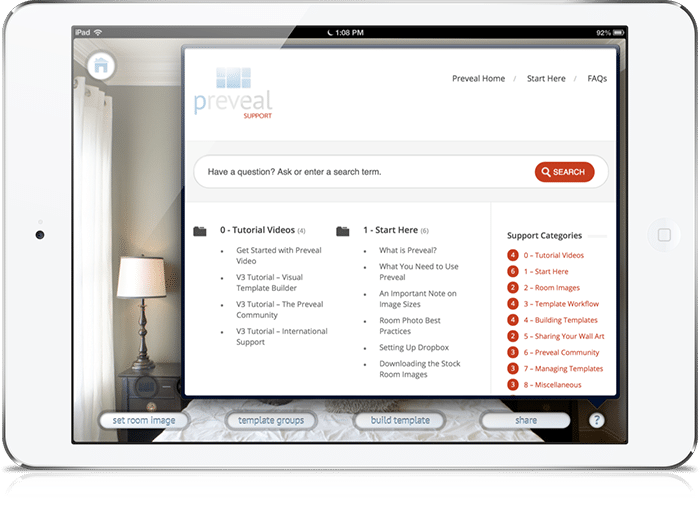
If you ever get stuck, help and support is built right into the application (yes, with links to videos showing you how to use the features):

Preveal Version 3 | Extensive Help & Support In Application

I twisted Chris' arm to give away two redemption codes for two lucky commenters below. Before you race off to type anything below, please first vote for Preveal on PPA Magazine‘s website.

Preveal Hot One Award

As a pioneer in this industry, I feel it is Preveal that totally deserves to win the Hot One Award for Best Mobile Business App. Voting ends on July 7th and you can vote daily.

Preveal LogoOnce you have voted, come back here and tell me a little bit about yourself and why winning one of two redemption codes will mean the world to you and your business. Please do not forget to include your email address as that's the only way we are going to be able to notify you. Good luck!

And do remember, version 3 of Preveal launches on July 8th. If you buy Preveal today, updates via iTunes are always included.

Filed Under: Business, Photography, Web/Tech Tagged With: Chris Scott, client, iPad, Photographers, Sell Images

The Power Of Photographs To Prime Emotions

June 27, 2013 by Kavetha Sundaramoorthy

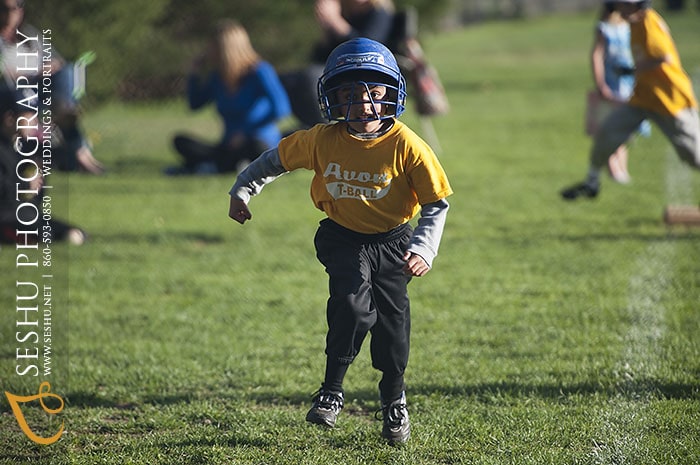
© Seshu Photography | Running Bases At Sperry Park In Avon, CT

What is the purpose of life?

Spirituality and philosophy have been trying to answer this question for centuries, so I don’t pretend to have a quick answer. I certainly don’t know what comes after life or why humans were made to exist.

But having worked as a psychiatrist for the past decade, I can tell you this: the one thing that gives meaning to life, in the here and now, is connection. Especially the connections you create with your immediate family.

Although we often hear about how one should behave to create closeness with loved ones, the field of psychology hasn’t done a good job of teaching families how their home environment can also make or break family bonds.

Why is this important? Because, our environments prime our moods.

You see, our brains tend to pick up things in the environment and incorporate them into emotions almost unconsciously. For example, studies have shown that when people are in a room where, among many things, there is a computer with an image of money as a screen saver, we tend to become more self centered and less likely to help someone out. This is even when we have no conscious recollection of a monitor in the room!

In another example, a British University cafeteria kept an honesty box next to the coffee machine. The idea was that anyone who took a cup of coffee would be trusted to pay for it. A study then found that if a small image of a pair of eyes “watching” was placed above the coffee machine, more people tend to pay up!

If the power of an unconscious visual cue is so great on our self image and behavior, imagine how powerful real images, such as family photographs, could be?

Dr. David Krauss, PhD has spent his life researching the ways photographs influence self image and family dynamics. Here are some of the ways:

I Matter: He says when parents choose to display pictures of their kids at home; it sends a powerful message to the children that they matter. They sense that their existence is important to their parents. After all, wall space is limited, and what you choose to give it up for says a lot about your priorities right?

I am growing: Photos often create a visual narrative of time. Children will enjoy seeing themselves growing up across the wall! This reinforces a healthy self image. I once had a nine year old patient tell me “When I look at all my photos at home, I know that even the worst thing will soon be okay and I’ll still make it and keep growing.”

I am loved: There are times in every family when the daily rush of life takes over and days go by with no time to express your love. But as we saw with the priming example, photos can be unconscious reminders, reassuring us even when words and actions are temporarily absent. In fact, a study by Open University found that people felt 11% happier just by looking at a photo of a loved one (TV, alcohol and even music didn’t have such a big impact!). And who wouldn’t like to feel 11% happier in an instant? I know I would!

I belong: Whenever I go back home to India, my siblings and I spend a lazy afternoon with my grandmother, looking through photos of the past fifty years, all the way from my great grandparents to today. It’s amazing the stories that come out of these sessions. And amidst the talking and laughter, I recreate my cultural roots and relearn family traditions. Knowing where you came from is very powerful. As much as possible, cherish your time this way with your older relatives and pass this gift on to your kids.

I can: There is a negative voice in everyone’s head that often makes us doubt if we are capable enough for something. Whether it’s to try out for the school drama or to work up the nerve to ask for a promotion, we all need reminders that can prime our brains to recall potential. Photos can be a rich medium for this.

Imagine having a picture of you climbing a mountain, graduating from college, proposing to your partner or your kid hitting a difficult shot; anything that truly took guts and skill. What a powerful reminder of potential that would be right?

So, these are all the ways in which real photos influence who we are.

But what about digital photographs?

With the ease of modern smart phones, we are all taking more photos than ever. Which is wonderful. But sadly, most of them are quickly forgotten in a computer drive or in your camera’s memory card.

Photos that don’t get looked at or talked about are almost useless. They lose their whole purpose.

Today, I invite you to take a look around your home. Does it make you feel happy, loved and connected? I look forward to hearing your thoughts below.

Kavetha is a psychiatrist who is passionate about all things brain/psychology related.

Filed Under: Photography Tagged With: emotions, Family Photographer, Fulfilling Life, photograph, Photograph Display, Prime

How Photographers Can Get A Grip On Their Expenses And Create A Profitable Business

June 25, 2013 by Jason Aten

Jason Aten is a photographer and the author of Starting Out Right: Building a Profitable and Sustainable Photography Business. In addition, he is the CEO of NinetyNine Beans, which provides Full-Service Accounting for Photographers. You can read more posts like this on his blog: www.startingoutright.net

Some of the most common questions asked by photographers are: how much should I charge? How do I set up packages? Should I do packages or a la Carte pricing? These are all great questions. They are important questions. Often, though, the problem is that this is the first question a photographer is asking – before they ask some other, very important questions.

Numbers

The first question I encourage people to ask themselves is this: how much does it cost you to be in business? I know it's not necessarily as sexy a question – and it's a hard one to answer – but it's impossible to really start figuring out things like pricing and packages, without a good grasp on the answer.

Do you know how much it costs you to be in business? Do you have a system in place to track your expenses? Surprisingly, even though they are running a small business, many photographers don't have a good system in place. In my business, I TRACK EVERYTHING. I want to know where my money is coming from, how I spend it, and whether or not it helps – or hinders – the business.

Start by tracking your expenses. Start with the expenses you have, whether you photograph anything or not. These Fixed Expenses include things like Administrative Expenses (insurance, supplies, training and education, etc), Capital Expenses (new gear, large purchases that you depreciate, real estate, etc), Advertising Expenses (website, business cards, marketing materials, bridal shows, etc), Overhead Expenses (utilities and expenses related to a physical space like electricity, gas, etc), and Employee Expenses (wages and benefits for all non-sales related employees).

Next, track all of the expenses that go into the products and services you offer. In addition to what the lab charges you for an 8×10, this includes all of the expenses that go into SELLING and PRODUCING a product. These are your Cost of Sales Expenses, and include things like the wholesale cost from your lab, design charges, editing and processing expenses, shipping, sales related labor, retouching and travel.

Understanding these two types of expenses will give you a good idea of what it will cost you to be in business – which gives you a good idea of where to start when thinking about pricing for a profit. It seems like a lot of work, and it is, but its worth it.

Second, develop a system to help you keep track of revenue and expenses on an ongoing basis. Even if it's just a simple spreadsheet – that's better than nothing. There are some great tools available, including Quickbooks (and their online version). My personal favorite is Kashoo, which makes it super easy to input transactions, track expenses and generate really useful reports you can use to make decisions about your business. Many of the photographer-specific Customer Relationship Management tools (like ShootQ and others) have features that make it easy to keep track of your revenue and expenses.

Whatever system you choose, using it will only be as useful as the effort you put in. Make a commitment to understanding the financial health of your business by getting a grip on your numbers. Understanding what it takes to be profitable and sustainable means that you can make decisions that help your business grow – and add value to your life.

By the way, once you're using a system to track your expenses, it becomes easier to measure your performance. The Professional Photographers of America publishes benchmarks to help you measure the financial health of your business. Those benchmarks are designed to help every photographer take home 35% of their gross revenue as owners compensation and profit, and can help you evaluate where you may need to make changes in your expenses.

Finally, it's worth it to hire a good accountant that understands your needs. Someone who knows small businesses and can help you set up a plan – and stick to it. Accountants aren't just for saving money at tax time! A good accountant can make you money all year long by helping you know exactly where you stand. Having an accountant can mean having a trusted financial advisor on your team, helping you make the right financial decisions for your business.

Want to know more? We're hosting a free webinar this Wednesday designed to help photographers “GET A GRIP ON THE NUMBERS: Bookkeeping Basics for Photographers.” Simply visit www.ninetyninebeans.com/webinars to sign up for FREE.

Filed Under: Business, Photography Tagged With: Administrative Expense, Capital Expense, Expense, Expense Insurance, Fixed Expenses, Overhead, Overhead Expense, Photographers, Pricing, Track Expenses

Eye Am, A Global Photography Project For Children

June 24, 2013 by Seshu | Editor & Publisher

When Jens Lennartsson, a Swedish travel and commercial photographer turned 30, he struck upon an idea to create a movement around the world that would empower children in some of the poorest countries in the world to tell their own stories.

Visually.

Jens is joined by Sara Hansson, also from Sweden, in this new global photography project called: Eye Am.

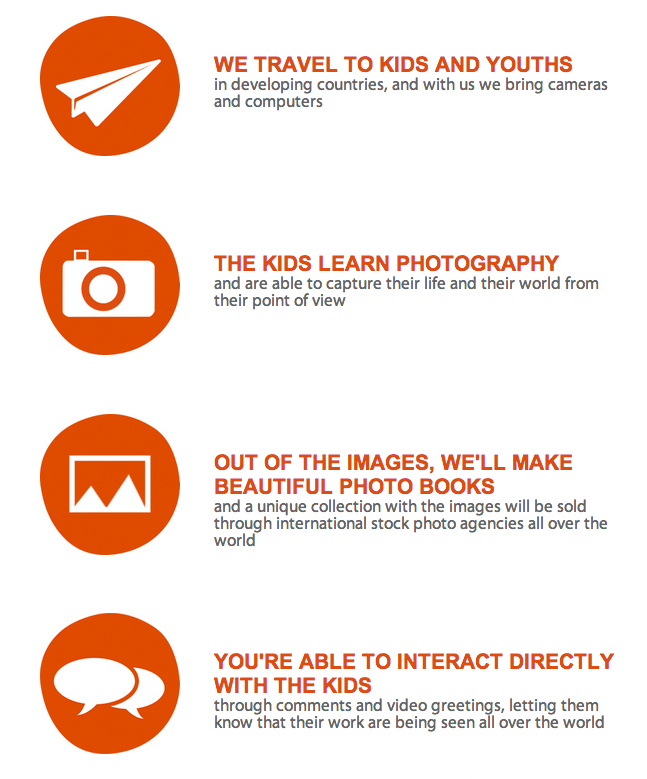
“By doing two week photo workshops, we teach kids in developing countries how to photograph, giving them the opportunity to show their life from their perspective, instead of just letting media tell their sometimes flat and generalizing story. And together with you, we create a more realistic view of the world.”

Jens and Sara sat down with me yesterday to talk about their project. Please check out this video below:

Eye Am Process

Lennartsson and Hansson are seeking to raise $33,000 in the next 12 days for this project. They want to be able to buy 20 cameras (and accessories like memory cards) and also computers that these young photographers can use in the field to process their images. These devices will be used in all three locations – 1) Renl, Ukraine, 2) Addis, Ethiopia and 3) Nairobi, Kenya

So, here's why this project appealed to me and I am helping Jens and Sara spread the word.

First off, I am from India and from what I have seen in the nearly 45 years of my existence, the images of India seen by those in the US are largely by non-Indians. While it's true they brings their unique perspectives and skill sets to capture images of either daily life or strife, there is nothing like reading, hearing or seeing the story unfold from the perspective of a local inhabitant. There are nuances that outsiders may simply miss that highlights the actual situation on the ground.

After years of being offered only a one-sided view of a situation, isn't it time we saw the world from a different, and thus, enriched perspective? By asking children to take part, we can be hopeful that their sense of spontaneity and living in the moment will garner us a fresh look into their lives and perhaps more importantly give those children a way to boost their confidence and appreciate themselves.

Whether it is the Ukraine, Ethiopia or Kenya, these kids are going to have an incredible ride into discovering who they are, for themselves. This project appeals to me because I am a father of two young boys who, given the opportunity, love to express themselves in sports, music and the visual arts. As a photographer, this is a no-brainer: we need to foster visual literacy among our young so that they in turn can continue to the tradition of recording and interpreting the world around them.

Learn more about this project and to support it, check out Eye Am's IndieGoGo's campaign page. I ask that you take a moment now to go to that page and give what you can.

Filed Under: Photography Tagged With: Eye Am, Global Photography, Jens, Lennartsson, photography project, project, Projects For Children, Sara Hansson

Interview With Documentary Landscape Photographer, Marc Wilson

June 19, 2013 by Seshu | Editor & Publisher

Working in the genre of documentary landscape photography, Marc Wilson looks at the memories and histories in the landscapes that surround us, and man’s interaction within it. He has exhibited in many solo and group exhibitions, both in the UK and internationally; in Milan, Grenoble and New York. Exhibitions include: The Terry O’Neill Award, 2013, The Royal Armouries Museum in Portsmouth and Leeds, the inaugural solo shows at the Back Hill and Now Showing galleries (London), a solo show at Focal Point gallery, Southend and group shows at Art 2001, Photo2005, The Photographers Gallery, The Association of Photographers gallery and Lucy Bell Fine Art.

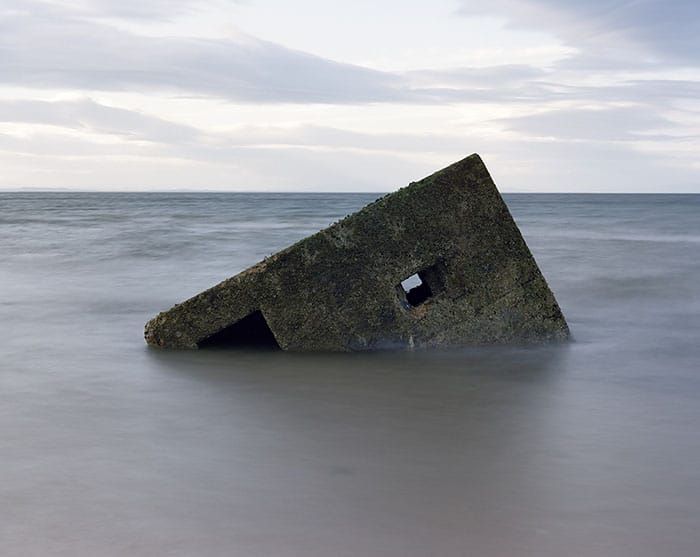
Findhorn, Moray, Scotland. 2011

An Update From Marc Wilson:

“To coincide with the 75th anniversary of the end of WW2 I am this year publishing a 3rd edition of the photo book The Last Stand. The first 2 editions sold out and having the publishing rights back means I am able to make this 3rd edition in a different format with a number of new images and new design.

This new smaller softcover format also makes it more affordable which is something I’ve always wanted to do with this book in these later editions.The new version will start at only £25 but is currently £20 during the pre-order. There are print and special editions options also.”

Throughout all of my photographic work, I feel it is important to create visual reminders of our histories and the stories they contain.

These visual markers then give us the trigger for story telling and remembrance…which is ever more important as the number of individuals who lived through these histories grows ever smaller each year.

In many cases, the photographic document will become the only visual record of these places and the connected stories as many defences are subsumed by sands or water, or some even, pulled down and removed.

Many people whom have bought the book of the work have told me how they now have, or wish to, visit these places.

For all of these reasons I feel driven to make work like this, work that I hope triggers discussion, storytelling, inquisitiveness, remembrance and thought.

Pre-order the 3rd Edition here.

You are called a ‘documentary landscape photographer' – is that a term you came up with?

I can’t remember where I read the expression first but it was about five years ago I think. I had always struggled slightly with describing my work as it did not seem to fit into any conventional genres but the term ‘documentary landscape’ desribed it perfectly.

Do you feel your work echoes the work of those landscape photographers who have gone before you or do you think your work stands on its own?

My work is very subject specific in that I seek out particular objects and structures within the landscape and the stories behind them, as opposed to either the urban sprawl or the greater landscape itself. The landscape does though play an integral role in my work, as both the background and container for the subjects. Whilst it could be seen to have echoes of the work of John Davies and Stephen Shore it probably more closley echoes the ‘New Topographics’ work of photographers such as Joe Deal and Robert Adams.

If you were to pay homage to any one landscape photographer, who would it be?

It would have to be John Davies … not a traditional ‘landscape’ photographer of course but I do find his work of ‘our landscape’ very inspiring and images that I can return to again and again, I think because of the human interaction found within.

Tell us about The Last Stand. What motivated you to start that project?

The seeds of the work came out of an older piece of work I produced called ‘Abandoned’ in 2003. Two locations in this work had military significance and I found myself returning to them (visually) and wanting to explore the subject matter further, and the more I did the more important it became to me that it was a story that I felt compelled, as a photographer, to tell. The work then became self motivating with each location visited and story told.

What have you discovered about yourself the most as you have gone through this project?

This work has really made me realise how important a photographer can be … not of course in terms of him or herself but in the subjects that they document, the stories and memories they have the ability to tell, and the importance of this. As a photographer I have a great responsibilty to tell these stories and the weight of that is what drives me on. The idea that work I produce is seen by others as ‘vital and important’ is a wonderful feeling.

Do you identify yourself as a photographer or an artist or is it a combination of the two?

I used to call myself a photogapher, then when I started working commercially I tried to separate the two strands into ‘photography’ and ‘art’ but today I am really quite comfortable with just being a ‘photographer’ and not trying to justify any diffeence to myself (or others). At the end of the day it is just a label but a bit of definition is no bad thing. I think the comfort of the word ‘photogapher’ has come as I feel more confident in the work I do and its place in society.

Studland Bay I, Dorset, England. 2011
Studland Bay II, Dorset, England. 2011
Newburgh I, Aberdeenshire, Scotland. 2012

Newburgh II, Aberdeenshire, Scotland. 2012
Les Landes, Jersey, The Channel Islands. 2013
Reighton Gap, Yorkshire, England. 2012

Cramond Island, Firth of Forth, Scotland. 2012
Findhorn, Moray, Scotland. 2011
Lossiemouth I, Moray, Scotland. 2011

Lossiemouth II, Moray, Scotland. 2011
Sainte-Marguerite-sur-mer, Upper Normandy, France. 2012
Wissant I, Nord-Pas-De-Calais, France. 2012

Wissant II, Nord-Pas-De-Calais, France. 2012
Hayling Island, Hampshire. England. 2013
Torcross, Devon, England. 2011

Loch Ewe, North West Highlands, Scotland. 2012
Spurn Point, Yorkshire, England. 2012
Arromanche -les-Bains I, Normandy, France. 2012

Arromanche -les-Bains II, Normandy, France. 2012
Brean Down II, Somerset, England. 2012

If there was one museum where you would like your images to hang permanently which one would it be and why?

It’s probably no great surprise but I think for The Last Stand it would, in the UK, have to be the Imperial War Museums. Simply that it seems the most appropriate venue to hold the images on a permanent basis.

Your images are quiet. They are devoid of humans, yet are full of suggestions that humans have inhabited that particular place in some interesting ways. Even your portrait say more about the space your subject takes up than the subject themselves. Is this your mission? If not, what are you trying to say.

In terms of this particular work it is very important for me to make sensitive and subtle images that are respectful of the memories I am depicting. There is no need to add ‘photographic glamour’ to these subjects. I have always been interested in the memories and histories that the landscape and objects within it can hold. To me the suggestion of human presence is what holds my interest more so than a physical presence. I feel it allows a wider audience to imagine themselves in these places. I think that is where my work differs from more traditional documentary photography and photojournalism. It is telling these same stories but in a different way and allows me to look at historical work.
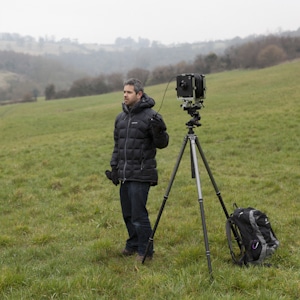
As for my portrait, I guess I set it up in the same way, without really realising it!

Marc WilsonI see you are using a 4×5 (or it is 5×7) view camera for your work in The Last Stand. Is that your first choice for your commercial work as well? What is it about his particular format that you like so much?

It is just the most appropariate format for the work, allowing the rise and fall that I need for the ‘architectural’ elements within the images and also the large film giving quite beautiful and subtle prints. It also works best for the quiet, sensitive and considered approach the work requires. Commercially I shoot digitally but still using shift lenses.

How did you get your start in photography? And, why have you spent a good deal of your own money pursuing documentary projects? What compels you to do what you do?

I studied Sociology at University and my final dissertation included elements of image making and photography and from there my love for the medium grew. I then went on to study at both degree and MA level. I spent some years teaching before starting to work commercially also about 7 years ago. It was only about 3 years ago that I felt I had ‘earned the right’ to start working on these projects again.

To me the story is everything. It is very difficult to get commissioned to produce this scale of work so the funding has to come from somewhere, in this case a combination of self funding and crowdfunding. The first stage of the work I funded 70% and crowdfunding 30%. This second stage will be more the other way round. My hope is that this work will go on to fund the next through print sales and books. (I am starting discussiosn about a printed book of the work very soon).

That said I am currently in the very early stages of discussion about continuing The Last Stand outside of Northern Europe and away from the second world war so it can happen.

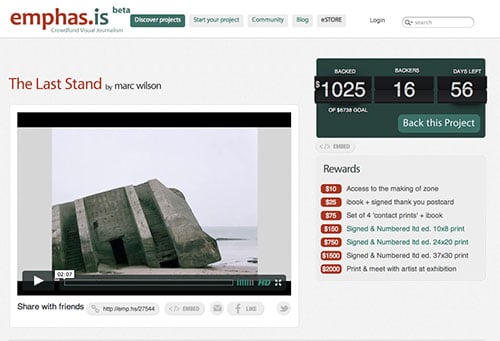
If this project by Marc Wilson resonates with you, please consider supporting his project, The Last Stand. You can make a donation here on this emphasis page.

Marc Wilson's The Last Stand Documentary Landscape Project On Emphas.is

Filed Under: Documentary, Featured Post of the Day!, Interviews, Photography Tagged With: Documentary Project, John Davies, Kurt Markus, Landscape Photographs, Last Stand, Marc Wilson, The Last Stand

Why You Should Buy Angela Pointon’s E-Book – “Worth More: A Simple Way To Create The Photography Brand, Pricing and Packages That Command The Money You Deserve”

June 18, 2013 by Seshu | Editor & Publisher

Do you ever wonder what your value proposition is to your potential client? In other words, what do you bring to the table that your “rightest” client will eat up and then thank you for it by paying you what you are really worth?

It's a simple question. But it's not so easy to answer or explain. Thankfully, Angela Pointon of Steel Toe Images has a new book out called “Worth More: A Simple Way To Create The Photography Brand, Pricing and Packages That Command The Money You Deserve.” [affiliate]

Long title, I know.

I just got done reading an advance review copy and I have to tell you the worksheets and exercises she puts you through are the very first steps any photographer must take to create a sustaining and successful business. It's critical that you define who your clients need to be and then work through your pricing and packaging that meets your target client's expectations. There is really no better way to synchronize your values with those of your clients.

From Worth More: “So we’re going to figure out your ONE awesome thing by conducting another written exercise. And honestly, there’s a chance you’re not doing anything awesome right now.”

When things are in sync, you get to make a living at something you love to do. No one can or should deny you that, especially you. So, here is what I am urging you to do. Watch this video below. Based on what you hear from Angela, figure out if you ant to be a thriving photographer or a struggling photographer. If it is the former, buy Angela's book. It's on sale from today through June 23 for $79. It goes up to $99 after that date.

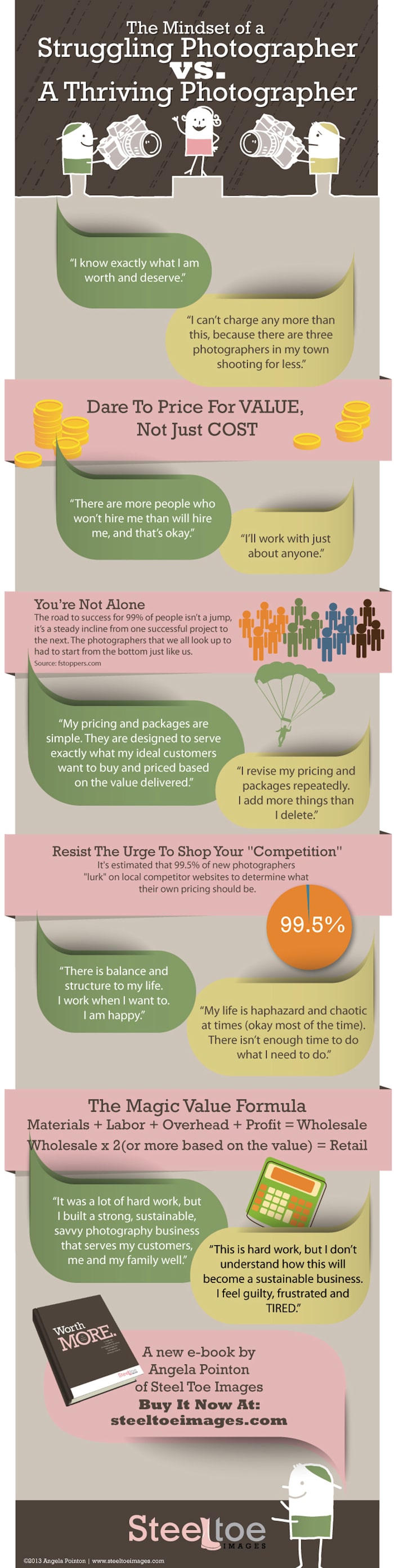
Angela also sent me this infographic that allows you to compare the two different photographers in the world: thriving or struggling –

Worth More By Angela Pointon

Now, let me be very clear about one thing. As I read through the e-book, Angela wants you to complete exercise after exercise so that the answers guide you to some startling and positive conclusions. If you are the type that buys info products and just sits on them, don't buy this book. That would be a sheer waste of money. However, if you are open to trying new things and actually doing what Angela prescribes, I'll guarantee that you will see incredible results.

So, why should you buy Angela Pointon's e-book? Very simply, reading it and doing the exercises will be transformative (with a little elbow grease) for your bottom line. Imagine not having to struggle to find the “rightest” clients. Imagine having time to spend with your loved ones. Imagine being able to create a nest egg that keeps growing. All because you spent a few hours gaining some much needed clarity on whom you want to serve and why.

For me saving $20 is still something. I'm going to bet it is for you too. So, get the book before the price jumps on June 24th.

Filed Under: Books, Marketing, Photography, Photography Business Tagged With: Angela, brand, Photography, pointon, Prices Packaging, Pricing, Worth, Worth More

Scott Strazzante Finds “Common Ground” In His 14-Year Personal Project

June 12, 2013 by Seshu | Editor & Publisher

It was first at Ohio University, where I was briefly working on a graduate degree in Visual Communications, that I came across the name Scott Strazzante. This was some 13 years ago.

Scott Strazzante | Common GroundRight around that time, Scott, while at the Chicago Tribune, began a personal project that he pursued on his own time. That documentary project, called Common Ground, explores the challenges farmers Harlow and Jean Cagwin face in rural Illinois.
The story takes an incredible turn when in 2002, the Cagwins lost their home to urban sprawl and a new subdivision. But Scott didn't stop making images then. A chance meeting in 2007 of Amanda Grabenhofer, who now lives in that subdivision, prompted Scott to continue the project by photographing her and her family.

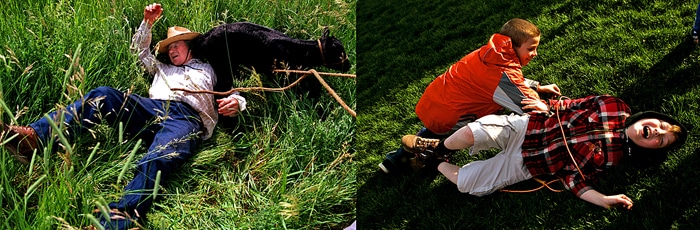
If you ever doubted if history repeated itself, all you have to do is see the wonderful diptychs that Scott, with the help of Mike Davis and Deb Pang Davis, has created of life on the farm when it existed and life in the new subdivision that overtook that farm.

Scott Strazzante | Common Ground Diptych

“Echoes of the Past” – In 2002, Harlow and Jean Cagwin left their 118-acre cattle farm in Lockport, Illinois to make room for the Willow Walk subdivision. Five years later, Ed and Amanda Grabenhofer and their four children have settled in at the end of Cinnamon Court. This series compares and contrasts these two very different ways of life on the same piece of land.

As Scott so eloquently says in my conversation with him (see video below), this project isn't a political statement of any kind. It leans more gracefully on the art side of things, where we are gently cajoled into experiencing disparate lives, lived on virtually the same place, or common ground.

Scott Strazzante is well on his way to publishing a book, thanks to this Kickstarter campaign. He has 21 days to go to raise $42,500.

I am asking you to back this project, to show your support of long-term, personal projects that photojournalists like Scott are doing simply because they feel compelled to share with us the world they witness on a daily basis. When I watched the campaign video, I knew right away that this was a very special project.

Scott and I have never met in person, but it's easy to discover the man's commitment to photojournalism and his love for narrating visual stories of everyday life. I applaud him for going the distance, completing this project and publishing this book, Common Ground.

Filed Under: Uncategorized Tagged With: Common Ground, Documentary Project, personal project, Scott, Scott Strazzante

A Candid Interview With Wedding Photographer, Laura Novak

June 11, 2013 by Seshu | Editor & Publisher

I watched a video recently by Laura Novak, a wedding photographer, about the one secret ingredient she uses in attracting the right wedding clients for her business.

So, watch that video first:

The video inspired a few questions in my mind and so I hopped on over to Twitter where I asked Laura for some clarification:

TB: In your recent video, you recommend e-sessions with wedding collections and offer it as a complimentary service. Do you then present those images from that session as part of your collection as well when it is time to send the files to the client (assuming you give files to clients)? Or, do you create products from the e-session that the client has to buy first to receive those files?

LN: I highly recommend creating products from the engagement session that you can sell to the client afterwards. Many of my clients purchase loose prints, save the dates, framed images for display at the wedding reception and albums. For example, how cute are these overlays from Design Aglow? All you need to do is take their favorite photo, place an overlay on top and add the wedding date. Done and done!

I always provide wedding and engagement files with the client's finished wedding album, so considering that is usually a year or more from the time of the engagement session they are pretty far away from receiving the files. Typically my clients are looking for products to purchase immediately after the engagement session to be part of their wedding.

Another great idea would be to show and sell a sign-in board. Brides and grooms love these! I really like the designs over at Design Aglow as well. 

TB: So what you are saying is, you would structure the collections to include a complimentary e-session, but the only way they can get the files is if they invest in $xxxx. I am worried some may see that as a bait and switch. Thoughts?

LN: Most of my wedding packages (the ones 10k or more) include all the engagement and wedding files with the finished wedding album. Because I state that up front, all of my clients know this and it is no surprise. Most people ask about files during the initial interview, so it gives us a chance to have a good conversation about it. In addition, that information is very clear right in the first page of my marketing materials.

Laura Novak | Wilmington, Delaware Wedding PhotographerTB: Not sure I am clear on what you mean by “they are years away.” Your e-sessions are years before their actual wedding date? I can see why people want their e-session images.

LN: Let's say that the e-session is six months before the wedding day. Then their wedding day comes and goes, and afterwards the client receives their proofs a few weeks later. Then it takes them a month or two to choose selections (best case scenario) and they have their album and finished files about 6-8 weeks after that.  Therefore, clients would typically get their files about a year or more after the engagement session.

TB: So, you let your clients make their final selections?  If they did (and I have) they pick images that just don't flow well. Thoughts?

LN: I do! It's their album, so the selections are completely up to them. I just do my best with what they chose and if they give me more creative freedom all the better! And if a year goes by and they don't choose their selections I create the album myself and ship it off (that part is in my contract).

Laura Novak has over 10 years of wedding photography experience, and her work has been featured on numerous national and international publications. Visit Laura's site, www.lauranovak.com, to download a sample album that Laura used to generate over $1.2 million dollars in wedding business. She lives in Wilmington, Delaware with her husband, John, and new baby, Andrew.

Filed Under: Interviews, Photography, Weddings Tagged With: Laura, Laura Novak, Secret Ingredient, wedding albums, Wedding And Engagement, wedding photographer

  • « Previous Page
  • 1
  • …
  • 29
  • 30
  • 31
  • 32
  • 33
  • …
  • 198
  • Next Page »

Subscribe To Tiffibox Treats!

Looking for a well-curated email newsletter that will leave you inspired and motivated about your photography business? Sign up below!

About Seshu

Seshu creates relaxed portraits of families and high school seniors in Avon, Connecticut. He also leads a successful headshot photography studio in Connecticut, helping professionals from a variety of disciplines project the very best versions of themselves. He created Tiffinbox as a way of inspiring photographers, to create better images and successful businesses. [Read More]

Email Templates For Headshot Photographers

Email Templates for Headshot Photographers

Recent Posts

  • How Capture One Changed My Event Photography
  • 10 Steps To Stay Positive In Times Of Great Stress
  • Why You Need To Read “Personal Branding For Photographers” Now
  • How To Master Your Website Content Step By Step?
  • Tony Taafe’s TNT Method For Headshot Photographers

Recent Comments

  • Stephen Davison on Are You A Business Owner Who Is Smart, But Stuck?
  • Ben A. on Don Giannatti Clinches The 8th Annual Tiffinbox Award
  • Dan on Don Giannatti Clinches The 8th Annual Tiffinbox Award
  • Donald Giannatti on Don Giannatti Clinches The 8th Annual Tiffinbox Award
  • Stephen Davison on G.E. Masana’s 6 Strategies For Wedding Photography Success
  • Naveen Kumar on Weddings In India Are More Than Being At The Right Place And At The Right Time
  • kartick on Weddings In India Are More Than Being At The Right Place And At The Right Time
  • Leonid Farbman on 6 Uncommon Trends To Grow Your Photography Business
  • Willow and Finch Wedding Photography on 11 Reception Tips To Help Your Wedding Photography
  • Web Designer Malaysia on How To Optimize Your Squarespace Website For Search Engines
  • Creastan on An Interview With Photojournalist G.M.B. Akash
  • Cindy Brown | Atlanta on An Open Letter To A Local Photographer

Become a Patron!

Copyright © 2026 · Tiffinbox · Site Design by Heather Mackan Creative · Built on Genesis