• Photography
  • Interviews
  • Business
  • Reviews

Tiffinbox

Inspiring Photographers

  • Home
  • About
  • Blog
  • Contact

Untouchable: Children Of God, A Documentary About The Sex Slave Industry In Nepal & India

September 5, 2013 by Seshu | Editor & Publisher

Krista Guenin, a wedding photographer based in Boston is on a mission to end the sex slave industry in Nepal and India.

I recently chatted with her about Untouchable: Children of God, a documentary project she is looking to complete by the end of December of this year.

Thousands of Nepali minors are forced to sleep with more than fifty men per day; they are locked into rooms or cages where they are beaten, starved, drugged, burned and raped by their captors and countless men who use and abuse them.

What will strike you the most about Krista is her commitment and conviction to help these girls out. To her, and this struck me most profoundly, it simply makes sense to use her skills as a photographer – what she refers to as a “gift from God” – to better people's lives.

It's not an easy commitment to make. She could have just as comfortably decided to simply photograph weddings in New England and been quite content. But she chose to step out of her comfort zone a number of times, to connect with these girls from India and Nepal and to tell their stories so that we may see them as human beings.
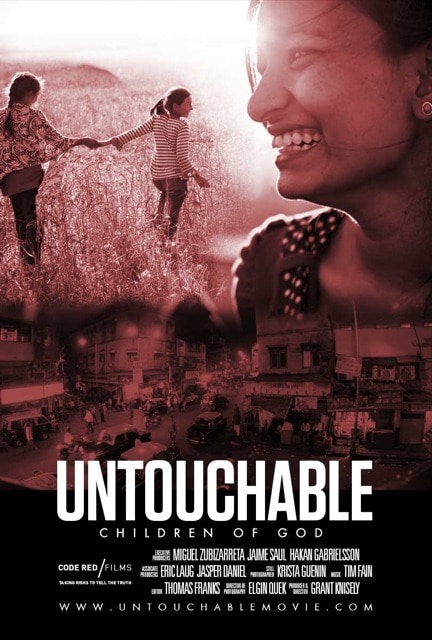
Untouchable: Children Of GodWhat will end the sex slave industry in Nepal and India? Conventional wisdom points to first changing a mindset among men. And this documentary, Untouchable: Children of God, aims to do just that.

Whether you are a woman or a man, I urge you to support this project. Krista and her colleagues are about half way there right now. Help them reach their goal to raise $50,000 so that they can finish this film and screen it in Nepal, India and more than likely distribute it worldwide.

To learn more about this project, please visit Untouchable: Children of God. If you have questions for Krista, please step up and ask them below. She has promised to come back and respond to you.

We all have a responsibility to do something. Every day that we delay another girl dies. The situation is urgent, and this film spotlights ordinary people compelled to take extraordinary risks for the cause of freedom.

Untouchable: Children Of God by Krista Guenin

Untouchable: Children Of God by Krista Guenin

Untouchable: Children Of God by Krista Guenin

Untouchable: Children Of God by Krista Guenin

Untouchable: Children Of God by Krista Guenin

Untouchable: Children Of God by Krista Guenin

Untouchable: Children Of God by Krista Guenin

Also, are you pursuing a personal photography project like Krista? Please feel free to tell us about it in the comments section below or email me directly.
Filed Under: Documentary, Home Middle Right, PhotoBlog Tagged With: Documentary, Documentary Project, India, India And Nepal, Krista Guenin, mission, nepal, Sex Slave, sex slavery, The Sex Slave, Untouchable: Children of God, Untouchables

Interview With Documentary Landscape Photographer, Marc Wilson

June 19, 2013 by Seshu | Editor & Publisher

Working in the genre of documentary landscape photography, Marc Wilson looks at the memories and histories in the landscapes that surround us, and man’s interaction within it. He has exhibited in many solo and group exhibitions, both in the UK and internationally; in Milan, Grenoble and New York. Exhibitions include: The Terry O’Neill Award, 2013, The Royal Armouries Museum in Portsmouth and Leeds, the inaugural solo shows at the Back Hill and Now Showing galleries (London), a solo show at Focal Point gallery, Southend and group shows at Art 2001, Photo2005, The Photographers Gallery, The Association of Photographers gallery and Lucy Bell Fine Art.

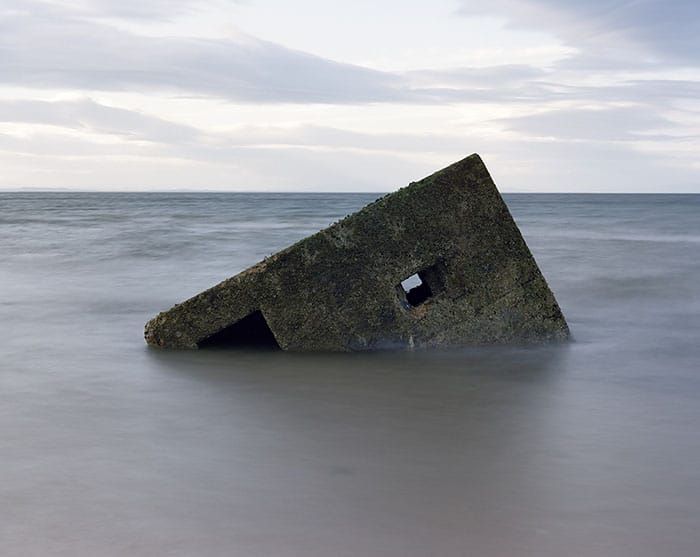
Findhorn, Moray, Scotland. 2011

An Update From Marc Wilson:

“To coincide with the 75th anniversary of the end of WW2 I am this year publishing a 3rd edition of the photo book The Last Stand. The first 2 editions sold out and having the publishing rights back means I am able to make this 3rd edition in a different format with a number of new images and new design.

This new smaller softcover format also makes it more affordable which is something I’ve always wanted to do with this book in these later editions.The new version will start at only £25 but is currently £20 during the pre-order. There are print and special editions options also.”

Throughout all of my photographic work, I feel it is important to create visual reminders of our histories and the stories they contain.

These visual markers then give us the trigger for story telling and remembrance…which is ever more important as the number of individuals who lived through these histories grows ever smaller each year.

In many cases, the photographic document will become the only visual record of these places and the connected stories as many defences are subsumed by sands or water, or some even, pulled down and removed.

Many people whom have bought the book of the work have told me how they now have, or wish to, visit these places.

For all of these reasons I feel driven to make work like this, work that I hope triggers discussion, storytelling, inquisitiveness, remembrance and thought.

Pre-order the 3rd Edition here.

You are called a ‘documentary landscape photographer' – is that a term you came up with?

I can’t remember where I read the expression first but it was about five years ago I think. I had always struggled slightly with describing my work as it did not seem to fit into any conventional genres but the term ‘documentary landscape’ desribed it perfectly.

Do you feel your work echoes the work of those landscape photographers who have gone before you or do you think your work stands on its own?

My work is very subject specific in that I seek out particular objects and structures within the landscape and the stories behind them, as opposed to either the urban sprawl or the greater landscape itself. The landscape does though play an integral role in my work, as both the background and container for the subjects. Whilst it could be seen to have echoes of the work of John Davies and Stephen Shore it probably more closley echoes the ‘New Topographics’ work of photographers such as Joe Deal and Robert Adams.

If you were to pay homage to any one landscape photographer, who would it be?

It would have to be John Davies … not a traditional ‘landscape’ photographer of course but I do find his work of ‘our landscape’ very inspiring and images that I can return to again and again, I think because of the human interaction found within.

Tell us about The Last Stand. What motivated you to start that project?

The seeds of the work came out of an older piece of work I produced called ‘Abandoned’ in 2003. Two locations in this work had military significance and I found myself returning to them (visually) and wanting to explore the subject matter further, and the more I did the more important it became to me that it was a story that I felt compelled, as a photographer, to tell. The work then became self motivating with each location visited and story told.

What have you discovered about yourself the most as you have gone through this project?

This work has really made me realise how important a photographer can be … not of course in terms of him or herself but in the subjects that they document, the stories and memories they have the ability to tell, and the importance of this. As a photographer I have a great responsibilty to tell these stories and the weight of that is what drives me on. The idea that work I produce is seen by others as ‘vital and important’ is a wonderful feeling.

Do you identify yourself as a photographer or an artist or is it a combination of the two?

I used to call myself a photogapher, then when I started working commercially I tried to separate the two strands into ‘photography’ and ‘art’ but today I am really quite comfortable with just being a ‘photographer’ and not trying to justify any diffeence to myself (or others). At the end of the day it is just a label but a bit of definition is no bad thing. I think the comfort of the word ‘photogapher’ has come as I feel more confident in the work I do and its place in society.

Studland Bay I, Dorset, England. 2011
Studland Bay II, Dorset, England. 2011
Newburgh I, Aberdeenshire, Scotland. 2012

Newburgh II, Aberdeenshire, Scotland. 2012
Les Landes, Jersey, The Channel Islands. 2013
Reighton Gap, Yorkshire, England. 2012

Cramond Island, Firth of Forth, Scotland. 2012
Findhorn, Moray, Scotland. 2011
Lossiemouth I, Moray, Scotland. 2011

Lossiemouth II, Moray, Scotland. 2011
Sainte-Marguerite-sur-mer, Upper Normandy, France. 2012
Wissant I, Nord-Pas-De-Calais, France. 2012

Wissant II, Nord-Pas-De-Calais, France. 2012
Hayling Island, Hampshire. England. 2013
Torcross, Devon, England. 2011

Loch Ewe, North West Highlands, Scotland. 2012
Spurn Point, Yorkshire, England. 2012
Arromanche -les-Bains I, Normandy, France. 2012

Arromanche -les-Bains II, Normandy, France. 2012
Brean Down II, Somerset, England. 2012

If there was one museum where you would like your images to hang permanently which one would it be and why?

It’s probably no great surprise but I think for The Last Stand it would, in the UK, have to be the Imperial War Museums. Simply that it seems the most appropriate venue to hold the images on a permanent basis.

Your images are quiet. They are devoid of humans, yet are full of suggestions that humans have inhabited that particular place in some interesting ways. Even your portrait say more about the space your subject takes up than the subject themselves. Is this your mission? If not, what are you trying to say.

In terms of this particular work it is very important for me to make sensitive and subtle images that are respectful of the memories I am depicting. There is no need to add ‘photographic glamour’ to these subjects. I have always been interested in the memories and histories that the landscape and objects within it can hold. To me the suggestion of human presence is what holds my interest more so than a physical presence. I feel it allows a wider audience to imagine themselves in these places. I think that is where my work differs from more traditional documentary photography and photojournalism. It is telling these same stories but in a different way and allows me to look at historical work.
As for my portrait, I guess I set it up in the same way, without really realising it!

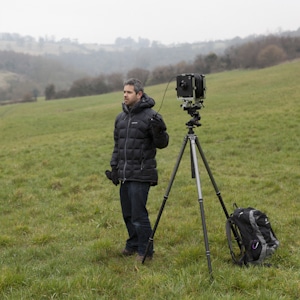
Marc WilsonI see you are using a 4×5 (or it is 5×7) view camera for your work in The Last Stand. Is that your first choice for your commercial work as well? What is it about his particular format that you like so much?

It is just the most appropariate format for the work, allowing the rise and fall that I need for the ‘architectural’ elements within the images and also the large film giving quite beautiful and subtle prints. It also works best for the quiet, sensitive and considered approach the work requires. Commercially I shoot digitally but still using shift lenses.

How did you get your start in photography? And, why have you spent a good deal of your own money pursuing documentary projects? What compels you to do what you do?

I studied Sociology at University and my final dissertation included elements of image making and photography and from there my love for the medium grew. I then went on to study at both degree and MA level. I spent some years teaching before starting to work commercially also about 7 years ago. It was only about 3 years ago that I felt I had ‘earned the right’ to start working on these projects again.

To me the story is everything. It is very difficult to get commissioned to produce this scale of work so the funding has to come from somewhere, in this case a combination of self funding and crowdfunding. The first stage of the work I funded 70% and crowdfunding 30%. This second stage will be more the other way round. My hope is that this work will go on to fund the next through print sales and books. (I am starting discussiosn about a printed book of the work very soon).

That said I am currently in the very early stages of discussion about continuing The Last Stand outside of Northern Europe and away from the second world war so it can happen.

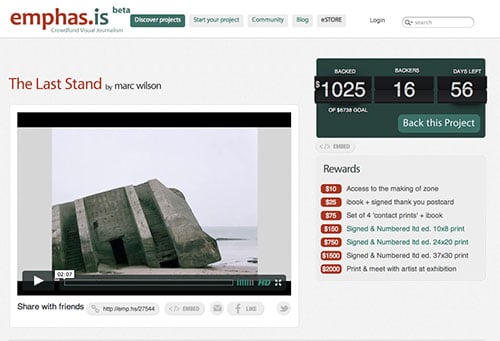
If this project by Marc Wilson resonates with you, please consider supporting his project, The Last Stand. You can make a donation here on this emphasis page.

Marc Wilson's The Last Stand Documentary Landscape Project On Emphas.is

Filed Under: Documentary, Featured Post of the Day!, Interviews, Photography Tagged With: Documentary Project, John Davies, Kurt Markus, Landscape Photographs, Last Stand, Marc Wilson, The Last Stand

Scott Strazzante Finds “Common Ground” In His 14-Year Personal Project

June 12, 2013 by Seshu | Editor & Publisher

It was first at Ohio University, where I was briefly working on a graduate degree in Visual Communications, that I came across the name Scott Strazzante. This was some 13 years ago.

Scott Strazzante | Common GroundRight around that time, Scott, while at the Chicago Tribune, began a personal project that he pursued on his own time. That documentary project, called Common Ground, explores the challenges farmers Harlow and Jean Cagwin face in rural Illinois.
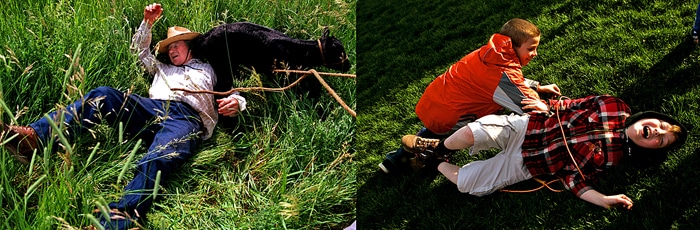
The story takes an incredible turn when in 2002, the Cagwins lost their home to urban sprawl and a new subdivision. But Scott didn't stop making images then. A chance meeting in 2007 of Amanda Grabenhofer, who now lives in that subdivision, prompted Scott to continue the project by photographing her and her family.

If you ever doubted if history repeated itself, all you have to do is see the wonderful diptychs that Scott, with the help of Mike Davis and Deb Pang Davis, has created of life on the farm when it existed and life in the new subdivision that overtook that farm.

Scott Strazzante | Common Ground Diptych

“Echoes of the Past” – In 2002, Harlow and Jean Cagwin left their 118-acre cattle farm in Lockport, Illinois to make room for the Willow Walk subdivision. Five years later, Ed and Amanda Grabenhofer and their four children have settled in at the end of Cinnamon Court. This series compares and contrasts these two very different ways of life on the same piece of land.

As Scott so eloquently says in my conversation with him (see video below), this project isn't a political statement of any kind. It leans more gracefully on the art side of things, where we are gently cajoled into experiencing disparate lives, lived on virtually the same place, or common ground.

Scott Strazzante is well on his way to publishing a book, thanks to this Kickstarter campaign. He has 21 days to go to raise $42,500.

I am asking you to back this project, to show your support of long-term, personal projects that photojournalists like Scott are doing simply because they feel compelled to share with us the world they witness on a daily basis. When I watched the campaign video, I knew right away that this was a very special project.

Scott and I have never met in person, but it's easy to discover the man's commitment to photojournalism and his love for narrating visual stories of everyday life. I applaud him for going the distance, completing this project and publishing this book, Common Ground.

Filed Under: Uncategorized Tagged With: Common Ground, Documentary Project, personal project, Scott, Scott Strazzante

Subscribe To Tiffibox Treats!

Looking for a well-curated email newsletter that will leave you inspired and motivated about your photography business? Sign up below!

About Seshu

Seshu creates relaxed portraits of families and high school seniors in Avon, Connecticut. He also leads a successful headshot photography studio in Connecticut, helping professionals from a variety of disciplines project the very best versions of themselves. He created Tiffinbox as a way of inspiring photographers, to create better images and successful businesses. [Read More]

Email Templates For Headshot Photographers

Email Templates for Headshot Photographers

Recent Posts

  • How Capture One Changed My Event Photography
  • 10 Steps To Stay Positive In Times Of Great Stress
  • Why You Need To Read “Personal Branding For Photographers” Now
  • How To Master Your Website Content Step By Step?
  • Tony Taafe’s TNT Method For Headshot Photographers

Recent Comments

  • Stephen Davison on Are You A Business Owner Who Is Smart, But Stuck?
  • Ben A. on Don Giannatti Clinches The 8th Annual Tiffinbox Award
  • Dan on Don Giannatti Clinches The 8th Annual Tiffinbox Award
  • Donald Giannatti on Don Giannatti Clinches The 8th Annual Tiffinbox Award
  • Stephen Davison on G.E. Masana’s 6 Strategies For Wedding Photography Success
  • Naveen Kumar on Weddings In India Are More Than Being At The Right Place And At The Right Time
  • kartick on Weddings In India Are More Than Being At The Right Place And At The Right Time
  • Leonid Farbman on 6 Uncommon Trends To Grow Your Photography Business
  • Willow and Finch Wedding Photography on 11 Reception Tips To Help Your Wedding Photography
  • Web Designer Malaysia on How To Optimize Your Squarespace Website For Search Engines
  • Creastan on An Interview With Photojournalist G.M.B. Akash
  • Cindy Brown | Atlanta on An Open Letter To A Local Photographer

Become a Patron!

Copyright © 2026 · Tiffinbox · Site Design by Heather Mackan Creative · Built on Genesis