• Photography
  • Interviews
  • Business
  • Reviews

Tiffinbox

Inspiring Photographers

  • Home
  • About
  • Blog
  • Contact

On Fear And Street Photography

March 22, 2013 by Olivier Duong

Olivier Duong is a Haitian-French-Vietnamese documentary photographer living in Fort Lauderdale, FL. Check out his websites: www.f-stopeight.com (Portfolio+Blog) and www.streetpresets.com (Street Photography Presets for Lightroom and Nik's SilverEfex)

I was pretty much shy and fearful as a kid , so much so that I couldn't even look at my own brother in his eyes when I was younger! But that has changed and now I am fearless to shoot in the streets. But it looks like fear is a big issue for many wanting to do street photography, so I put this article together by drawing from personal experience and psychology.

1) Fear Is Normal

The first thing to understand is that fear is normal. You have an alert system designed to react when something dangerous is approaching or forming, and it is called fear. This is why when you are in a shady neighborhood you suddenly want to hit the gas pedal because of fear. This fear is good, it's here to protect you: if you didn't run of fear of lions, you would be history! So do not worry because you fear in the first place! It's perfectly normal.

2) Irrational Fear

Whereas fear is good, and fear of rejection normal, irrational fear is bad and can even literally paralyze you. There is a certain probability that certain things can happen to you, irrational fear makes these seem extremely probable when in reality they are extremely improbable. Let's take meteorites for example. You CAN die from a meteorite but what are the astronomical odds of this? And irrational fear of being hit by a meteor will most likely lead you to believe that the day you walk out, is the day a meteor will hit you.

In the streets there is an irrational fear of rejection, we believe that every single person will probably do something to us, get mad or do something else. Truth is this will only happen once in a while, most of the time when you are out, absolutely nothing happens. We will get yelled at once in a while, but guess what? It's statistically bound to happen, just like it's statistically bound to happen while behind or in front of a counter at a store. You will get yelled or challenged in the streets but so will you be at any kind of work, that's just life and there is no need to have an irrational fear of it.

3) What Is There To Fear In The Streets?

In order to get into conquering your fear of street photography, we must look at what exactly causes the fear. Is it the streets themselves? No, for I am sure you walk in streets without any problem, so what is it? It has to be people. You do not fear them when you are walking in the streets, and if you were invisible with your camera I am sure there would be no fear … So what is there to fear in the streets? I believe that it is the fear of people, the fear of people's reaction, and even more specific, their potential rejection. We are afraid of being yelled at or something worse.

Street Presets BannerFrom Seshu: One way you can show the grittiness of the street is by converting your color images into black & white, using presets for Lightroom, Nik's SilverEfex Pro or Adobe Camera Raw. Check out Street Presets [affiliate] by Olivier Duong. Applying these presets to my images takes me back to my first inklings as a street photographer in Tokyo, Japan. I spent a great many days just walking, watching, talking to strangers and photographing them, if they didn't mind. Will share some of my favorite images soon!

4) Fear Of Rejection Is Normal

Humans are hardwired for relationships: language, art, love, friendship – all revolve around relationships. So rejection actually strikes at the very core once it's being expressed, hence the fear of rejection. We all want to feel that we belong so we will do anything we can to not feel rejected. That fear is once again, normal! When you are in the streets and fear the reaction of someone, it's because you are human and can't help it. This is why some fear the streets, some fear to blog, etc.

5) Change The Channel

I do not think that one cannot fear, it's a mechanism built-in the system like pain is. So what to do? The answer is simple: Change the channel.

Your mind is like a big, huge TV screen and you are the viewer. You might not have control over what goes on in your mind but you have the remote control to change the channel. And just like a real TV screen, your mind can only be focused on one thing at a time: try to think about pot roast and at the same time the Empire State building to see how you fare. When you are in the streets and any kind of nasty images come into your mind “You're gonna get yelled at”, “He's gonna punch you”, etc, etc. These fears are irrational because of the odds of them happening … so what you do is you replace these images/thoughts that come with some other thoughts/images, and since you can only be conscious of things once at a time, you are basically overriding your fear with other things.

6) Occupy Your Mind

Here's some other things to tune your mind to when you don't like what's on in the theater of your mind:

– GPS: Think about a destination point and only think about it, your mind will be occupied on arriving to the destination and will not bug you with fearful thoughts while going there (camera in hand, shooting, of course)

– Camera: Make your mind only focus on things like composition, ISO, Aperture, Depth of Field, Camera shake, etc, and the mind will be too preoccupied for anything else.

– Future: While in the streets, think about how you will be later in your room with all the great pictures you will take. Your mind will be so focused on the prize that it will forget about the present. This is also great if you focus on an incentive (“If I get 5 good shots, I will get a new Video Game or ice Cream, etc”). Incentives work very well!

– Fear: Shift your mind from fearing the streets to fearing NOT getting any good shots!

– Music: Put your headphones on and listen to some music while chanting the lyrics in your head.

7) What's Really At Stake

Fearing the streets will cost you, it will cost you a lot. If you do not take a picture, your vision will never be made concrete and you will lose that opportunity forever. You will increasingly be miserable the more you do not shoot in the streets because you will let lots of good photographs slip through your hands … with no one to blame but yourself. Your vision should trump many things like cameras and fear. Fear is not worth loosing a photograph. If you do let your fear win, what you will be left with is regret. Regret for not having taken that picture when the time came. If you care about your vision and photography, the stakes are high!

8) It Gets Better

All I can say is it only gets better. You are a bit hyper at first, but once you get in the streets and occupy your mind and then get a knock-out photograph, you will not stop! Fear in street photography can be beaten once you realize that YOU have the remote control to change the channel. Street photography is waiting for you, don't let your fear get in the way of your vision, it's much too precious. Stay focused and keep on shooting.

Street Photography | Olivier Duong

Street Photography | Olivier Duong

Street Photography | Olivier Duong

Street Photography | Olivier Duong

Street Photography | Olivier Duong

Street Photography | Olivier Duong

Are you looking for some gritty black & white presets for Lightroom, Nik's SilverEfex Pro or Adobe Camera Raw? Check out Street Presets [affiliate] by Olivier Duong.


Filed Under: Photography Tagged With: Fear Of Rejection, Irrational Fears, Olivier Duong, Overcome Fear, Street Photography

How To Make Relationship Marketing For Your Photography Business A Piece Of Cake

March 21, 2013 by Seshu | Editor & Publisher

Let me guess. You spend at a minimum a $1.50 for a cup of coffee every day. If tea is your thing, I am still probably not too far off the mark. Even if you make your beverage of choice at home, your cost is probably around the 50 cent range. Am I right?

What would you say if I told you that you can learn to market your photography on 42 cents a day.

Yup! You read that right.

Now, I don't know about you, but when times are tough, I don't stop thinking of ways to get the word out. I do just the opposite. I obsess about the many ways I can let people know about my growing businesses – photographing business executives and relaxed portraits of couples and families in Connecticut.

Alicia Caine | Served Up Fresh

Alicia Caine | Served Up Fresh

When Alicia Caine (that's her on the left) at Served Up Fresh wrote to me and said she was working on a new guide that had everything to do with marketing for photographers, I couldn't wait to check it out. She actually made it rather easy for me to get a sneak peek at what she was about to launch. You can sign up here, to get a free chapter download link, too.

Alicia has a proven track record for producing useful guide books for photographers. You may have heard of her Easy As Pie pricing guide. Or, her Happy Place Business Plan. Each has been meticulously researched and elegantly designed. Her expertise comes from working as a photographer. Like you and I, she looked for and found a way to support a growing family, offering portraits in an area that was remote and economically hard-pressed. That should be enough inspiration (it is for me) for you to see how she was able to succeed in establishing a thriving photography business.

I am sure there was a lot of hard work. But that goes without saying. What is rarely mentioned in success stories like Alicia's is her marketing chutzpah. She is proactive at establishing local business relationships that constantly refer her work. She calls it “relational marketing.” And, I wanted to know more.

I was curious to how she set things up. What did she do or say to arrange for those meetings to take place? How did she approach them? What was her offer? How did she go about define who she was going to serve? How did set up her email marketing campaign? What changes did she make to her website to make it so attractive that clients had to book her portrait sessions?

You see where I am going with this?

Piece Of Cake Marketing by Alicia CaineI just had a lot of questions and this guide book – Piece of Cake – is a loud and welcome response to each of those queries and more. Like her previous guide books, this one isn't just an information dump. That kind of an e-book, in my opinion should be a thing of the past because it doesn't add any value. No, Piece of Cake is a whopping 108 pages, with seven worksheets that guide you from one section to the next.

I found myself reading, taking notes and then working through the questions in the worksheet. And no, I am not done going through them all yet.

Friends, Alicia is clear on one thing: this isn't a one-size fits all type of solution. I suspect, that's why the worksheets are important. The answers you arrive at after completing each one will empower you to approach your marketing in your own way. You don't have to copy what your competition is doing. In fact, what you do will be so unique and distinctive that it will be hard to be copied by your peers in the same market.

Now, who doesn't want that, right?

Full disclosure time: I invested in this guide. That's right. I paid full price for it because I believe it will help my businesses. And because Piece of Cake not only meets but exceeds my expectations, I have chosen to promote it here as an affiliate. I make a small commission that helps support this website, when you buy the guide book using one of the links in this post. So, if you feel you will benefit in getting clear on how relationship marketing can help your photography business, please buy this guide now.

You bet there is a time limited offer – from now through March 26th, Piece of Cake is only $169. After that date, the price is going to increase to $349. It should be fairly clear to you that if you act quickly, you save a bundle. In fact, I suggest you invest that $180 you will save by taking a few people in your town or city out to lunch, or a cup of coffee. Getting to know other business owners in your zip code is key to making your own business grow.

After you have had a chance to read and act on the ideas and suggestions in this guide book, please come back here and let us know how you fared. Tell us what you put into action and what the results were.

So, here's to your business growth in 2013 through relationship marketing!

Filed Under: Marketing, Photography Tagged With: A Piece Of Cake, Alicia Caine, Business Relationship, Marketing, Marketing For Photographers, Photography Business, Piece Of Cake, Relational Marketing, relationship marketing

Why You Should Master Your Digital Channel

March 20, 2013 by Seshu | Editor & Publisher

Couple of days back, I published a guest post by Aaron Hockley about how photographers can or should choose their social media channels carefully.

Days after that post went live, I heard Jonathan Canlas (in a conversation with Todd Reichman of A Man To Fish fame and podcast) say rather bluntly that while it's all well and good to be on Facebook, Facebook “LIKES” don't pay bills. It made me think more about how I've been using social media, be it Twitter (nearly 8,300 followers) or Facebook.

The discussion in that podcast inspired me to also look at “why” I was using social media. Was it a source of real information? Or, was it entertainment? With a Twitter or Facebook presence, was I truly “marketing” to my target audience? I wanted to know how my posts measured. Ultimately, the question is: Am I able to convert visitors to actual paying photography clients.

Now, as a photographer, I am committed to doing one thing well – making images. Marketing, while exciting, comes in at a distant second, at the utter chagrin of both my accountant and my wife.

I know, as probably you have figured out for your own business, that being “out there online” is a vital part of your day. If you don't exist online these days, it's very difficult to sustain yourself as a business. Your clients are online, and so should you. But how to parse your day into useful chunks of time – time spent that can be measured and will bring in the results you want for your bottom line?

I didn't have an answer for that question until I ran into Chris Brogan‘s new offering called Mastering The Digital Channel [affiliate]. While I haven't taken this self-paced course yet, what I really like about Mastering The Digital Channel is that one has direct access to Chris Brogan!

As a photographer you may or may not have heard of Chris Brogan. He is the CEO of Human Business Works, a company that is dedicated to helping professionals understand and run relationship-based businesses. I've enjoyed his presence on Twitter and follow him there, but despite a large number of followers, he has always responded to my questions directly and promptly.

Chris, with Julien Smith, have written two books – Trust Agents: Using the Web to Build Influence, Improve Reputation and Earn Trust and The Impact Equation. Independently, Chris has also written Google+ for Business: How Google's Social Network Changes Everything and Social Media 101: Tactics and Tips to Develop Your Business Online. If you own a Kindle or an iPad with the Kindle application, consider buying It's Not About the Tights: An Owners Manual on Bravery.

Am I fan of Chris Brogan? You, betcha! I've always enjoyed his no-nonsense, fluff-free delivery of his blog posts, or when his podcasts. He comes across a genuine guy who loves to teach.

Right about now you are probably wondering why you should consider Mastering The Digital Channel by Chris Brogan. I hear you loud and clear.

It's only natural, easy and convenient to reach among those you already know in the photography industry. But I truly believe that if you want to shake things up, you should also be looking outside your bubble.

Now, let me be clear: Mastering The Digital Channel, isn't for everyone. However, if you've been spending your time online and seeing absolutely no return, right about now you probably think social media is a joke or you don't even try to dip your toes into it for long stretches of time. I hear it from a ton of people I meet at photography gatherings. But before you dismiss it completely, shouldn't you have the right frame of mind, the right tools and the right guidance to make a truly informed decision? That's where Mastering The Digital Channel comes in.

This course is just about to launch and yes, there is a launch special. In fact, if you use the code “special”, you save $200 off.

Being online isn't “the IN thing,” it's the “right thing” to do for your business.

Learn to master your digital channel from an attentive and qualified teacher. I know you won't go wrong if you follow the steps Chris Brogan outlines in his course.

Sign up for this course now and save $200.

Full Disclosure: Like all other programs or products I mention or promote here, I do make a small commission from each signup to support the running of this website.

Filed Under: Marketing, Photography Tagged With: Channel, Chris Brogan, Digital, facebook, Photographers, The Social Network

3 Important Tips For Photographers To Choose The Right Social Media Channel

March 15, 2013 by Aaron Hockley

This is Aaron Hockley's third guest blog post. Aaron is a professional photographer and writer who tweets too much and blogs a few times each week. His professional work finds him working with businesses for events, publicity, and editorial work; he also creates abstract and travel photos for leisure. In addition to photography for clients Aaron often works with other photographers to help them understand and refine their online and social media presence. Read Aaron's first blog post here. And, his second post here.

How's your social media life today?

Have you Tweeted? Pinned? Instagrammed?

What about LinkedIn? Facebook? Flickr?

Feeling overwhelmed? You're not alone. There are a lot of social networks and social media outlets that compete for our time as photographers. One could probably easily fill an eight-hour workday with nothing but online social media activities. That wouldn't leave time for actually making or editing any photos!

Post-Storm Fort | Aaron Hockley

How do you decide where to spend your effort with social networking? I think you can make those decisions based on three factors, and one of them is a bit of a cheat.

1) Where Are Your Clients (or Fans)?

When we look at social media marketing or social networking from the aspect of trying to grow one's photography business, the online world is no different than the offline world. If you're engaged in offline advertising, mailers, networking, or other marketing efforts, you're (hopefully) targeting your audience. If you're trying to sell your senior portrait services, you're targeting high school juniors and seniors rather than sending a mass-mailer to everyone in your city. The same principles should apply online.

Identify your ideal clients. We already mentioned high school seniors if that's what you do. If you photograph weddings, you're looking for brides and can make some generalizations about their age and, depending on your positioning, income levels. How many wedding planning boards are there on Pinterest? Thousands? Millions? If I shot weddings I'd be all over that. Do you make fine art landscape images? Odds are that you know something about your typical buyer. If you're a commercial shooter, you probably want to connect with marketing folks, agencies, art directors, and the like.

Figure out where those clients live online. For high school seniors, right now the buzz is that Twitter and Instagram are the most popular networks. Corporate types are found on LinkedIn and increasingly on Twitter. If you want to find brides, Facebook is a good place to be and to connect with others in that segment. I'm seeing a fair amount of discussion on Google+ that involves folks willing to buy fine art prints and books.

2) Where Are Industry Connections?

Building relationships with clients (both existing and potential) is one aspect of social networking, but the other big area that can benefit photographers is connecting with industry professionals. Developing connections with other photographers, manufacturers of photo equipment, and vendor partners can have various benefits to your photography. In some cases, “it's who you know” can lead to referrals. Perhaps getting to know other industry folks can lead to publicity or an “in” with a gear manufacturer. Maybe you just want to bounce ideas or problems off of someone who has been in a similar situation.

Right now, I'm making the most connections with other photographers and industry folks on Google+.

The Atrium Transport | Aaron Hockley

3) Do You Just Want to Have Fun?

If your purpose in social networking is purely to have fun, then heck, do whatever you want … but don't complain that you're not getting business results if you're not making social media choices based on business criteria.

Lowering the spout | Aaron Hockley

So … Where Do You Go?

There's not a single right answer. I've given you some ideas above, but ultimately you need to look at your business and figure out what makes sense for you. You don't have to be everywhere, on every social media channel. You can't be everywhere. It's okay to ignore a social network that isn't relevant for your business or area of interest. Trying to reach retail photographer customers? They're not likely to book you via LinkedIn. You probably won't pick up a corporate job via your Instagram images. Look at what you do, where you want to be, and where your clients and partners are hanging out. Be there, and don't feel bad about about ignoring other places.

Filed Under: Marketing, Photography Tagged With: 3 Tips, aaron hockley, Linkedin, photographer, social media, Social Media Marketing, Social Networking

Photography Equipment Buying: A Business Perspective

March 14, 2013 by Travis North

Travis North is a Landscape Architect and freelance fine art Photographer out of Philadelphia, Pennsylvania with over eighteen years of experience. He is the founder and editor of Shutter Photo Magazine, which has been a source of photography inspiration and wisdom since 2008. Follow him on Twitter.

Photography as a medium can be described a great number of ways. It’s a creative release, inspiring and emotional. For many, it’s a source of income or a private business where you are your own boss. And Photography is expensive. It doesn’t matter how you cut it down, by the time you add up the cost of all your equipment – and let’s not forget the accessories right down to the camera strap – the bill would make your accountant cringe. Now it’s one thing if you’re been lucky enough to make a substantial income from your art. But every photographer I know (even the most successful) is always talking about the next product they’re thinking about buying. If money wasn’t the object, there would not be “thinking”, you would already have that new $1,400 USD lens. So in this article I’d like to focus on a very businessman’s term: ROI, or Return On Investment. Worry not, we’re not going to talk strict numbers – we’re going to talk gear. We’ll talk about where you get the biggest returns and what gear is ultimately important. But most of all, we’re going to talk about where you can cut corners for the sake of ROI.

Focusing on the Deliverable

When it comes down to determining the value of something, you ultimately need to focus on what is expected in the end: What is the deliverable? If you are working as a fashion photographer and your works are expected to be posted on billboards throughout the urban landscape, then you might have a case for buying yourself a high-end medium format camera. But if photography is more of a hobby and your supplemental income is in the form of post card sales, that would be the opposite end of the spectrum. Now I’m not trying to simplify the context too much, but the end product ultimately drives what type of equipment you have and use. It’s a simple philosophy, really: Use only the tools that you need to use.

There’s an interesting story about the space race back in the 1960’s. The problem was that a traditional ink pen does not write in zero gravity, and so NASA allegedly spent thousands, if not millions, of dollars researching and developing a pen that can write in zero gravity. In contrast, the Russians used a pencil. Now the story may not be true, but it makes the point: The simplest tool that does the job is the one you ultimately should use. On a personal note, I use a Nikon D80. It is not the best camera on the market. And to be fair, it’s not the best camera that I could be using for the type of photos that I create. But photography is not my primary income and so I have to weigh the ROI vs. my gear lust, and I couldn’t justify spending the money on the camera I really wanted. Instead, I took the money I saved and funneled it into gear that gave me the better ROI; like better flashes, better tripods and better lenses. Of course as my income from photography increases – or if my photography business moves in a direction that warrants it – then I may revisit the camera body upgrade down the line. But my current deliverable demands do not require such an upgrade at this time.

Planning for Upgrades

Bolted In | D. Travis North | Cellblock 4, Eastern State Pennitentiary

If this is your studio, the best return on investment will come in the form of tripods and lighting equipment. A better lens won't necessarily have as much impact here as you would think.

The hopes are, of course, that your work and your scope will evolve. Your client base will grow larger, your income from photography – be it primary or secondary – would increase and then you will be able to revisit the ROI considerations again a year from now or two years from now. Ultimately, the hope is that you will be looking to upgrade your photography equipment down the line. You’ll need an upgrade plan. You probably have some idea of where you would like to go with your photography, and you should create your upgrade plan to compliment your photography goals. You can expect that the plan will change as you evolve or as new products come to market. But every upgrade, every accessory, needs to be thought of in advanced. I have three simple rules when considering gear upgrades:

1) Avoid proprietary features that would channelize my upgrade path.

2) Quality is worth extra cost, but it must be justifiable.

3) I must have immediate and continued use for the product.

These three rules apply to every product I consider, from the camera body all the way to my camera bag.

The first rule is the most abstract, so let's speak on that briefly. Basically, I don't want to be locked into any single proprietary format, nor do I want to limit my options down the line. The exception is camera systems because that's unavoidable. There’s a very strong reason why I most often recommend Canon or Nikon products: Between the two companies, they control more than 70% of the market. Both manufacturers make great products, and they tend to be neck-and-neck in terms of advancement. In short, you couldn’t go wrong with either brand. But the real reason I suggest those brands more than any other is the simple fact that every other photography-related company on the planet wants to tap into Canon and Nikon’s market. That means that you can find compatible products – from remote triggers to lenses – for either brand. Not only does that yield a massive amount of options, but when companies compete, you and your ROI win.

So let's talk about where you get the biggest bang for the buck. The answer could be different for each photographer. A photographer specializing in landscape photography may want to look at a more premium, full-frame camera to take advantage of wide-angle lenses. Sports photographers are going to want to spend their money on lenses. Macro photographers may be interested in bellows systems or extension tubes. Personally, I shoot a lot of ruins and work indoors very often. While I would love to have a camera body with better high-ISO support, the reality is that the best investment for me happened to be off-camera flashes and accessories. Your case will be unique to your own style of photography. So you'll need to evaluate and weight your options to determine where's the best place to spend your money.

Quality vs. Cost: Taking Advantage Of Small Margins To Save Costs

The most innovative and best products are not always from one of the big brands. And even if they are, the cost difference is in many cases beyond the point of diminishing returns. In other words: If the quality differences between two products is not discernible without the use of a testing lab, go for the more economically priced product. Because the truth of the matter is that if you can’t tell the difference, your client certainly won’t be able to either. To illustrate my point, let's talk about lenses.

Lens Choices

It’s at this point that I would like to remind everyone that Ansel Adams was working with lens technology far inferior to whatever you’re using right now. With the advancements in lens technology over the past twenty years, the quality comparisons have gotten so tight that the margins aren’t even measurable without adding extra decimal places. We fixate on these tiny details and make exaggerated claims that one lens’s sharpness is “far superior” to another when in truth, we’re arguing about a 0.1% difference. Is it really worth it? No. And it certainly isn’t worth the cost difference.

Twenty years ago, when Canon and Nikon were the clear front-runners in the lens market, third party lenses weren’t a consideration to pros. Third party lenses were a consumer product. They weren’t built as well and the image quality wasn’t strong. But they were significantly cheaper. Pros could justify the cost, but a consumer could not. Fast forward to 2013. In my opinion, some of the strongest innovation comes from the third party lens manufacturers, and their still carry a significantly more economical price tag. My favorite comparison is the Sigma 24-70mm F/2.8 vs the Nikon or Canon version. On paper, they are all essentially the same lens. All have great image quality, all yield the same amount of distortion at the wide end and all are built very well. The images created with either lens are interchangeable. The quality differences between them is immeasurable outside of the lab. The primary difference between these two lenses is not image quality, it’s price. The Nikon (about $1,700 USD) and the Canon (about $1900 USD) are each more than twice the cost of the Sigma (about $825 USD). And so I ask, is the Nikon or the Canon worth the extra cost? The cost difference is simply beyond the point of diminishing returns. Is that fraction of a percent in image quality worth twice the cost? I would say no. Not even for the full-time professional.

And the discussion could go into any topic, from remote triggers (Pocket Wizards vs. Radio Popper) to Tripods (Gitzo vs. Manfrotto – they’re even under the same parent company) or hot-shoe flashes (Nikon vs. Nissin or better yet, Nikon SB-950 vs. a used Nikon SB-60). But if you can keep that point of diminishing returns in focus, and if you can clearly keep an eye on how tight the quality margin is between two products, you have an advantage. You don’t need to buy the Nikon 24-70mm or a Gitzo tripod when the Sigma and Manfrotto versions will serve you just as well at half the cost. Simply knowing about what options are out – and knowing that the ROI is going to be much greater – could really change your gear upgrade plan a great deal. Heck, you may even be inclined to start with a different camera body from the start.

Final Thoughts

Of course the purpose of this article is not to take business away from the giants, nor do I intend to promote specific third-party brands. My hope is that this article got you thinking about justifying your equipment purchases. I would encourage you consider my three rules every time you contemplate product purchases. Ultimately, what I really want for you is to have a better return on your investment. And that starts with buying smarter. So continue to analyze your options beyond a reasonable doubt because, let’s face it, we’re all gear nerds. We find joy in reviewing such data. But keep the quality differences in perspective with your ROI and buy the product that makes the most sense for your needs and budget. Good purchasing habits will only help you and your business.

Filed Under: Commentary, Photo Gear Tagged With: Business Perspective, lenses, Photography, Photography Business, photography equipment

3 Factors That Influence Photography Pricing

March 13, 2013 by Bryan Caporicci

Bryan Carporicci dives into three influencing factors when it comes to pricing your photography. If you have read his first article on pricing, you are in for a treat again. He co-wrote a book for photographers with fellow photographer Robert Nowell called “Pricing for Profit.”

In the book I co-wrote with Robert Nowell, titled “Pricing for Profit”, we share our belief in the idea of calculating your prices based on Cost of Sales. Certainly this is the best starting point, but there are other factors that must be considered when calculating your prices, most importantly quality, perceived value and confidence.

Quality

The quality and artistic measure of your work will have a healthy influence on how you can price your photography. In order to sell something to someone, you have to provide a quality of service or product that the client couldn’t produce on their own. If your photography resembles the basic snapshot-style of images that anyone could take with their own point-and-shoot camera, chances are you cannot charge anything in the neighborhood of what we are suggesting. If, on the other hand, your photographs exhibit a quality of light, posing and finesse that makes your work stand above the competition, then you certainly can demand a premium for your creative fees.

Perceived Value

We have all heard the saying that beauty is in the eye of the beholder, and this is true of the professional photography industry. The way that a client perceives a product or service is directly related to the price that they are willing to pay for it. People buy things not necessarily for the thing itself, but rather for the way that the thing makes them feel. This has been proven to be true time and time again in all kinds of business environments.
Perceived value can come from things such as how we package the goods that we deliver our clients, to the length that we will go to to provide exceptional customer service. If you create a higher perceived value for your photography and your products, then you can demand a higher price for those products and services.

Confidence

Confidence is a photographer’s ability to sell him or herself and his or her products or services without any hesitation or apology. It is especially important for starting out photographers, to disassociate themselves from their own price list. We have often heard photographers saying that they would never buy photography at the prices that they themselves charge. As a result of that thinking, they find it extremely difficult to sell to others when they don’t believe in their own pricing system.

You need to be confident and sure of your pricing structure, and you need to present it in such a way that instills confidence in your client. If you don’t believe that they will buy, it is likely that they will sense that. If you don’t believe that what your selling is worth the price you’re charging, they will see that as well. This is why it is important to be extremely confident in the prices that you are asking for your photography.

Next week, I’ll be going into detail about the last “influencing factor” for pricing – the Cost of Sales model. This is the only measurable way to calculate your pricing, and it’s where things start to get fun!

How do you arrive at your photography pricing? What factors do you use to arrive at your numbers? Discuss below!

Filed Under: Business, Photography Tagged With: Photography, photography industry, price, Pricing Strategies, your photography

Have A Photo Conference Hangover? 7 Steps To Implement Conference Ideas for WPPI, Mystic Seminars, Inspire Photo Seminars

March 12, 2013 by Anne Ruthmann

Anne Ruthmann is a wedding & lifestyle photographer in Boston, MA. She spent 10 years practicing marketing & management in corporate and non-profit businesses before pursuing her passion for photography in 2004 as an independent small business. She is a regular contributor to PhotoLovecat.com and loves helping others find creative and smarter solutions to business problems. Follow her on Twitter to see her daily adventures and thoughts.

David Beckstead At WPPI | Las Vegas, Nevada

You went to WPPI, you saw lots of awesome speakers and products, but now what?! Here are some step-by-step tips for implementing what you gained at WPPI (or other photography conferences). Start with paper, sticky notes, or an electronic document that makes it easy to move ideas around on a page.

1. Create Top 5 Action List

List the top 5 actions you want to take in your photography and/or business this year. It's critical to build this list from your memory and capture your top 5 action items without influence from any other factors. The 5 most important things for you will already be on the top of your mind and looking at materials will only remind you of less important things you might want to do.

2. Create Awesome Ideas List

List everything else you learned or thought was a great idea. List as much as you can- fill pages upon pages if you need to- the key is to get all of those awesome ideas buzzing in your head out on to a page so you can physically organize them outside of your brain. This is where you can pour through your notes and brochures if you'd like in order to recapture ideas you forgot about. Reflecting on everything you experienced and putting it into a tangible medium is a critical step in learning and moving beyond ideas floating in your mind.

3. Map Ideas onto Actions

For each of your Top 5 Actions – find Awesome Ideas that support those actions, and list the supporting ideas under each action. For example, if one of your Actions is: “Start Selling Albums”, look for ideas related to albums: brochures from album companies you like, sales ideas you heard in a seminar, designers you might be able to work with, album software that could help you, etc. Do this for each of your Top 5 Actions.

4. Eliminate The Waste

Even though you probably picked up a TON of awesome ideas at WPPI, you really need to let go of things that you can't take action on in the next couple of months. Get rid of any brochures that don't relate to your top 5 action items. You still have your written list where all of the awesome ideas are stored and you can return to them at any time, but there's no need to keep clutter around that isn't going to be immediately useful. There's always next year or the year afterward, and by that time, there may be even better ideas out there that will blow away any ideas you captured this year.

5. Schedule Time to Take Action

Block out time in your calendar to implement your action items. Maybe you create one day a week to focus on them, maybe you set aside an hour each day. Whatever you do- put it in your calendar with an alert or reminder so that you aren't filling that time with less important things, like social media, when you could be creating action that directly benefits you and your clients.

6. Prioritize Actions for Importance

Decide which action is most important to begin moving on immediately, versus what can wait a few weeks. This will help you focus and invest your time wisely toward completing actions that are most critical to your photography business. Put your prioritized Top 5 Action List in a place where you will see it every day, so that even as you get in the thick of your business, you have a regular reminder of what you need to do in order to move to the next level.

7. Connect With Helpful People

Once you start taking action on your items, you'll inevitably want some help figuring things out or getting feedback on what works and doesn't work. If you don't already have a network of people near you that you can bounce ideas off of, search Facebook for Groups titled “[Major City or State] Photographers” – there's a good chance someone has already created a group on Facebook where you can connect with other photographers near you. Make sure you have your website displayed in your profile in case moderation is required to join the group.

If you liked this post by Anne, you should read the wildly popular one she wrote for Tiffinbox called “6 Reasons Why Photographers Suck At Business.”

Yep, sound off below! Anne and I want to hear from you in the comments section below.

Filed Under: Business, Conferences, Photography

“I Love Photography, Not Numbers” – Let’s Discuss Your Pricing, 1 of 3

March 6, 2013 by Bryan Caporicci

Today's guest post is by Bryan Caporicci, a professional photographer based in Canada. Bryan has quickly become an educator on various topics and has been a keynote speaker at numerous workshops and seminars. He co-wrote a book for photographers with fellow photographer Robert Nowell called “Pricing for Profit.” He is also a featured blogger for the Huffington Post.

If you are new to photography, it may surprise you to know that the time you spend running a photography business will be taken up mostly by business and less by photography. If you have been running a photography business for a while, I think that you’ll agree to this fact.

The vast majority of us get into photography because we are creative and visual. Those that are able to make their business flourish however, realize early on that they need to have a strong understanding of business in order to make their career successful.

Photographers are unique in the sense that we almost start our business backwards. The majority of successful businesses are founded by people who studied business first and then decided what they were going to sell second. For example, how many accountants do you know who decided one day “I’m good with numbers” and started their own accounting firm? Most accountants will go through extensive training and internships before they even considering starting their own company. With photography though, most don’t have formal business training, marketing experience, or a financial background. We just know that we love photography and want to do it full-time.

There are an unlimited number of resources on the topics of photography and business (this blog included), however in doing some research, I’ve been unable to find a definitive guide that clearly outlines a step-by-step process to pricing photography services and products. In addition, I’ve never found a resource that actually spelled out how to plan and organize your photography business volume.

In an attempt to help photographers take their business to the next level and start making a living from photography, Robert Nowell and I wrote a book called “Pricing for Profit” that was modeled after our popular seminar series with the same title.

While nothing will replace the value of formal education, extensive research, continuing education courses, business workshops, and so on, our book is designed to be a means of taking the mystery out of pricing your photography for a profitable bottom line.

For the next 4 weeks, join me as I share some insight into the concepts behind our book here on Tiffinbox and help you uncover the most efficient way to price your photography work to make a viable living.

Stick around – it’s going to be a wild ride!

More about Bryan Caporicci: Since his start in the industry eight years ago, Bryan has rocketed to the top of the photography industry in his market area. Bryan was one of the youngest photographers in Canada to receive his Craftsman of Photographic Arts and in 2012, he was named one of the top 25 most inspiration wedding photographers by Wedding Bells Magazine. Bryan's photographic philosophy is simple – he believes in photographing people being themselves. He believes in genuine, pure and simple imagery and he feels that photography is best enjoyed only once it's printed.

Filed Under: Business, Photography Tagged With: Bryan Caporicci, Pricing For Profit

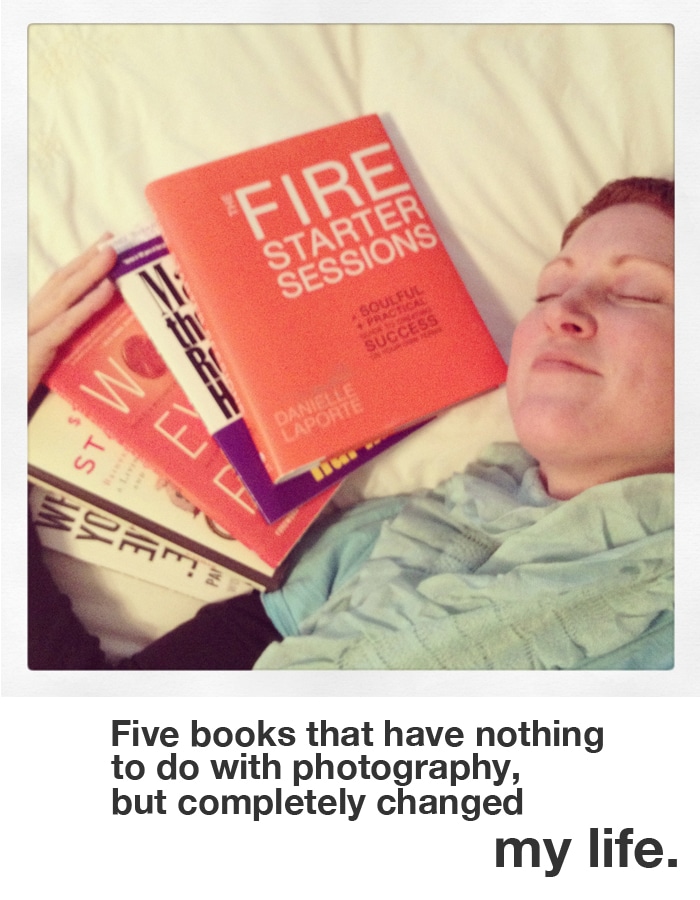
5 Books That Have Nothing To Do With Photography, But Completely Changed My Life

March 5, 2013 by Angela Pointon

Growing up I always had a book on my nightstand. On summer vacations when the only distraction was a meal or two, I'd read about five books a week. Books were a huge part of my life until I was forced to read so much in school that it left little time for reading on my own terms.

Recently, my passion for reading was reignited. I was determined to “unlearn” some of the things I learned. I wanted to, in a sense, find evidence of a truth that was just a mere glimmer of a spark inside my soul. I wanted to believe that I'd be able to turn a blind eye to 60-hour work weeks, mere minutes each day with my kids and the incessant, nagging, haunting repeat of negative voices in my brain.

For anyone who has worked a large percentage of their life at a job that was unrewarding, unfulfilling and seemingly a means to a weekend of menial tasks required before the workweek starts again, you know what I mean.

Okay let's shake off that negativity. Cause I've got some truly awesome business and life books for photographers that rocked my world. They'll rock yours, too.

mewithbooksandtext

I'm putting these in the order that I actually read them. I don't have favorites or a list of top fives. These are all equally fab in my, ha, book.

Book 1: Different

If you've listened to any of my webinars or followed me for any length of time, you know that I scream about this book from the hilltops. Different by Youngme Moon is the quintessential marketing book that is critical for anyone who has an interest in marketing or who markets their own business. This video she made gives you a great quick peek at what her book is about.

I also had the chance to see her speak about a year ago. I loved her so much, it was all I could do to keep myself from plowing onto the stage like it was a hardcore rock show and stage dive into a sea of business peeps.

That would've been weird. Glad I didn't.

My big takeaway from Different: I should have saved that $50,000 I spent on grad school and spent the couple of bucks to read this instead. Seriously. It talks about the critically important parts of marketing and leaves all the, shall we say, BS behind.

Book 2: The Art Of Earning

The Art of Earning by Tara Gentile was the therapy I needed at just the right time (for like ridiculously cheaper than I ever thought I'd buy therapy for). In this e-book, she attacks the often lame perception that people have about their worth, the value of their services and how they should price themselves. Truthfully, I still struggle with little conversations in my head about pricing and worth. Reflecting on what I learned in this book helps me get over those thoughts every single time.

That's what I mean about this book offering a bit of therapy.

I had the chance to see Tara speak in Philly about 7 months ago, as well. It was great to get to chat with her one-on-one afterward about why she wrote The Art of Earning. In her words, she was finding herself hearing “valuation” dilemmas and head trash from so many of her clients, that she figured she should write about it and help people get over it already!

My big takeaway from The Art Of Earning: we are all the biggest offenders of limiting our own abilities to earn more money. We need to get over it and get ready to take on the world, instead.

Book 3: Crush It!

Albeit a bit dated (meaning one small part in this book speaks about Twitter as a “new social platform”), this book had some awesome content about hustle and being true to your own self. I tend to read a lot of female authors, but found Gary to have a tender side and a true willingness to want to teach from the heart through stories about his own experiences.

In Crush It! he talks about working in his family's wine store in New York and using video and YouTube to do something completely different than anyone else in their industry had done up until that time.

Now an author of multiple books, he travels the country speaking about it. What I really liked about Gary is how unapologetic he is about himself. He talked about how others thought his video set should be more polished and professional, and how he refused to censor his profanity-laden mouth as his audience grew by the thousands.

My big takeaway from Crush It!: don't underestimate the power of hustling and being true to yourself (and no one else). With elbow grease and creativity, everyone is capable of achieving anything.

Book 4: The Fire Starter Sessions

This is a deep kick-in-the-guts-and-pants-at-the-same-time read. In The Fire Starter Sessions, Danielle LaPorte describes how she used to work one-on-one with people “stuck” in their professional lives. What she noticed is that everyone had a small fire burning inside of them that, at one point or another, was suppressed and repressed. No matter how small the fire was, it never went away. When life created a series of events, people started noticing that fire again and wanted to inflame it, but didn't quite feel like they had permission to.

In this book, Danielle gives us all permission (even though we don't need it from anybody, truthfully).

What she does so beautifully, however, is step-by-step she goes through the same program she used to work her clients through. It offers a lot of introspection, guidance and makes the thoughts that once seemed real and absolute, disappear into the vast fog of sillyness.

My big takeaway from The Fire Starter Sessions: all of us let other people's opinions mess us up at one point or another. This book helped make that inner voice louder and stronger than any other voice out there.

Book 5: May Cause Miracles

I'm still in the middle of this book. It's the most “woo woo” of the entire bunch. What I mean by that is it's very deep, very spiritual and might be a bit too much so for some (even me).

If you tend to look at meditative thinking as something that will make no difference, you might not make it far enough in this book to see a difference. However, I'm personally looking past that myself, because I see the value in the state that the author is trying to get the reader to by the end.

In May Cause Miracles, Gabrielle Bernstein takes us on a journey that most people otherwise wouldn't take. It's a journey familiar to extreme yogis and meditative gurus… but for you and I? Not so much.

It is proven that within 40 days of repeating an activity or way of thinking, it creates a shift inside of us that has greater chance of permanency. So in her book, Gabrielle sets up 40 days of very short morning, mid-day and evening exercises that briefly change your thinking. One day at a time.

My big takeaway (so far) from May Cause Miracles: I do see some perspectives shifting already, and I'm only into the 20th day of the 40 days. As I mentioned, it's a bit “woo woo” and sometimes, truthfully, I feel silly. But, I'm trusting in this book to shift my outlook on some views, because, honestly, without these 40 days of exercises and meditations, I'm not sure how else they'd shift.

If you're like me, you've got too many books you'd like to read and not enough time. If you love Amazon, then I highly recommend you do what I do. Create an Amazon Wish List and pick away at them one at a time.

What I Did With Everything I Learned

I took a lot of the learnings from the books above and got inspired to write a brief book for photographers, too. It isn't a how-to book, but rather an inspirational slant on what you need in order to be a successful photographer today.

I recently launched it, and it's called: The Art Of A Photo Business: What Every Photographer Wished They Learned Before Starting Their Photography Business.

Download it here in all electronic formats.

What books have you read that inspired you to think differently? I'm always looking for new ones to add to my Wish List, so submit your favs below!

Filed Under: Books, Business Tagged With: books for photographers, books photographers should read, business books, business books for photographers, Marketing Books

The Power Of Starting Something Stupid

March 5, 2013 by Seshu | Editor & Publisher

I have to admit, the word “stupid” in our house, with two young ones, is a “bad” word. Anytime the kids have a spat between each other, that word “stupid,” pops up and of course they get admonished.

So, I was a little nervous showing Richie Norton's book off to my sons, who now knowing how to read, were blushing at the title of the “Advance Reader's Edition” that I had just received from publisher.

I hadn't read 10 pages of this new book, when my friend Josh Solar who is friends with the Norton's, offered to introduce me to Richie Norton. Richie is now based in Arizona, where he is finishing his MBA from Thunderbird School of Global Management.

I couldn't pass up the chance to discuss with Richie, his book and other topics relating to setting personal goals, the life of an artist, what get's in the way of our making decisions and well, things I think you will find interesting.

So, here we are talking over a somewhat spotty Skype connection (so please bear with us if the audio or video cuts out a bit):

After I stopped recording, I couldn't help but continue discussing some of these topics with Richie. At one point, Richie suggested that I tell you about a chapter deep in his book about “Authenticity.” In it, he said, he interviewed photographers Michael Colon and Jonathan Canlas. I have another 100 pages to go before I get to that chapter but if the front of the book is any indication, I'll get there quite quickly.

Richie's writing style is elegant and simple. No jargon being tossed at me and most definitely no psychobabble. I told Richie that it was as if a friend was reading the book to me. It's also peppered with examples to inspire and remind one that there have been a slew of people in the past and present who have been told that their idea has been “stupid” but have excelled at it. Is it a feel-good book? Perhaps. But I also think it is a practical book, without it being overly pedantic. Richie is clear on this from the get go – you may have ideas, but if you don't jump in and put in the work, those will remain only as ideas. Perhaps when I finish the book, I'll come back here and review it more thoroughly.

Richie Norton's book, The Power of Starting Something Stupid, comes out today – March 5, 2013.

Order your copy from Amazon or other more local bookstores of your choice.

If you read it, please come back here and tell us about it. Your comments and questions are always welcome. By the way, I am up to Chapter 3 now.

Filed Under: Books, Business, Photography Tagged With: Start Something

  • « Previous Page
  • 1
  • …
  • 32
  • 33
  • 34
  • 35
  • 36
  • …
  • 198
  • Next Page »

Subscribe To Tiffibox Treats!

Looking for a well-curated email newsletter that will leave you inspired and motivated about your photography business? Sign up below!

About Seshu

Seshu creates relaxed portraits of families and high school seniors in Avon, Connecticut. He also leads a successful headshot photography studio in Connecticut, helping professionals from a variety of disciplines project the very best versions of themselves. He created Tiffinbox as a way of inspiring photographers, to create better images and successful businesses. [Read More]

Email Templates For Headshot Photographers

Email Templates for Headshot Photographers

Recent Posts

  • How Capture One Changed My Event Photography
  • 10 Steps To Stay Positive In Times Of Great Stress
  • Why You Need To Read “Personal Branding For Photographers” Now
  • How To Master Your Website Content Step By Step?
  • Tony Taafe’s TNT Method For Headshot Photographers

Recent Comments

  • Stephen Davison on Are You A Business Owner Who Is Smart, But Stuck?
  • Ben A. on Don Giannatti Clinches The 8th Annual Tiffinbox Award
  • Dan on Don Giannatti Clinches The 8th Annual Tiffinbox Award
  • Donald Giannatti on Don Giannatti Clinches The 8th Annual Tiffinbox Award
  • Stephen Davison on G.E. Masana’s 6 Strategies For Wedding Photography Success
  • Naveen Kumar on Weddings In India Are More Than Being At The Right Place And At The Right Time
  • kartick on Weddings In India Are More Than Being At The Right Place And At The Right Time
  • Leonid Farbman on 6 Uncommon Trends To Grow Your Photography Business
  • Willow and Finch Wedding Photography on 11 Reception Tips To Help Your Wedding Photography
  • Web Designer Malaysia on How To Optimize Your Squarespace Website For Search Engines
  • Creastan on An Interview With Photojournalist G.M.B. Akash
  • Cindy Brown | Atlanta on An Open Letter To A Local Photographer

Become a Patron!

Copyright © 2026 · Tiffinbox · Site Design by Heather Mackan Creative · Built on Genesis