• Photography
  • Interviews
  • Business
  • Reviews

Tiffinbox

Inspiring Photographers

  • Home
  • About
  • Blog
  • Contact

3 Factors That Influence Photography Pricing

March 13, 2013 by Bryan Caporicci

Bryan Carporicci dives into three influencing factors when it comes to pricing your photography. If you have read his first article on pricing, you are in for a treat again. He co-wrote a book for photographers with fellow photographer Robert Nowell called “Pricing for Profit.”

In the book I co-wrote with Robert Nowell, titled “Pricing for Profit”, we share our belief in the idea of calculating your prices based on Cost of Sales. Certainly this is the best starting point, but there are other factors that must be considered when calculating your prices, most importantly quality, perceived value and confidence.

Quality

The quality and artistic measure of your work will have a healthy influence on how you can price your photography. In order to sell something to someone, you have to provide a quality of service or product that the client couldn’t produce on their own. If your photography resembles the basic snapshot-style of images that anyone could take with their own point-and-shoot camera, chances are you cannot charge anything in the neighborhood of what we are suggesting. If, on the other hand, your photographs exhibit a quality of light, posing and finesse that makes your work stand above the competition, then you certainly can demand a premium for your creative fees.

Perceived Value

We have all heard the saying that beauty is in the eye of the beholder, and this is true of the professional photography industry. The way that a client perceives a product or service is directly related to the price that they are willing to pay for it. People buy things not necessarily for the thing itself, but rather for the way that the thing makes them feel. This has been proven to be true time and time again in all kinds of business environments.
Perceived value can come from things such as how we package the goods that we deliver our clients, to the length that we will go to to provide exceptional customer service. If you create a higher perceived value for your photography and your products, then you can demand a higher price for those products and services.

Confidence

Confidence is a photographer’s ability to sell him or herself and his or her products or services without any hesitation or apology. It is especially important for starting out photographers, to disassociate themselves from their own price list. We have often heard photographers saying that they would never buy photography at the prices that they themselves charge. As a result of that thinking, they find it extremely difficult to sell to others when they don’t believe in their own pricing system.

You need to be confident and sure of your pricing structure, and you need to present it in such a way that instills confidence in your client. If you don’t believe that they will buy, it is likely that they will sense that. If you don’t believe that what your selling is worth the price you’re charging, they will see that as well. This is why it is important to be extremely confident in the prices that you are asking for your photography.

Next week, I’ll be going into detail about the last “influencing factor” for pricing – the Cost of Sales model. This is the only measurable way to calculate your pricing, and it’s where things start to get fun!

How do you arrive at your photography pricing? What factors do you use to arrive at your numbers? Discuss below!

Filed Under: Business, Photography Tagged With: Photography, photography industry, price, Pricing Strategies, your photography

Should Photographers List Their Prices? If So, Where?

June 26, 2012 by Angela Pointon

Angela Pointon is the founder of Steel Toe Images. She inspires photographers and other creative people to kick major butt through her consulting sessions, blog, emails, workshops and her first book (coming soon), called “ A Swift Kick In The Pants: Business Smarts For Us Creative Types”. Follow Angela on Twitter or on Facebook.

Should You List Your Prices, And If So, Where?

Pretty much every photographer I meet asks me this question. And whether you’re just starting out or have been around for years, it’s something that challenges many.

Angela Pointon With Money

Never In Expensive Print

A photographer I met with recently was about two years into the business. They thought that glossy brochures were a mandatory marketing “must” and printed a boatload when their business first launched. That was mistake #1. Mistake #2 was printing them with prices mentioned. When you need to increase prices (which they did), those brochures become useless. Ouch.

Price sheets should be printed off one or two at a time, never more. As your business grows, your price will typically increase. You never want to have a price written somewhere that isn’t easy to change.

Maybe On Your Website

If you receive most of your business through referrals, these consumers already have a price point in mind, because they probably already asked your past client. But if your business is a blend of referrals and completely fresh clients, you might be thinking that pricing can help attract them to you.

Consumers are busy these days. If you do not list your pricing, some will be frustrated that your price isn’t listed publicly for the entire world to see. So if you aren’t going to list prices (more on that in a minute), make it very easy for them to request it. Have your phone number and a quick form on the website (asking just a 3-4 questions… not a gazillion) and respond within 24 hours with an unbelievably well written and remarkable email or amazing phone conversation about what makes your business different. Attached to that, include your most recent price list.

But Seriously, Why List It?

Now we get to the why. Why… I mean, really… why list pricing on your website? What do you feel it is going to accomplish? You do not want someone choosing you based on price. So why go there right away?

If you and I were going on a date, I wouldn’t ask you how much you were planning on spending on me the first time we met. And you shouldn’t let people be so rude as to judge your value from a website visit alone, either. After all, what makes your business unique and what establishes your value is so much more than a price.

But ignore me if you must. If you’re going to list prices, be a tad vague. List starting prices and clarify that exact pricing will be provided. Give yourself the opportunity to at least engage with them, discuss your style and what you have to offer before you can have the only deciding factor be price.

Don’t Wait Too Long

If you do decide to remove pricing from your website, telling a potential client your pricing at a face-to-face meeting is too late. You’ve already invested time in them, and remember: you are qualifying them as much as they are qualifying you. Before you sit down with anyone, communicate how you’re unique and what you have to offer, and state your typical pricing range or send them your pricing sheet. Ask them if it’s within their budget. If it’s not and they aren’t willing to adjust their budget to afford you, you’ve saved yourself a ton of time. Spend that precious time on more qualified clients, instead.

How has listing or not listing prices worked for you or against you? I’d love to hear your stories!

Filed Under: Marketing, Photography Tagged With: angela pointon, Business, competition, increase prices, list price, Marketing, photographers list, potential clients, price, price list, price sheet, Pricing, suggested retail price, time based pricing

4×6 Print, $6 Or $60, Who’s Right?

December 20, 2010 by Seshu

Fundy, AvatarThis is a guest post by Andrew “Fundy” Funderburg, the creator of the Fundy Album Builder and Fundy Album Proofer. Please check out the free trials available at http://www.fundysos.com. If you were looking to design albums yourselves, I highly recommend Fundy's products.

I've seen many forum posts on pricing prints for photographers and they usually all end badly. There are those that defend the high price points due to labor, business costs and what the market will bear. And those defending the low end price points, focus on auto-fulfillment, and what the market is willing to pay.

So who's right? Well the answer is simple, both price points are correct?

How can this be? Well, ‘correct' pricing is based only on two things.

1. What the market is willing to pay for something.
2. That a price is profitable according to retail pricing rules.

Let's take a closer look. It's pretty easy to find out if people are willing to pay a certain price for something. You simply throw it out there in the marketplace and if people pay money for it, then it is a viable price. You can move the price point up and down. When it goes down, more people buy it, when it goes up fewer people buy it. Pretty soon, you find the happy price point, quite a few buyers at a profitable price point.

What is profitable? Well, according to the Professional Photographers Association of America, you'll want to have at least a 35% cost of goods mark up to be profitable – that is, pay your bills, run a profit and grow your business. A 35% cost of goods, simply means that for every $1.00 you make, it costs you 0.35¢. If you sell ice cream on the street corner, and you buy it for 0.35¢ and sell it for $1.00, then you have a 35% cost of goods.

To get retail pricing of goods, simply take your costs and divide by the percentage (35%=0.35). So, if something costs you $10 to create for your client:

$10 ÷ 0.35 = $28.50

We'll use this simple formula to prove both arguments are correct. We did this recently in a speaking engagement we had at ProDPI headquarters. We were using our new pricing program, Prosper™ during the demonstration.

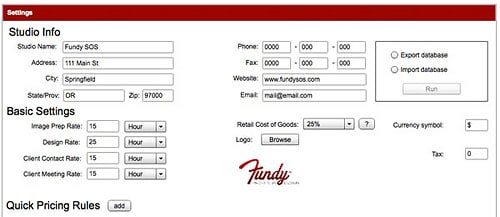
Here in our settings, we have our cost of goods set at 25%, a good COG for an established photographer. We've also estimated our hourly rate in our studio for the work we do.

Prosper Settings Window

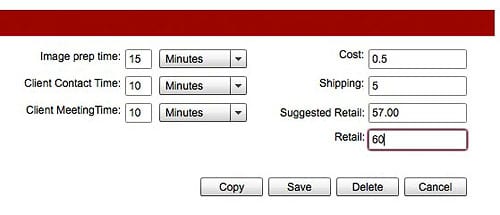
Now, let's look at two scenarios. The first being a photographer who is selling art prints for a portrait sitting or of the bride and groom in a posed shot. This is a special order, the photographer is going to retouch the print, have it shipped to the studio and the bride or groom (probably the bride) are going to come in and pick it up.

Print Pricing Scenario 1

As you can see we've calculated that we spend 15 min. finding, opening and retouching the image. We've set aside 10 minutes contact time with the client on the phone and 10 minutes time meeting the client in the studio to chat and $5 for shipping to our studio. Prosper™ has done the math for us, and calculated all of our costs and divided by 0.25. The total is $57. I'm going to just round that off to $60. So, you can see that with this business scenario, $60 for a 4×6 is the proper amount. And if the photographer educates the client about the quality of the print, it should sell.

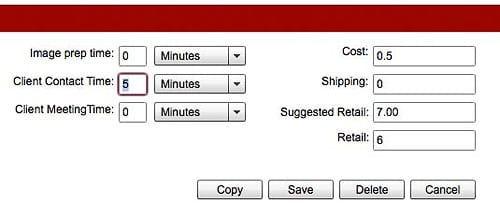
Print Pricing Scenario 2

As you can see, quite a bit has changed here. In this scenario, we've used numbers for an auto-fulfillment. This photographer shoots the wedding, does minimal batch retouching with an action and uploads the whole wedding for anyone to buy. After that, they are done. We've added the price of the print to the calculation and allotted 5 minutes for a quick call or email if the client asks about the delivery of the print. As you can see, Prosper™ has done the math for us and come out to $7 for a retail price on this print. I've rounded down to $6 for the purpose of this discussion.

So, as you can see, depending on how your run your business, $6 or $60 can be the right price for a 4×6 print. It all depends on how much work you are putting into the final product. The only mistake you can make is creating a fine art print and pricing it like an automated fulfillment print.

The simple matter of fact is, if you know your cost of goods then calculating your pricing is easy Junior High School math.

Prosper™ is a product of Fundy Software. You can find out more here about a free trial and the limited time pricing special happening right now.

Filed Under: Business, Photography Tagged With: andrew, Business, business costs, competition, Fundy, highest price, how to use, Marketing, photographer, photographic printing, price, price prints, Pricing, print, printing pricing, retail price, retailing

Subscribe To Tiffibox Treats!

Looking for a well-curated email newsletter that will leave you inspired and motivated about your photography business? Sign up below!

About Seshu

Seshu creates relaxed portraits of families and high school seniors in Avon, Connecticut. He also leads a successful headshot photography studio in Connecticut, helping professionals from a variety of disciplines project the very best versions of themselves. He created Tiffinbox as a way of inspiring photographers, to create better images and successful businesses. [Read More]

Email Templates For Headshot Photographers

Email Templates for Headshot Photographers

Recent Posts

  • How Capture One Changed My Event Photography
  • 10 Steps To Stay Positive In Times Of Great Stress
  • Why You Need To Read “Personal Branding For Photographers” Now
  • How To Master Your Website Content Step By Step?
  • Tony Taafe’s TNT Method For Headshot Photographers

Recent Comments

  • Stephen Davison on Are You A Business Owner Who Is Smart, But Stuck?
  • Ben A. on Don Giannatti Clinches The 8th Annual Tiffinbox Award
  • Dan on Don Giannatti Clinches The 8th Annual Tiffinbox Award
  • Donald Giannatti on Don Giannatti Clinches The 8th Annual Tiffinbox Award
  • Stephen Davison on G.E. Masana’s 6 Strategies For Wedding Photography Success
  • Naveen Kumar on Weddings In India Are More Than Being At The Right Place And At The Right Time
  • kartick on Weddings In India Are More Than Being At The Right Place And At The Right Time
  • Leonid Farbman on 6 Uncommon Trends To Grow Your Photography Business
  • Willow and Finch Wedding Photography on 11 Reception Tips To Help Your Wedding Photography
  • Web Designer Malaysia on How To Optimize Your Squarespace Website For Search Engines
  • Creastan on An Interview With Photojournalist G.M.B. Akash
  • Cindy Brown | Atlanta on An Open Letter To A Local Photographer

Become a Patron!

Copyright © 2026 · Tiffinbox · Site Design by Heather Mackan Creative · Built on Genesis