• Photography
  • Interviews
  • Business
  • Reviews

Tiffinbox

Inspiring Photographers

  • Home
  • About
  • Blog
  • Contact

The First Job For Photographers: Get To Know The Business

September 24, 2012 by Seshu | Editor & Publisher

This is Russ Klettke's interview with Brian Dilg, who is Chair of Photography at the Photography School at the New York Film Academy. In addition to 20 years of professional teaching experience around the world, Dilg's work has been published in The New York Times, Time Out, Village Voice and covers of books published by Simon and Schuster, Random House and Hyperion. He has also worked in post-production for major fashion houses, consumer products manufacturers and media organizations. He also has won awards as a filmmaker and worked as a director, cinematographer and editor of narrative, documentary, music video and commercial films.

Q: What do you tell photography students about careers in the industry?

As an instructor at a New York-based school of photography (The Photography School at the New York Film Academy), I regularly provide advice to student commercial photographers and photojournalists about the kinds of careers they may achieve. It is hugely beneficial for them to envision the heights to which they can aspire – we are is New York, after all, where you can become the best of the best in almost every endeavor – but it is also essential to consider the entry point at which one can enter the profession.

I have a quick way of summarizing what a career in photography likely will entail. In your first job, you probably will be someone’s assistant, and a lot of your time will not involve taking pictures. Across the later arc of your career, you are likely to be self-employed and therefore must have business skills – in addition to your acumen and artistry as a photographer.

Q: So, they are to start from the ground up – but does that mean actually taking photos?

Let’s discuss first things first. The role of the photographer’s assistant, or someone who works in the administrative and support side of photography, is not just about paying dues. You will learn vital parts of what makes a photographer valuable to his or her clients and their craft. Between what you shoot and what is ultimately used in print editorial, multimedia advertising or online publications there is a lot of editing, organizing, legal documentation, processing and selling. Long-term, every photographer has to know how this works and how to manage it.

Q: We suppose this varies, depending on the type of photographer the student hopes to be one day, yes?

The specific path you wish to take – smaller-scale commercial (including weddings), larger-scale commercial (fashion and advertising photography), and photojournalism – would likely involve these entry level positions:

Smaller-scale commercial – Most established photographers need assistants to help with lighting, equipment, on-location support and administrative tasks. Work with a pro and learn to be a pro. Often, the assistant will price out a job (some use contract templates found on Blinkbid.com) and handle client contact to some extent.

Larger-scale commercial – The digitech assistant on advertising, high-end fashion and other large-budget commercial shoots may appear to be the most popular person in the production. As they work on the computer tethered to the camera, clients and talent might be clustered around them as they identify whether or not the shoot is getting them what is intended – in real time. The work doesn’t end there, as a lot of organizing and file backup is required post-production, along the path that selected images take to become a final product.

Photojournalism – While the budgets for photojournalists are shrinking for print media, rare is the project where the assistant can travel with the photographer to newsworthy locales – unfortunately. But there is plenty for the photojournalist’s assistant to do in the office: editing, cropping, backing up files, processing prints and communicating and invoicing are all in their role. This person gets a first-hand look at what clients (media) want and need, and the value they place on good images.

Of course, assistants in each category need to be working on developing their own skills and portfolio, even when that is not their full-time responsibility. For example, the photojournalist should seek out local media assignments, enough to develop credits and tear sheets. Commercial photographers-in-training should jump at any opportunity to work with smaller clients.

Q: Is it essential for the photographer to also be a businessperson?

Concurrent with developing a portfolio, the photographer needs to become comfortable with the business imperatives of a photography career. Indeed, the first job for photographers is to get to know the business. In addition to the skills development mentioned above, the future independent photographer needs to understand the importance of selling in their career. By selling, we mean relationship development. You’re only as good as you hope to be and working as much as you want when clients know you and trust you. That boils down to a personal style, your professionalism, how fun you are to work with and your ability to establish reasonable expectations on the part of your clients – on top of providing top-quality photography.

Do you agree that the first job for photographers who are either professionals or want to go pro should be to get to know the business? Sound off below in the comments section. Your voice counts!

Filed Under: Business, Photography Tagged With: commercial photographers, new york film academy, photographer, Photographers, Photography, photography school, Photojournalism, school of photography, visual arts, Wedding Photography

I’m Young, But I Can Shoot Too! How to Start Building Your Reputation

August 9, 2012 by Ferina Santos

Ferina Santos is part of the team behind Open Colleges, Australia's provider of photography courses. A feisty nerd at heart with an obsession for media and vanity, she captures all her random musings with daily photographs in her blog, A Pink Banana.

“Sorry, but you just don’t have enough experience.”

As a photographer just starting out, you’ll probably hear that kind of thing a lot – I know I did! The problem is that art galleries and publishers are afraid of wasting their time with someone who’s not ready, and regular people who would hire a photographer are doing so for things like weddings and other special one-time events, so they really need to believe you can get it right the first time.

What you need is to start building a reputation and finding people who will recommend your work. But how can you even get to that point? How do you start to make a name for yourself if no one will give you a chance?

There’s no one way to make it in photography, because no two photographers are the same. Do you want to go the more artistic route and try to make it into galleries and publish books of your work? Or are you more interested in just providing quality professional shots and making a few bucks?

Either way, what I learned the hard way is that there are several common things that every budding photographer needs. And by the way, if you’re having a problem with people dismissing you because you’re too young, there’s a way around that, too.

Figure out who you are as a photographer. This is one of those things that sounds super simple and incredibly hard at the same time, but it’s important to decide (to a certain degree, at least) if you’re going to have a focus or just shoot whatever interests you. Having a focus (say, you shoot events like weddings) can help when you’re trying to get hired by people because you should have the specific kind of photos they are looking for and that will help them to see that you can do what they need. Speaking of which …

Build a portfolio. If there’s one way to “prove” to people that you can do it, it’s by actually doing it. Don’t be afraid to take chances, and never give up on a particular kind of shot or subject just because one shoot doesn’t go well. Unless you just know that you’re going to be a wedding photographer and that’s it, the best thing to do is take a wide variety of shots (of anything that interests you) so that you can show your range.

The nice thing about this, too, is that you can pick and choose what you show different people. Up for that wedding job? Here are your photos of people and events.

Be an apprentice. Want to learn a lot and make a great relationship that can potentially help you a lot? See if there are any working photographers who would be willing to show you the ropes in exchange for you essentially being their intern. If you find the right person and they like your work, this can be a fantastic way to start getting jobs and building your reputation if they throw a few jobs your way.

Work for free. No one wants to do work and not get paid for it, but when you’re starting out, unfortunately that’s often the reality. Instead of thinking about it like you’re not getting money you deserve, looking at it as training and getting your name out there. Doing a few free jobs is one of the best ways to get portfolio-ready photographs – and meet people who may actually want to hire you for pay in the future!

Take a class. Just like becoming someone’s apprentice, deciding to take a class can help you to improve your skills, learn new techniques, and forge helpful relationships. Not only will you be meeting other people who share your interests and might know about jobs or other opportunities, instructors can often be great resources. Much of the time, they are photographers themselves, and may be able to take you under their wing or introduce you to other professionals who can help.

Let your work speak for you. So now we come to that whole age thing. If you’re fresh out of college – or even younger! – you’ve probably been told that you’re too young or too inexperienced, but think back on those situations where this happened. Did you approach someone in person or lead with your personal history?

If someone has the option of hiring a baby photographer (meaning you’re young, not that you photograph babies) or getting someone with a decade of experience, chances are they will go with the person who’s been working longer. That’s why you can’t start by talking about yourself. If possible, mail in your portfolio or start a website and post it online so that people can see your work first.

This way, they’ll see you first as a photographer and judge you by your work before they even think about age and how long you’ve been working. Most people, if they see evidence from your portfolio that you can do the work, won’t even ask how old you are!

What would you add to Ferina's list of suggestions? Chime in below!

Filed Under: Business, Commentary, Photography Tagged With: building reputation, ferina, photo industry, Photographers, santos

Obsessing Over The Competition

August 6, 2012 by Angela Pointon

This is Angela Pointon‘s third guest post on Tiffinbox. Read her first post and second post too. Follow her on Twitter and don't forget to scroll all the way down to sign up for a special event with Angela.

Arguably, visual artists are able to see the work of their competitors easier than any other industry in the world. You waltz onto their website and boom. There’s their latest stroke of brilliance.

Your Competitors and You | Angela Pointon

Do you poke around the competition’s websites from time to time?

If your competitors are making a big impact using their creativity and their own marketing skills, and it’s killing your morale and confidence, I’m here to help.

There are two critical things you’re learning by looking at your competition. You just don’t realize it.

1. Blending In More.

The only thing looking at competitor sites will do is cause you to be MORE LIKE THEM. The world doesn’t want more of them. They want to be able to find unique differences between businesses. The world actually wants you to be more like yourself. Because if you’re more like them, then why should a buyer choose you over them when you’re practically identical? You have untapped talents to offer the world, and we need to start exploring and strengthening those talents.

2. Morale Deprivation.

You are your own biggest critic. Rather than cultivating a defeatist attitude by seeing things they’re doing that you’re not, challenge yourself daily to do something new… something more creative than you did yesterday. It will cause you to be introspective and to grow your own creativity. Most importantly, it will boost your self-confidence because you did it!

Limiting yourself by judging your own success against the competition is stunting your creativity’s future potential. The more you can be yourself, the more you can look at yourself, the more you can challenge yourself… THAT is what will make your business shine.

Register for a rare webinar with Angela Pointon.

Tiffinbox is presenting a rare chance to register for a three-part webinar series. Angela of Steel Toe Images will present A Swift Kick: Three Things Every Photographer Should Know About Business. Space is limited and will sell out. Learn more and register.

Filed Under: Business, Photography Tagged With: angela pointon, creativity, educational psychology, obsessing over the competition, Photographers, Photography, positive psychology, problem solving, swift kick, the competition

Want A Self-Hosted WordPress Website?

July 18, 2012 by Seshu | Editor & Publisher

A rather frazzled wedding photographer asked out aloud why her wordpress.com based blog/site was suddenly seeing advertisements that she hadn't approved. I quickly contacted her and let her know that because her site was (nameofherbusiness.wordpress.com) she was having WordPress dictate what goes on her site. What she has is a “managed” blog site. One easy solution would be to move to a self-hosted site.

Thankfully, there are ways to move your content over to a site that you have more control over. Also, if you are just starting out as a photographer and want to do it right, read on.

Full disclosure – not long ago, this site was hosted and managed by Typepad. In a future post, I'll go into more detail about why I moved from that managed option to a self-hosted solution.

I first came across this blog post: How To – Move From WordPress.com To WordPress.org. If that's a bit too geeky, check out the graphic below:

A Step-by-Step Guide to Creating Your Self-Hosted WordPress Website
Like this infographic? Get more WordPress and hosting tips from Synthesis.

And, if that doesn't do it for you, you may want to sign up for this FREE 9-part course called Site Set-Up Kit. Produced by Wendy Cholbi and Pamela Wilson, it's targeted towards beginners and they promise that it will be jargon-free. Even though I publish this and other blogs using the WordPress platform, I signed up to learn something new.

Tiffinbox, for example, is a self-hosted site. That means, I pay to host it on a server owned by BlueHost.com [affiliate] and I get to decide on what gets published, including advertisements. When, not if, you start considering where to host your blog or your website, I recommend BlueHost as an option. They routinely rank high among website hosting companies and I have always found their customer service to be very prompt.

So, if you have a website or blog hosted and managed by say, Blogger, Typepad or LiveJournal, where you really do not have a way of controlling all of the content you see on your site, you should be going the self-hosted WordPress route.

Yes, there is a little bit of work involved in setting it up. So, if you have any questions about that feel free to ask in the comments section below. I am happy to help as best as I can, or, I will direct you to a resource who will address your concerns.

I just stumbled upon another blog post about setting up a self-hosted WordPress website by Michael Hyatt. Check it out too!

Filed Under: Photography, Web/Tech Tagged With: akismet, blog hosting, blog hosting services, blog software, blogger, computing, content management systems, hosting company, hosting wordpress, hosts, livejournal, maintain control, matt mullenweg, Photographers, self hosting, typepad, website hosting companies, wordpress, wordpress platform, world wide web

How Photogs Can Work Smarter, Not Harder

June 4, 2012 by Angela Pointon

Angela Pointon loves creative people. She studied photography, but had a love affair with business and marketing in graduate school. She decided to combine all of it together when she started Steel Toe Images. She inspires photographers and other creative people to kick major butt through her consulting sessions, blog, emails, workshops and her first book (coming soon), called “A Swift Kick In The Pants: Business Smarts For Us Creative Types.” Angela resides just outside Philadelphia. She lives with her amazing architect husband and their two small boys. All of them are vegetarian (yay!), and they rock out to fantastically awesome music from time-to-time (especially on Friday nights).

If your photography business is like most, there is seasonality to it. Meaning, when it rains it pours and when it’s dry it’s a desert.

I know many of you are in your busy season now. Clients are calling, you’re spazzing, you need sleep, you’ve got too much to do.

The great news is: you can bring sanity to every season – busy or slow. How?

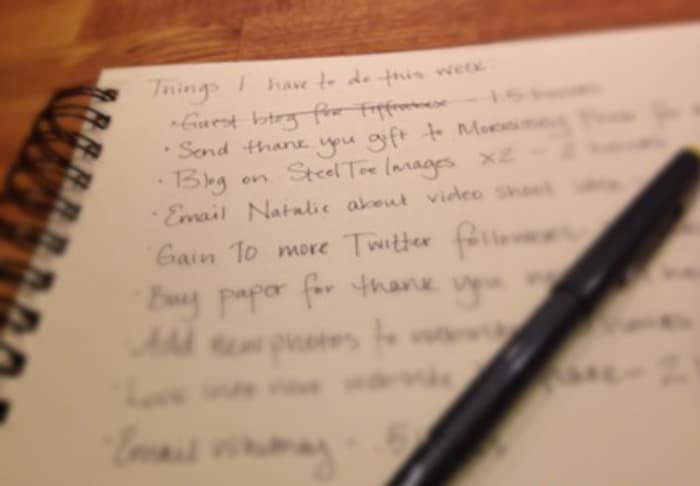
You need to create three lists.

Angela Pointon | Making Lists

I don’t care if your lists are on a blackboard, a scratch pad or in a fancy color-coded excel file… but they have to be written down. This is important. Lists DON’T WORK if they’re in your head. As brilliantly creative as you are, you cannot keep an organized, separated set of three lists in that pretty little head of yours.

So once you figure out where you’re gonna store these lists, you need to create them. The good news is it’s super quick to do.

Listen up.

List #1: What I have to accomplish this week.

Every Monday morning you’re going to spend 15 minutes creating a list of what you HAVE to do that week. You’re going to write approximate time lengths next to each task so that you know how many hours of work you have ahead of you for that week. Add the hours up and make sure it isn’t going to kill you. If it is, see what makes sense to push to next week (or get some help… or a cloning machine).

List #2: What I have to accomplish today.

Each and every morning of the week you’re going to spend 5 minutes creating your list of what you HAVE to accomplish that day. In creating this daily list, you’re taking tasks off of your weekly list and you’re putting them on your to-do list for the day. Your weekly list is becoming shorter day-by-day. How delightful!

List #3: What I have to accomplish when I’m slow.

As you’re driving, in the shower, walking the aisles of the grocery store or talking to friends, you’re always coming up with “wouldn’t it be cool if” ideas of pure fabulousness. Don’t let these sparks of brilliance become dim and never see the light of day. Instead, put them on your “slow time” list so that you can refer to them as business is becoming slower. You can proactively plan to tackle these awesome ideas (using List #1 and List #2 in the same ways) when you have some spare time. Never again will you be waiting for the phone to ring, getting worried and depressed. Instead, you’ll be rocking out by creating something awesome that you thought of to improve your business, your brand, your photos, your service or whatever!

Now look at you! What an awesomely organized and well-managed person you’ve become. All with three simple little lists.

Filed Under: Business, Photography Tagged With: angela pointon, create listing, human interest, listing, management, organize, personal life, photographer, Photographers, planning, smart, stay organized, steel toe, time management, work

  • « Previous Page
  • 1
  • …
  • 14
  • 15
  • 16
  • 17
  • 18
  • …
  • 26
  • Next Page »

Subscribe To Tiffibox Treats!

Looking for a well-curated email newsletter that will leave you inspired and motivated about your photography business? Sign up below!

About Seshu

Seshu creates relaxed portraits of families and high school seniors in Avon, Connecticut. He also leads a successful headshot photography studio in Connecticut, helping professionals from a variety of disciplines project the very best versions of themselves. He created Tiffinbox as a way of inspiring photographers, to create better images and successful businesses. [Read More]

Email Templates For Headshot Photographers

Email Templates for Headshot Photographers

Recent Posts

  • How Capture One Changed My Event Photography
  • 10 Steps To Stay Positive In Times Of Great Stress
  • Why You Need To Read “Personal Branding For Photographers” Now
  • How To Master Your Website Content Step By Step?
  • Tony Taafe’s TNT Method For Headshot Photographers

Recent Comments

  • Stephen Davison on Are You A Business Owner Who Is Smart, But Stuck?
  • Ben A. on Don Giannatti Clinches The 8th Annual Tiffinbox Award
  • Dan on Don Giannatti Clinches The 8th Annual Tiffinbox Award
  • Donald Giannatti on Don Giannatti Clinches The 8th Annual Tiffinbox Award
  • Stephen Davison on G.E. Masana’s 6 Strategies For Wedding Photography Success
  • Naveen Kumar on Weddings In India Are More Than Being At The Right Place And At The Right Time
  • kartick on Weddings In India Are More Than Being At The Right Place And At The Right Time
  • Leonid Farbman on 6 Uncommon Trends To Grow Your Photography Business
  • Willow and Finch Wedding Photography on 11 Reception Tips To Help Your Wedding Photography
  • Web Designer Malaysia on How To Optimize Your Squarespace Website For Search Engines
  • Creastan on An Interview With Photojournalist G.M.B. Akash
  • Cindy Brown | Atlanta on An Open Letter To A Local Photographer

Become a Patron!

Copyright © 2026 · Tiffinbox · Site Design by Heather Mackan Creative · Built on Genesis