• Photography
  • Interviews
  • Business
  • Reviews

Tiffinbox

Inspiring Photographers

  • Home
  • About
  • Blog
  • Contact

Will You Switch To Medium Format Cameras?

January 8, 2013 by Doug Levy

Doug Levy is a photographer based in Ayer, MA. He shoots weddings and portraits. Check out his blog. Check out Doug’s first guest blog post about second shooting weddings. Doug will be teaching classes about his lighting techniques and the business of photography at Inspire Photo Seminars. Follow him on Twitter.

When wedding season starts to slow down, I start to look for interesting projects to shoot during the slower time of year. One thing I’d wondered about for years was the holy grail of cameras, medium format digital. Now, I should preface this with the fact that I’ve never shot medium format anything, let alone digital. My first “real” camera was a Nikon D70s in 2006 and I’ve shot exactly one roll of film since then, on my wife’s old plastic 35mm Nikon, and that took me six months to finish.

One portrait I’d had rolling around in my head for a while was to take a few minutes to introduce myself to Bob, owner of B&J Cycles, a Harley Davidson repair shop on my street. I thought a photo of Bob would be the perfect opportunity to test out a medium format system, so I called Derrick Brown at Imagelink to see if I might be able to rent a camera and back for a few days. I’ve been using Derrick’s calibration software for years, and we have a mutual friend, but despite his being just down the road, I’d never had the chance to meet him in person until recently.
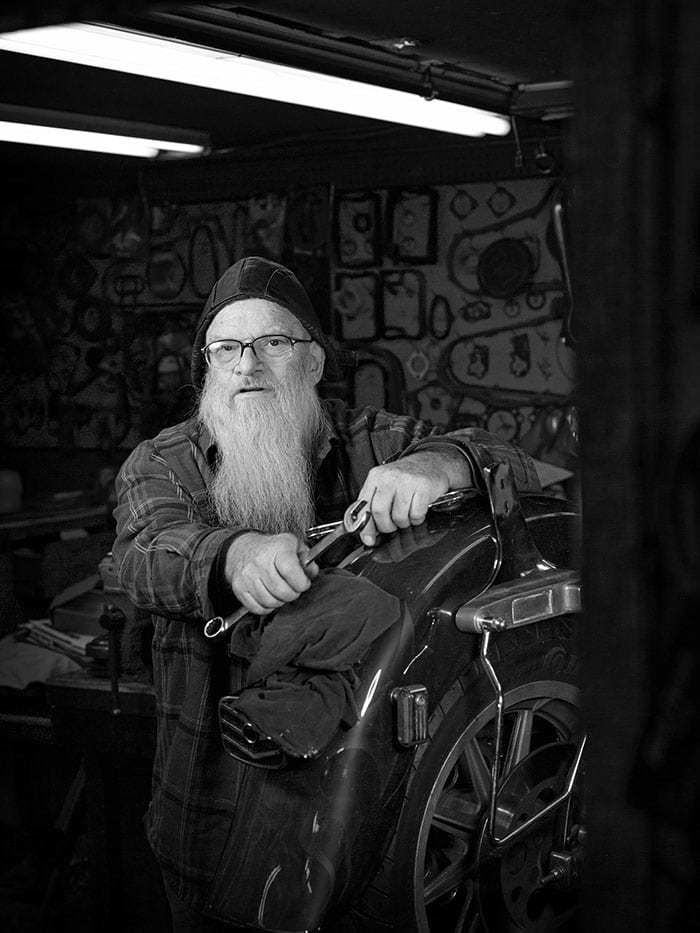
Doug Levy Medium Format Portrait

When I called Derrick up he immediately invited me over to his studio, where we spent a couple hours discussing the options in the current medium format digital world, and ended with him offering to loan me a Hasselblad H2 and Phase One P25 back for a weekend. I suspect he knew I wasn’t going to be shelling out $20k+ anytime soon for a new IQ system, but that the used price of a P25 ($5,000-$6,000) was something I could probably pull off.

And it’s true, with a few months of careful budgeting, I probably could have afforded to pick up a used P25 system, and I even spent a few hours one afternoon looking around on eBay to gauge the market.

But here’s what I didn’t expect. While there were a lot of things to like about the H2 and P25 combo (1/800 flash sync, a gorgeous gigantic viewfinder, autofocus that was better than I’d expected, true 16-bit color), the back was beyond unusable to judge color, focus or exposure unless you shot tethered. It really makes you appreciate how far camera and LCD technology has come in a short time.

As 95 percent of the work I do is on location, and about 90 percent of that takes place in situations where tethering is either impractical or outright impossible, shooting the P25 was essentially equivalent to shooting film. By that I mean that you don’t know what you have until you’re back at your desk reviewing the files.

Now that doesn’t mean I had a horrible weekend with the camera, far from it in fact. I shot a couple hundred photos with it, and it’s an absolute joy to use. The ergonomics are well thought out and I managed its hefty weight quite well. The larger finder made manual focus fine tuning a breeze and the Hasselblad HC 80mm lens Derrick loaned me ranks up there with Nikon’s 200mm F/2 as the sharpest I’ve ever used. And when you do make it back to the computer, the files at ISO 50 and 100 are stunning in their depth and clarity.

This was probably an unfair comparison, to pit a camera that was at the top of the line in 2004 against my daily driver, the Nikon D4, but as someone who makes my living with my camera, I had to ask myself if my wedding and corporate clients would really see the difference between the cameras, and the answer to that is a resounding: “not a chance.”

That’s not to say that when Powerball hit half a billion dollars the week after I returned the camera that I wasn’t already building a brand new Phase system in my head (because I was), but until the current backs with their gorgeous iPhone-like screens drop into the sub-$10k used market, I’ll stick with my 35mm Nikon system.

So, will you give medium format its due? Do you work in medium format now? Chime in with a comment below. Thank you!
Filed Under: Photo Technology Tagged With: camera, doug levy, medium format, Medium Format Cameras, nikon

Nope, Film Is Not Dead

March 18, 2011 by Seshu | Editor & Publisher

I've loved Utah-based Jonathan Canlas‘ wedding photography for quite some time. I must have come across his website quite randomly about four or five years ago. His images continue to inspire me. The moments are real and the processing is just right.

Little did I know back then that he was a wholly film-based photographer. Yes, film. Some of us may remember that medium. With digital being all the rage – I mean who isn't addicted to chimping, right? – why would a photographer eschew Photoshop actions (that can make your digital images look like they were shot on film) and other “bells and whistles.” The answer is simple. Because he can, he wants to be different and his clients love him for it.

So, take a moment to look at his work again.

Now that you are back, do you see anything different? Do the images just appear more tactile, or have more depth to them? Or, is it my imagination? I believe it is the former.

Whichever way your answer sways, if you are curious about how Jonathan Canlas photographs weddings or portrait sessions using film, you have three options to learn from him.

You see, in addition to being a successful photographer, Canlas is a wonderful teacher. For several years, Canlas has offered the Film Is Not Dead workshops for those photographers looking for a solid foundation in film photography.

Canlas has also very patiently answered questions via Formspring. You should follow him on Twitter where most of these responses show up.

The last option, is a resourceful guidebook called FIND (Film Is Not Dead). There is a dedicated website where you can order this truly comprehensive offering. Jonathan generously offered me a review copy and I just got done reading it. As a photographer who cut his teeth on Tri-X and TMAX 3200, a lot of what he had to say in the book was not new to me. As a mostly 35-mm film photographer, though, I learned a great deal about medium-format cameras. So much so that I am now actively looking for a used Yashica-Mat 124-G.

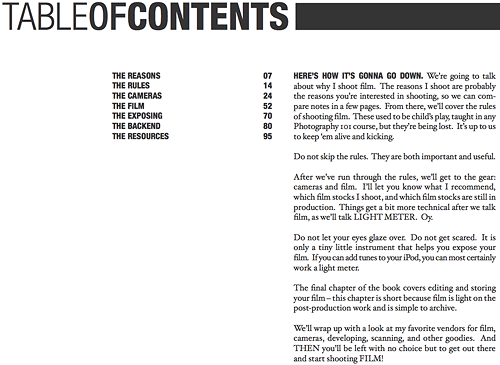
Here is a breakdown of the table of contents:

Jonathan Canlas' Film Is Not Dead PDF Table Of Contents

This is a 95-page e-book that is sprinkled with great wisdom and some jaw-dropping images. If you are clueless about working with film, because you simply never had the opportunity or were too intimidated, then you need to run out and get this hefty PDF. Unlike other PDFs that may discuss a particular type of digital technology that is sure to change over time, I feel what Jonathan Canlas has produced for us will be as timeless as his own work. Indeed, its his generous spirit that allows us to share his vast knowledge about a medium long thought of as “old,” or worse, “dead.”

Thanks to companies like Kodak and Ilford, who continue manufacturing film, Canlas feels strongly that he will be working in that medium for a very long time and now so can you.

Buy the Film Is Not Dead guidebook by using the code “SESHU” and receive $45 off the final price. All I ask in return is that you subscribe to the Tiffinbox newsletter. Goodies like this will only be available in the future for my newsletter subscribers so you may want to get a headstart.

Full disclosure – I received a review copy of this PDF, but I don't make a dime for mentioning it here on Tiffinbox. If you liked this review and bought the PDF, please come back here and post your comments. I'll try and have Jonathan swing by and answer any questions you may have.

Filed Under: Books, Film, Photography Tagged With: camera, dead, digital imaging, Film, film formats, film photography, jonathan, jonathan canlas, mass media, medium format, photographer, Photography, Portraits, resource guide, resource guides, used film, Wedding Photography, yashica

Subscribe To Tiffibox Treats!

Looking for a well-curated email newsletter that will leave you inspired and motivated about your photography business? Sign up below!

About Seshu

Seshu creates relaxed portraits of families and high school seniors in Avon, Connecticut. He also leads a successful headshot photography studio in Connecticut, helping professionals from a variety of disciplines project the very best versions of themselves. He created Tiffinbox as a way of inspiring photographers, to create better images and successful businesses. [Read More]

Email Templates For Headshot Photographers

Email Templates for Headshot Photographers

Recent Posts

  • How Capture One Changed My Event Photography
  • 10 Steps To Stay Positive In Times Of Great Stress
  • Why You Need To Read “Personal Branding For Photographers” Now
  • How To Master Your Website Content Step By Step?
  • Tony Taafe’s TNT Method For Headshot Photographers

Recent Comments

  • Stephen Davison on Are You A Business Owner Who Is Smart, But Stuck?
  • Ben A. on Don Giannatti Clinches The 8th Annual Tiffinbox Award
  • Dan on Don Giannatti Clinches The 8th Annual Tiffinbox Award
  • Donald Giannatti on Don Giannatti Clinches The 8th Annual Tiffinbox Award
  • Stephen Davison on G.E. Masana’s 6 Strategies For Wedding Photography Success
  • Naveen Kumar on Weddings In India Are More Than Being At The Right Place And At The Right Time
  • kartick on Weddings In India Are More Than Being At The Right Place And At The Right Time
  • Leonid Farbman on 6 Uncommon Trends To Grow Your Photography Business
  • Willow and Finch Wedding Photography on 11 Reception Tips To Help Your Wedding Photography
  • Web Designer Malaysia on How To Optimize Your Squarespace Website For Search Engines
  • Creastan on An Interview With Photojournalist G.M.B. Akash
  • Cindy Brown | Atlanta on An Open Letter To A Local Photographer

Become a Patron!

Copyright © 2026 · Tiffinbox · Site Design by Heather Mackan Creative · Built on Genesis