This guest post is by Julia Spencer, from Visual Watermark, who writes guides about the photography industry and interviews people.
Worried the photos you share online are being used without your consent? Watermarking images is a great way to protect yourself against people passing your work as their own. Plus it helps build brand awareness.
Ideally, a watermark should be a means to reach out to fellow photographers and consumers to let them know who took this amazing shot and not suspect everybody for wanting to steal your work and thus divert their attention from your great composition.
Here are some key pointers to keep in mind when watermarking your photos:
1. Choose Watermark Position Wisely
Watermark placement can be tricky. You want to place it carefully so it protects your image but doesn't detract the viewer from the photo. Ideally, you should place it in the center of the image, but never on a solid or smooth background. Otherwise, it will be too easy for someone to remove it completely. Here go better and worse areas for watermark placement.
 Green areas represent better place for your watermark. Red zones are places to avoid.
Unfortunately, centered watermark will be “too much” for most images and your viewers will definitely point to this. Unless, you host a photo stock website, of course. Oversized watermarks are a common practice in this business.
Here you can get a better idea of the best areas to place your watermark in an image. Also, depending on your subject, you can blend the watermark into the photo, like in the example below:
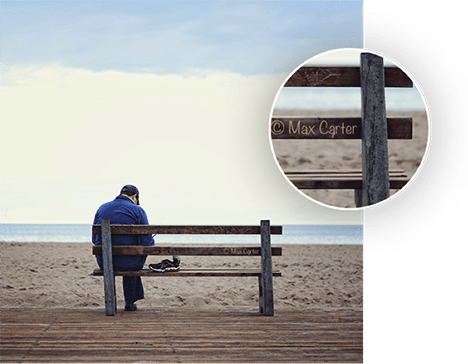
The second thing to consider when watermarking your photos is the size of the watermark. Make sure it's large enough to protect most of the picture's details. As a result, your watermark would not be removed without significantly damaging the image quality. Ideally, your watermark should cover at least 30% of an image.
2. Semi-Transparent Watermark Looks Better
You can make the watermark semi-transparent – it will still protect your photo but the watermark will seem less obtrusive. Using the right software, it's easy to place a transparent watermark to your photos.

3. Always Watermark Hi-Res Photos
Many photographers put watermarks on hi-res photos only. These photos can be used for wide format digital printing and thus it's very-very important to protect them. On the other hand, they leave low-res images without watermarks.
However, this is not a commonly held opinion. If you want to place a watermark on your photos, you can use a batch watermark maker. Photo editors like Photoshop don't allow you to adjust watermark size and position for horizontal and vertical photos. So, you must use a batch watermark creator, such as Visual Watermark.
4. Watermark Protects Your Rights
US-based photo attorney Carolyn E. Wright recommends that you place your watermark on each of your images. The official copyright notice includes 3 key elements:
The first part is the © (the letter “c” in a circle), the word “Copyright,” or its abbreviation, “Copr.”
The second part is the date of first publication.
The third part is the name of the owner.
The final copyright form should look like as simple as: “© 2013 Your Name.”
Copyright notices in the US can be used without registering your images with the US Copyright Office. Watermark removal is a law-restricted activity with fines starting at $2500 per image.
5. Let Them Know How To Find You!
It's a good idea to provide your website address and/or other contact information. This helps to promote your work. Your potential customers should know how to find you!
When people share your image, they rarely doubt to mention where they took it. Your contact details will help to find you. However, don’t place everything in your watermark. Website address or a phone# is fine.
Summing Up
Ultimately, the key benefits of watermarking your photos are copyright notice and brand recognition. It informs people that your work is copyrighted and it also identifies you as the author. Plus, if your photos have a watermark, other people will have a way to link it back to you or contact you to ask for permission to use your work.
So what are your preferred methods to copyright your photos? We'd love to hear from you, so don't hesitate to leave your comments below.